
Guide
A2 · Elementary
Grammar
This, That, These and Those: Choosing and Referring to Things
Choose this, that, these and those by number and speaker position. Use one and ones clearly, with ten explained checks.
7 min read
1,186 words
Updated Oct 22, 2026

On this page (7 sections)
1. Start with a shared scene
Imagine that you are standing beside a table. One jacket is on the table near your hand. Two coats are on a rail across the room. You can say “This jacket is warm” and “Those coats are long.” The words help your listener find the thing you mean.
Near and far depend on the speaker’s position and attention. They do not mean an exact number of metres. In this guide, the speaker stays beside the table. The near objects are beside the speaker; the far objects are across the room. Every question tells you which position to use.
2. One or more than one
One or more; near or far
this jacket
One thing, near the speaker
This jacket is warm.
that coat
One thing, farther away
That coat is long.
these jackets
More than one, near the speaker
These jackets are warm.
those coats
More than one, farther away
Those coats are long.
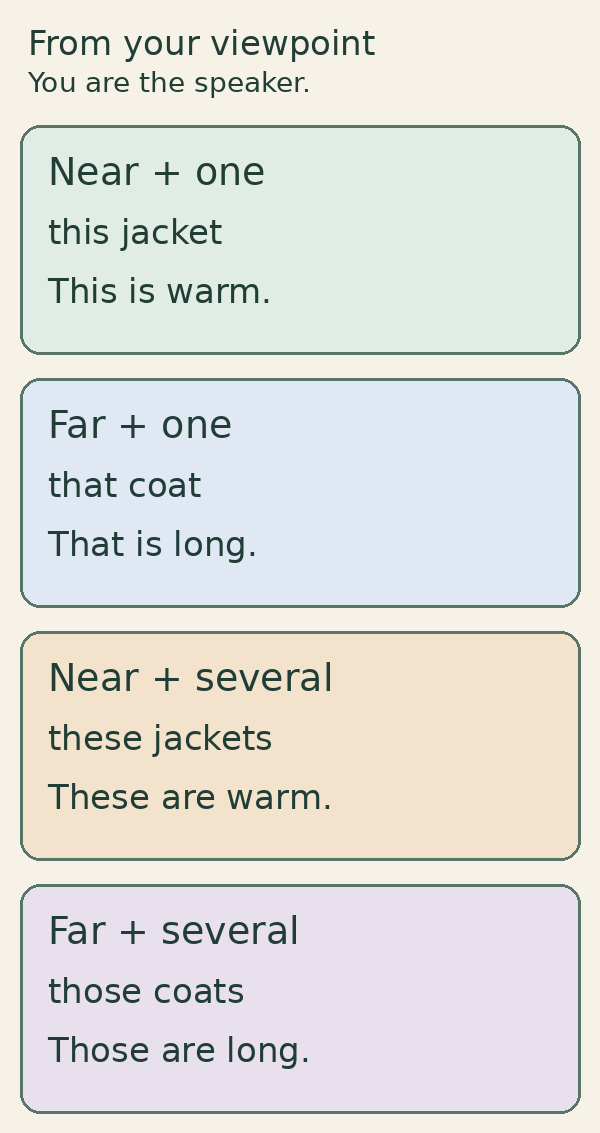
This and that go with a singular countable noun: this jacket, that coat. These and those go with a plural noun: these jackets, those coats. Check the verb too: this is, that is, these are, those are. The distance changes this to that; the number changes this to these.
A simple way to check is to ask two questions. How many things? Where are they in relation to the speaker? One nearby pen is this pen. Several nearby pens are these pens. One pen farther away is that pen. Several pens farther away are those pens.
3. With a noun or on its own
You can use these words before a noun: This jacket is mine. You can also use them without a noun when the listener knows what you mean: This is mine. In the second sentence, this refers to the visible jacket. Do not leave the reference unclear.
Compare “These bags are heavy” with “These are heavy.” Both are complete sentences if the listener can identify the bags. In “This bag is heavy”, bag is singular. In “These bags are heavy”, bags is plural. Do not mix this with bags or these with bag.
Pointing is useful in a shared scene, but the reader of a message may not see your finger. Add the noun or place when needed: Those coats beside the window are mine. The extra words tell your listener exactly which group you mean.
4. Choose the blue one
One can replace a singular countable noun that you have already named: “Which jacket do you want?” “The blue one.” Here one means jacket. Ones replaces a plural countable noun: “Which shoes do you want?” “The black ones.” Here ones means shoes.
Use this one or that one for a single item, and these ones or those ones for several items. This, that, these and those can also stand alone: “Which shoes?” “Those, please.” Both “those” and “those ones” are possible in this simple pointing context.
One can also be a number. “I need one jacket, not two” tells us how many. “I like the blue one” replaces the already named noun jacket. Look at the job the word does. Do not use ones to replace an uncountable noun such as water. Say some water instead.
5. Make reference clear
“I want that one” works when both people are looking at the same item. If two items could fit, add a colour, size or place: “I want that red one on the top shelf.” A clear description is more useful than repeating that more loudly.
The listener may stand on the other side of the room. A coat far from you could be near the listener. Keep one viewpoint while you answer a task. In real conversation, listen to the speaker’s words and notice where that speaker is. There is no fixed label that makes an object permanently this or that.
6. Check the choices
Choose by number and the stated speaker position. For typed answers, write only the missing word.
Answer on paper, then open the explanations below. Enable JavaScript to check answers here.
7. From rule to selection task
Reference card: this + one near thing; that + one farther thing; these + several near things; those + several farther things. Use is with this/that and are with these/those. Use one for an already named singular countable noun and ones for an already named plural countable noun.
Try a clear selection: “Which notebook?” “That small green one on the shelf, please.” Self-check: the notebook is countable; one means one notebook; that matches the speaker’s far position; small, green and on the shelf identify it. For several notebooks, use “Those small green ones on the shelf.”
The market-stall lesson gives you a fixed customer position and different objects to choose. When an answer seems difficult, return to the two checks: number first, then the speaker’s position.
Related Guides





Continue learning this topic
Review an explanation, study examples or try a related practice test.
- Practice test Noah Adams, longtime host of NPR’s All Things Considered, dies at 84 — B1 English Listening Practice Test
- Practice test Noah Adams, longtime host of NPR’s All Things Considered, dies at 84 — B1 English Grammar Practice Test
- Practice test Noah Adams, longtime host of NPR’s All Things Considered, dies at 84 — B1 English Vocabulary Practice Test
- Course lesson This, that, these and those – A1–A2: Grammar Foundations
- Course lesson Having and getting things done – B1–B2: Grammar in Context