
Guide
B1 · Intermediate
Grammar
Myself or Each Other? Reflexive and Reciprocal Pronouns
Choose reflexive and reciprocal pronouns by meaning. Compare myself, each other, by myself and emphasis, with 12 explained checks.
7 min read
1,247 words
Updated Oct 22, 2026

On this page (7 sections)
Who does the action, and who receives it? That simple check helps you choose myself, themselves or each other. This B1 guide covers self-directed actions, shared actions, emphasis and by myself. Allow about 20 minutes for the explanation and 12 checks.
Who receives the action?
Compare three meanings. “I helped her”: I gave help to a different person. “I helped myself”: the person giving and receiving the help is the same. “We helped each other”: help passed between members of the group. These sentences are not interchangeable.
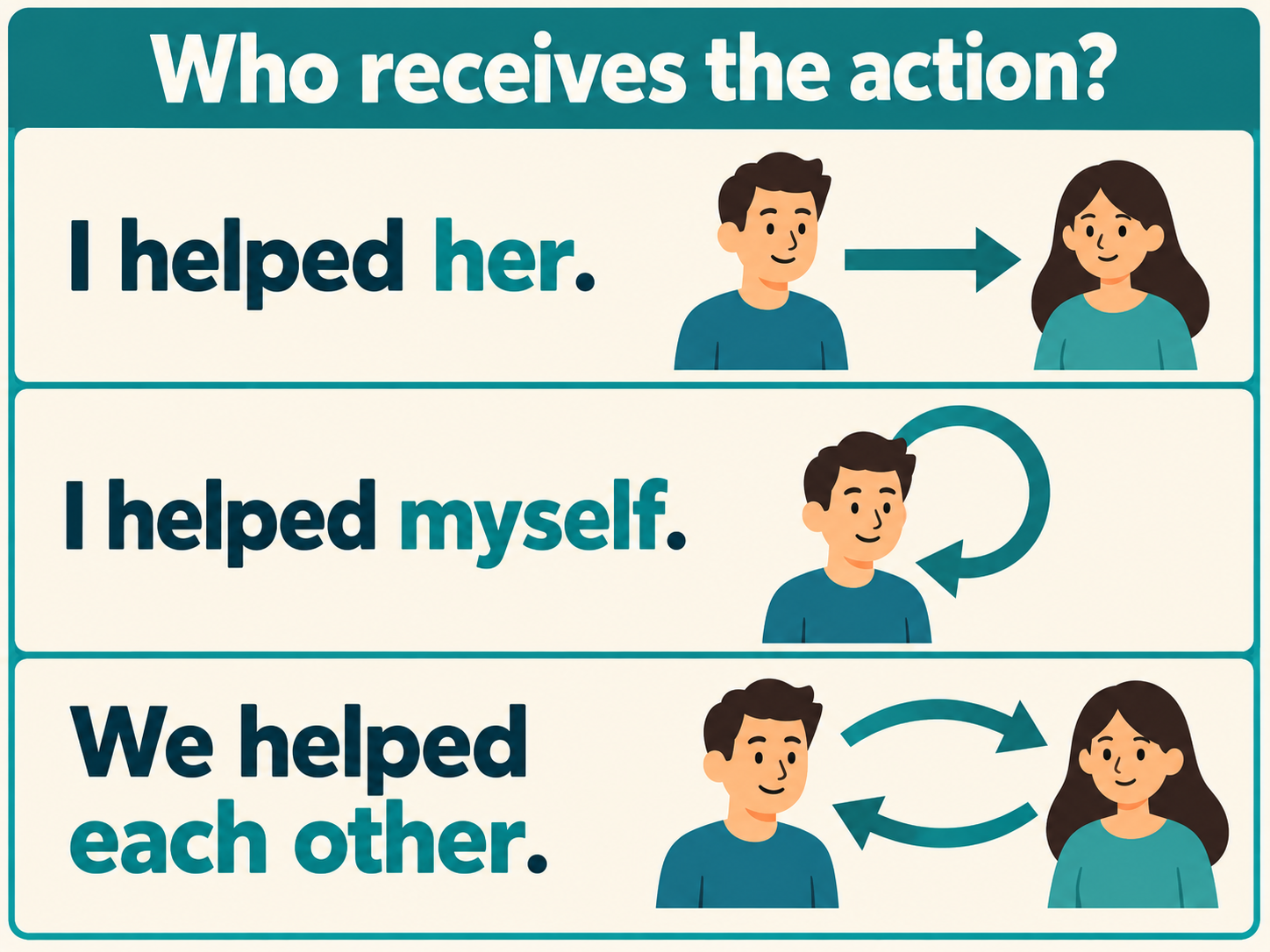
A reflexive pronoun points back to the subject of its clause: “Lena introduced herself.” Lena did the introducing and was the person introduced. Compare “Lena introduced her”: her normally refers to another woman. Choose by reference, not by which word sounds more formal.
Match the reflexive forms
I → myself; you (one person) → yourself; he → himself; she → herself; it → itself; we → ourselves; you (more than one person) → yourselves; they → themselves. The form must match the intended subject. “Please introduce yourself, Ben” addresses one person. “Please introduce yourselves, Ben and Ana” addresses two.
The plural endings use -selves, not -self: ourselves, yourselves, themselves. Singular they can refer to one person whose gender is not specified: “Each visitor can introduce themselves.” Themself also occurs with singular they. This guide’s plural they examples involve a group and use themselves.
Same participants, different direction
“Ava and Ben checked themselves in the mirror” means each checked their own appearance. “Ava and Ben checked each other’s work” means Ava checked Ben’s work and Ben checked Ava’s. Use the possessive each other’s before work. The apostrophe belongs before the s: each other’s, not each others’.
Each other is not limited to exactly two people. “The four neighbours help each other” describes help within a group. One another can usually express the same reciprocal meaning. In these exercises, it is accepted where it fits. A plural subject alone does not tell you the direction: the context must show whether the action returns to the same people or passes between them.
By myself and I did it myself
By + reflexive can mean alone or without help. “I sat by myself” usually means nobody sat with me. “I built it by myself” often means nobody helped, even if other people were in the room. Add context when the distinction matters: “I made the model by myself while my friends talked nearby.”
An emphatic reflexive highlights who did something: “The organiser herself checked the list” or “I checked it myself.” Removing herself or myself leaves the basic sentence complete. Depending on context, “I did it myself” may also suggest that I did not get help. Do not force these expressions into a single meaning when the surrounding facts allow more than one.
Natural English and common errors
English often leaves out the reflexive with ordinary daily routines: “I washed and dressed.” “I dressed myself” is useful when independent ability or a contrast matters. It is not always wrong, but it may add a meaning you did not intend.
Do not use myself as a formal substitute for me: “Please email Sam and me.” You are the receiver of someone else’s email, so ordinary object me fits. Test the sentence without Sam: “Please email me.” Use “I sent myself a reminder” when I both send and receive it.
Choose and explain
Answer on paper, then open the explanations below. Enable JavaScript to check answers here.
Apply in a practical team task
Your turn · self-review
Use it yourself
Make your own answer before opening the model. Other accurate answers are possible. Use the checklist to review meaning and form.
Practice only. Your writing stays on this page; it is not submitted or saved.
-
Model answer and explanation
I checked my own notes. Then we checked each other’s notes. “One another’s notes” is also possible. Check who performs and receives each action, use a possessive before notes, and avoid claiming that you were alone unless the facts say so.
Use the same action paths in the repair-café lesson. Before choosing a pronoun, name the actor and receiver. For by phrases, decide whether the context means alone, without help, or both.
Related Guides






Continue learning this topic
Review an explanation, study examples or try a related practice test.
- Practice test Video of Long Beach Cyclist Encounter Prompts Call for Investigation — B2 English Listening Practice Test
- Practice test Video of Long Beach Cyclist Encounter Prompts Call for Investigation — B2 English Grammar Practice Test
- Practice test Video of Long Beach Cyclist Encounter Prompts Call for Investigation — B2 English Vocabulary Practice Test