
Guide
A2 · Elementary
Reading
Materials and Shapes in English: Describe Everyday Objects
Describe everyday objects using materials, shapes, textures, patterns and parts. Eight explained checks teach careful identification without unsupported guesses.
9 min read
1,531 words
Updated Oct 20, 2026
On this page (7 sections)
Look closely at ordinary objects
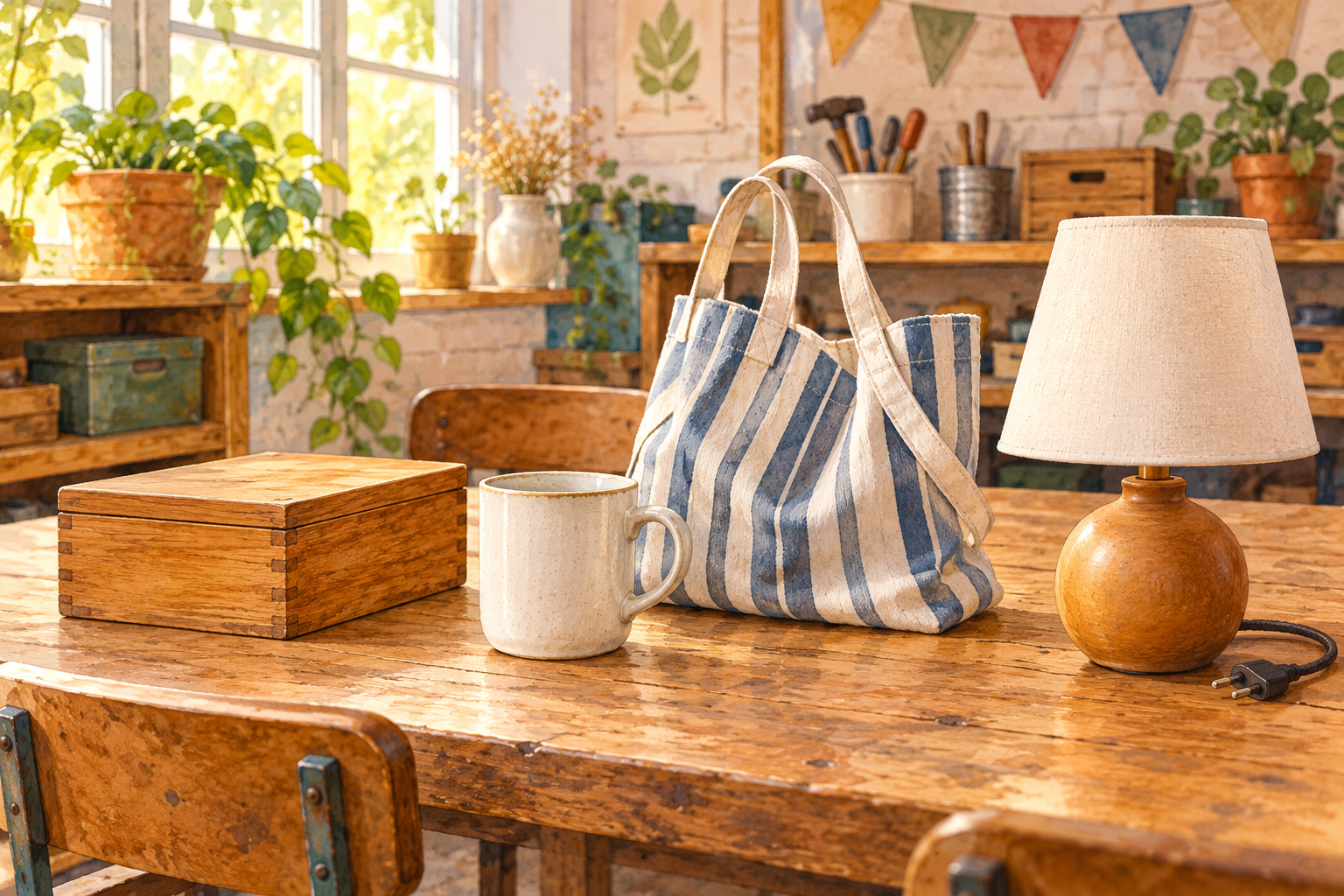
A useful description helps another person find the right object. At a fictional repair café, a mug, lamp, bag and wooden box can all arrive on the same table. “The nice thing” does not help much. “The box with a flat lid” is more useful because another person can check that feature.
This page teaches English words for identifying objects. It does not teach repair techniques. All object records are invented. Look for material, shape, texture and a distinctive part. Do not add a guess about an owner, price or age just because an object looks familiar.
A plain mug has no pattern; a handle is the curved part used to hold it. A lamp may have a base and an arm. A bag may have handles or a strap. These details are often more useful than saying that something is beautiful or old.
Materials and material adjectives
A material is what something is made of. Wood is the material; wooden is the usual adjective: a wooden box. Compare “This box is made of wood” with “This is a wooden box”. Both describe the material. Do not say “a wooded box”: wooded usually describes a place with many trees.
Material | Example phrase | Useful sentence |
|---|---|---|
wood | a wooden box | The box is made of wood. |
metal | a metal handle | The handle is made of metal. |
glass | a glass jar | The jar is made of glass. |
plastic | a plastic bottle | The bottle is made of plastic. |
paper | a paper bag | The bag is made of paper. |
cotton | a cotton bag | The bag is made of cotton. |
leather | a leather strap | The strap is made of leather. |
Metal, glass, plastic, paper, cotton and leather can come directly before the object noun. Some objects combine materials: a wooden box with a metal handle. A shiny surface could be glass or plastic. Use a supplied label or known information; if you only have a picture, say that the material is not certain.
For phrases such as a piece of wood, review counting units for everyday materials.
Shapes and dimensions
Round describes a circular form: a round lid. Square describes a form with four equal sides and four square corners. Rectangular describes a form with four straight sides and four square corners, often with two longer sides and two shorter sides in everyday descriptions. A picture of a box from an angle can distort its appearance, so use the supplied record where necessary.
Flat means level rather than rounded or curved. A curved handle bends instead of making a straight line. Wide and narrow describe how much space something covers from side to side. Compare a wide strap and a narrow strap on similar bags. Without a comparison or measurement, these words are relative.
You do not need to calculate measurements to identify these objects. “A round base and a curved arm” helps distinguish one lamp. “A flat lid” gives a different kind of information from “a wooden lid”: one is form and the other is material.
Textures, patterns and features
Texture concerns the surface. Smooth means without noticeable bumps; rough means uneven. Soft and hard describe how something feels when pressed or touched. In this language task, read the supplied description rather than testing an unfamiliar object yourself.
A pattern is a repeated design. Striped means covered with stripes: repeated long lines. Plain means without a pattern in this context. These distinctions remain useful without colour. Two bags can be the same colour but differ because one is striped and the other is plain.
A handle is a part you hold. A lid covers the top of a container. A strap is a long strip used to carry or fasten something. A bag can have both a strap and handles. Count them carefully: one long strap is not the same as two short handles.
Build a useful object description
Use two short sentences instead of a long string of adjectives. Frame one: “It is a [material] [object].” Frame two: “It has a [shape or distinctive feature].” You can also use “It is made of …” when that feels easier. The aim is a clear description, not a lesson in every adjective-order rule.
The first sentence identifies the general object and material. The second helps a reader distinguish it from another wooden box. “A lovely wooden box” adds an opinion but may not help identification. If a material is unknown, omit it or say so instead of inventing it.
What the description does and does not tell you
Compare two imaginary mugs: one has a complete handle; the other has a missing handle. That difference can identify the correct mug. It does not tell you why the handle is missing, how to repair it or who damaged it. Similarly, a chip is a small missing piece, not proof that an object is useless.
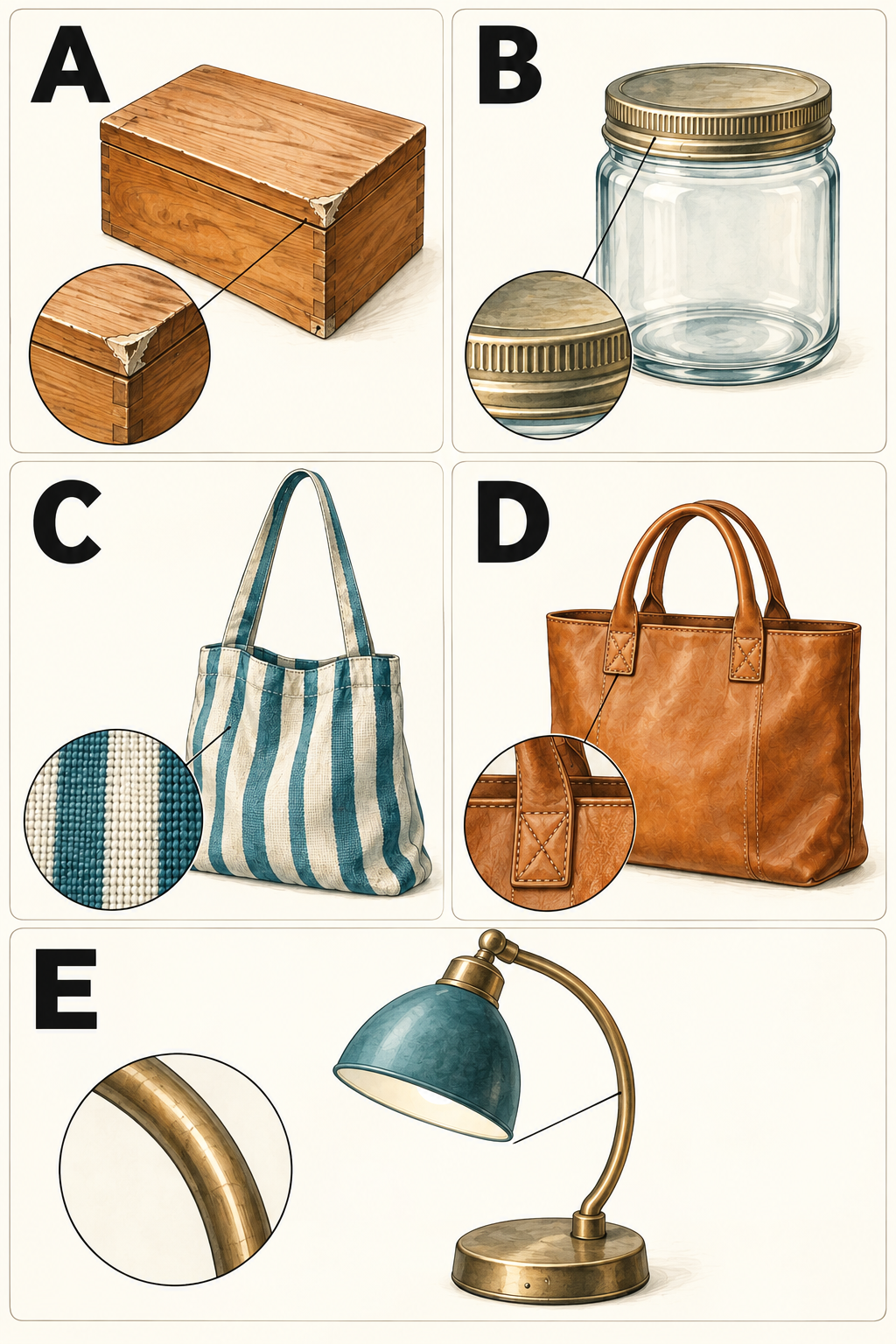
Use evidence words in your explanation. For Object C, “striped” and “one long strap” are two independent clues. For Object B, “glass” and “metal lid” come from the written record. Be honest about the source of your knowledge: a photo might show the lid clearly but not establish the material.
Age, value, ownership and working condition are different facts. Unless the record supplies them, write “not stated”. This habit keeps an intake description neutral and avoids blaming a person or making a promise about an item.
Eight checks and a description checklist
Questions 1–4 sort vocabulary. Questions 5–8 use the object records above. Match all the important details rather than choosing an object that shares only one word.
Answer on paper, then open the explanations below. Enable JavaScript to check answers here.
Checklist: name the object; use known material information; add its shape or dimensions if helpful; include one distinctive part, pattern or condition; remove guesses about value, age and ownership. A specific description can still be short.
Your turn · self-review
Transfer task: your turn
Self-check: correct object and material; at least one distinguishing feature; two clear sentences; no unsupported claims. Equivalent wording is welcome.
Practice only. Your writing stays on this page; it is not submitted or saved.
-
Model answer and explanation
It is a leather bag. It is plain and has two short handles.
Next, practise with new intake notes in What Needs Repair? Match the Object Descriptions. The related vocabulary and description resources provide optional extra practice; unpublished resources will be available after release.
Related Guides




Continue learning this topic
Review an explanation, study examples or try a related practice test.
- Practice test Wisconsin congressman describes swimming to safety after small plane makes emergency landing in Lake Wausau — C2 English Listening Practice Test
- Practice test Wisconsin congressman describes swimming to safety after small plane makes emergency landing in Lake Wausau — C2 English Grammar Practice Test
- Practice test Wisconsin congressman describes swimming to safety after small plane makes emergency landing in Lake Wausau — C2 English Vocabulary Practice Test