
Guide
A2 · Elementary
Grammar
Countable and Uncountable Nouns: Rules, Examples and Exercises
Learn countable and uncountable nouns with A2 examples and 16 exercises with explained answers. Practise a/an, some/any, much/many and useful counting units.
14 min read
2,482 words
Updated Oct 7, 2026
On this page (21 sections)
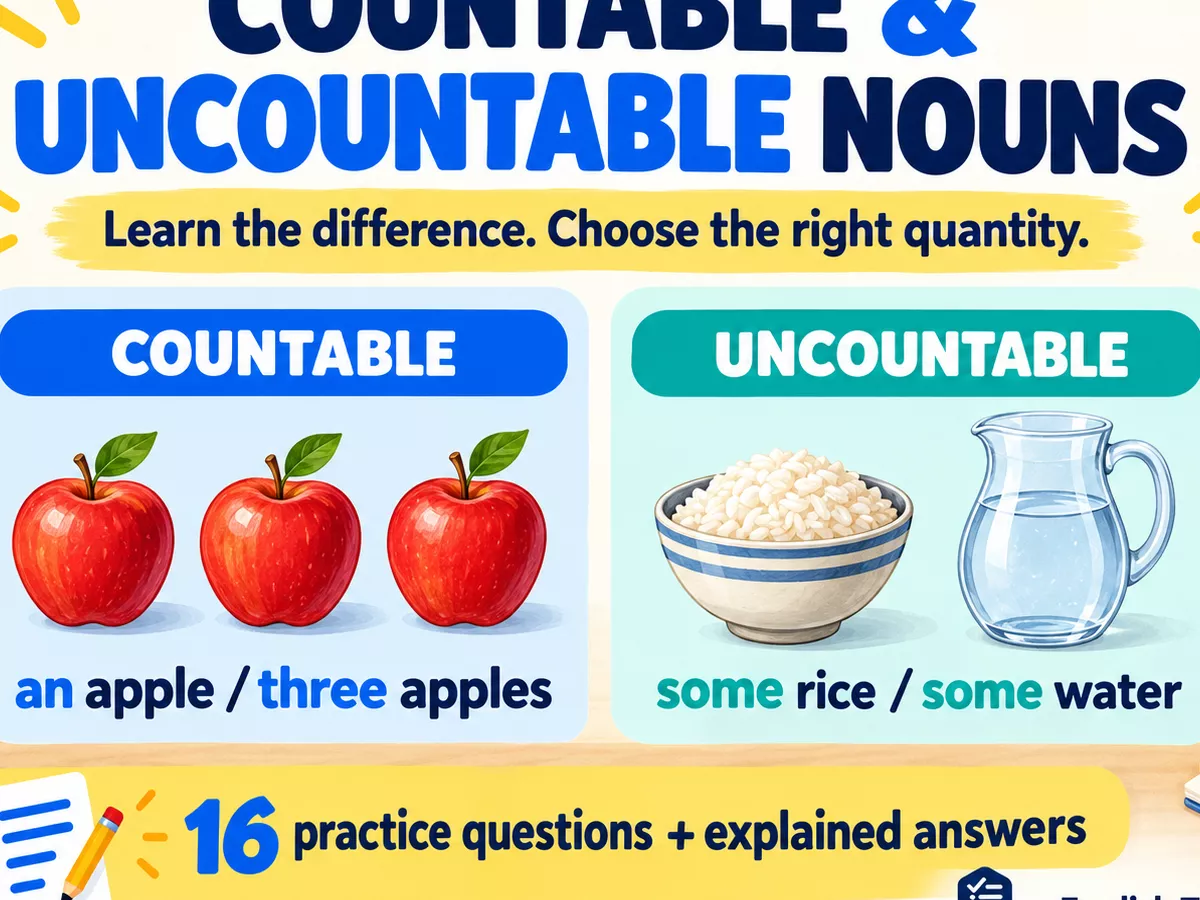
Countable and uncountable nouns affect more than plural endings. They help you choose a or an, ask about quantity and decide whether a sentence needs is or are. This A2 guide explains everyday nouns, useful units and common mistakes, followed by 16 original questions with explained answers. Learn the meaning in a whole phrase rather than trying to memorise a rule from a picture alone.
Start with the meaning in the sentence
A countable noun can name a separate item: one chair, two chairs. An uncountable or mass noun often presents something as an amount: some water, a little rice. This is a grammar distinction, not a claim that you cannot physically count grains or measure liquid. English normally treats rice as a mass noun, but grain is countable.
Learn a noun with an example and its intended meaning. A dictionary may show C for countable, U for uncountable, or both. Some nouns change their grammar when their meaning changes. One coffee in a cafe commonly means one serving; coffee as a substance can be uncountable. Context makes those uses clear.
Countable nouns: singular and plural
A singular countable noun usually needs a determiner in a normal sentence: a book, the book or my book. Choose a or an by the next sound, not just the written letter: an orange but a useful book. For more than one, use the plural: two books, some chairs. Some plurals are irregular, such as person and people.
Agreement follows the noun phrase: A chair is missing; Two chairs are missing. Many and a few work with plural countable nouns: many bags, a few visitors. Be careful with an irregular plural: How many people are coming? People is plural here even though it does not end in -s.
Review sounds and articles in English Articles: A, An and The.
Uncountable nouns: amounts and useful examples
In their ordinary meanings, water, rice, bread, money, information, advice, furniture and luggage are commonly uncountable. Use some water, useful information or new furniture, not an information or several furnitures. A mass noun generally takes singular agreement: The information is useful. A long list of facts does not automatically make information a plural noun.
Some of these patterns differ from other languages, so translating word by word can cause mistakes. Keep a short personal list with one complete sentence per noun. Focus on nouns you actually need for travel, work or home, and check a learner's dictionary when a new meaning appears.
Count the container, piece or measure
two bottles of water — count the containers; water describes what is inside.
three slices of bread — count the portions; bread stays unchanged.
a piece of advice; two items of luggage — use a countable unit for the individual item.
After two or more, make the unit plural. The uncountable noun normally stays unchanged.
Choose a realistic unit for your meaning. A loaf of bread is a whole loaf, while a slice is a smaller piece. For mass nouns such as furniture, a piece of furniture can identify one object. You do not need a unit in every sentence: We need some water is complete when an exact quantity is not important.
Some, any, much and many
Some often describes an unspecified positive amount or number: We bought some apples and some rice. Any is common in ordinary negatives and information questions: We do not have any rice. Are there any apples? Offers and requests often use some: Would you like some tea? Could I have some more water? These are helpful patterns, not absolute bans on other contexts.
How many asks for a number with a plural countable noun: How many bags? How much asks for an amount with a mass noun: How much luggage? Much and many also fit negatives. In ordinary positive conversation, a lot of works with both: a lot of books, a lot of work. The noun meaning controls the choice.
Meaning changes and common mistakes
Compare some paper for printing with a paper for a history class: the first is a material, the second an essay. Some cheese means an amount of food; several cheeses can mean several varieties. Similarly, time can mean an available amount, while three times means three occasions. Do not label these words always countable or always uncountable without checking their use.
Avoid adding -s to advice, information or furniture in their usual meanings. If a task asks for one item, choose a countable unit. Do not assume some only belongs with uncountable nouns: some apples is correct too. Check the head noun before choosing a verb, especially when there is an of phrase: Two bottles of water are on the shelf.
Practise everyday words with the Everyday English Vocabulary guide.
Practice 1: countable forms and quantity
Choose the correct option for the noun and meaning shown. Each question provides its own context.
Answer on paper, then open the explanations below. Enable JavaScript to check answers here.
Practice 2: useful mass nouns and counting units
Select the phrase that fits the stated meaning. Count a piece or container when the main noun is uncountable.
Answer on paper, then open the explanations below. Enable JavaScript to check answers here.
Practice 3: some, any, much and many
Choose the best neutral option from those provided. Read offers and requests differently from ordinary information questions.
Answer on paper, then open the explanations below. Enable JavaScript to check answers here.
Practice 4: correct forms and recognise meaning
Follow each question's specific instruction. For corrections, keep all other words and change only the incorrect noun phrase.
Answer on paper, then open the explanations below. Enable JavaScript to check answers here.
Answers and explanations
Complete each exercise and choose Check my answers to reveal its answers and explanations. You can also open the complete answer key below for self-study.
Show the complete answer key (1–16)
Practice 1: countable forms and quantity — answers
an — Orange is a singular countable noun beginning with a vowel sound. Exactly one fruit calls for an orange, not the plural or mass meaning.
clocks — Three counts separate objects, so the countable noun needs its regular plural clocks.
many — Chairs is a plural countable noun. How many asks for a number of chairs; how much is used for an amount with a mass noun.
much — Water refers to the liquid as an amount here, so use how much. The bottle is countable, but it is not the noun being measured by the gap.
Practice 2: useful mass nouns and counting units — answers
information — Information is normally uncountable in this meaning. Use information without a plural -s or a/an; a piece of information counts one item.
piece of advice — One needs a countable unit. Advice itself is normally uncountable, so a piece of advice expresses one suggestion.
bottles — Two counts the containers, so bottle becomes bottles. Water stays unchanged because it describes what each bottle contains.
is — Furniture is normally a singular mass noun, even when it includes several objects. Use is; say pieces of furniture when you want to count the objects.
Practice 3: some, any, much and many — answers
any — An ordinary negative uses any with a mass noun such as rice. A needs a singular countable noun, and many needs a plural countable noun.
some — Some is natural in an offer. Milk refers to a liquid amount here; a and many do not fit this mass-noun meaning.
many — Not many goes with the plural countable students. Only two explains that the number is small.
much — Time means an available amount in this sentence, so not much fits. Many times would refer to separate occasions, a different meaning.
Practice 4: correct forms and recognise meaning — answers
I bought two bread rolls and some cheese. — Cheese is uncountable when it means a food amount. Cheeses can be correct for different types, but the question explicitly excludes that meaning.
The hotel has new furniture. — Furniture is normally uncountable in ordinary English. Do not add a plural -s; new pieces of furniture would also describe separate items, but changes more words than requested.
two cups of coffee — Coffee can be countable when it stands for servings. The sentence refers to two drinks, not an exact volume or a rule that coffee always has one countability.
an essay or written assignment — A paper in this study context is one countable written assignment. Paper as a material is normally uncountable, as in some paper for printing.
Check your learning
Choose Check my answers at the end of each exercise to see your score and explanations, up to 16 points in total. Accepted alternatives also count. Record your first attempt, then use Try again to practise mistakes. This is practice, not a CEFR level test, and your answers are not saved.
For a noun mistake, decide whether the sentence counts an item, a serving, a unit or an amount.
For a quantity mistake, pair many with plural countable nouns and much with uncountable nouns in the meaning used.
Write a short shopping note with counted items and amounts, then check its articles, units and verb agreement.
Build a useful shopping note
Write a short shopping note with two counted items and two amounts. For example, use a number with apples, a unit with water and some with rice. Then write a question asking how much or how many you need. Read the noun phrase aloud and check whether you are counting an item, a container, a serving or an amount.
Frequently asked questions
Can an uncountable noun ever become countable?
Some nouns have both uses when the meaning changes. Two coffees can mean two servings, and several cheeses can mean different types. That does not make every mass noun freely countable: an advice is still not the usual way to express one suggestion.
Why do offers often use some instead of any?
An offer or request is not simply asking whether something exists. Some is a common friendly choice in Would you like some tea? or Could I have some water? Ordinary information questions often use any. Context and the speaker's expectations can affect the wording.
Is information countable or uncountable?
Information is normally uncountable: some information, not an information or informations. To count individual facts, use a piece of information or two pieces of information. Advice and furniture follow a similar pattern. Check the meaning in the sentence rather than adding -s automatically.
Related Guides






Continue learning this topic
Review an explanation, study examples or try a related practice test.
- Practice test Question words: who, what, where, when, why, how, how often, and how many — A1 English Grammar Practice Test
- Practice test Past simple: regular and irregular verbs — A1 English Grammar Practice Test
- Practice test Daily life: a simple morning routine — A1 English Reading Practice Test
- Course lesson Subject pronouns and possessive adjectives – A1–A2: Grammar Foundations
- Course lesson A, an and singular nouns – A1–A2: Grammar Foundations
- Course lesson Plural and uncountable nouns – A1–A2: Grammar Foundations