
Guide
B1 · Intermediate
Listening
Clarifying and Checking Understanding in English
Ask focused questions, repair names and numbers, and confirm instructions with useful B1 English conversation patterns.
9 min read
1,451 words
Updated Nov 4, 2026

On this page (7 sections)
Clarification keeps a conversation moving
Not understanding one detail does not mean that you have lost the whole conversation. A useful response tells the speaker which part you need. ‘Sorry, could you repeat that?’ is a good start when you missed everything. When you heard most of the message, a more focused question saves time: ‘What time did you say?’ or ‘Which entrance should I use?’ Asking early is often easier than correcting an action later.
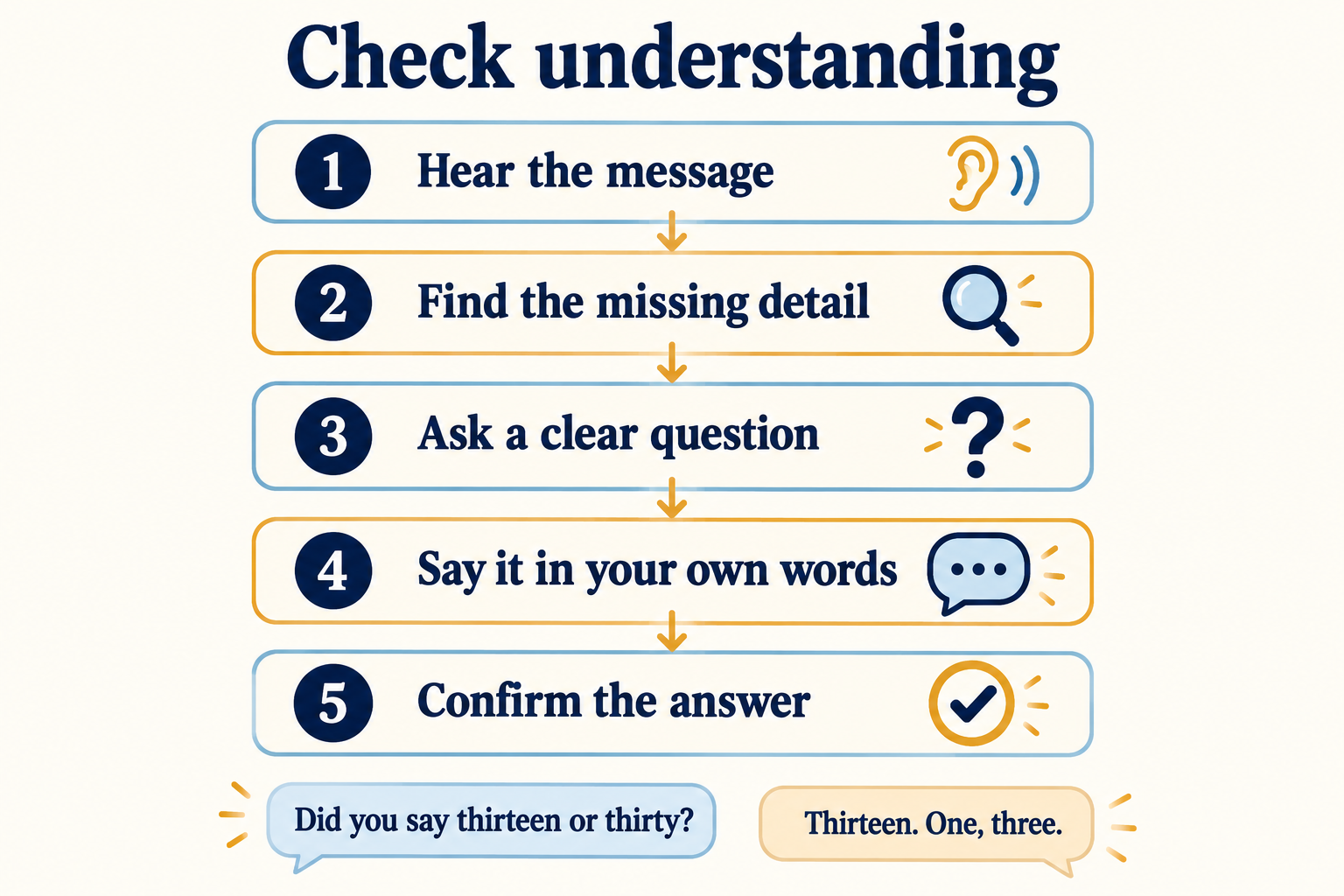
This guide follows a five-step routine: hear the message, identify the gap, ask a clear question, paraphrase the answer and confirm. You may not need all five steps for a simple detail. Use them when an instruction includes several actions or when a mistake would matter. A friendly voice can help, but accurate information is the main goal.
Ask for the kind of help you need
For a missed sound, ask for repetition: ‘Could you say the last part again?’ For speech that is too fast, say ‘Could you say that a little more slowly?’ For a long sequence, ask ‘Could we go through those steps one at a time?’ These requests solve different problems. Repeating the same fast sentence may not help if you need the speaker to divide the information into smaller parts.
If only one detail is missing, name it. ‘Sorry, which room?’ is usually clearer than saying ‘What?’ several times. Use a full question when the setting calls for more formality: ‘Could you tell me which room I should go to?’ With someone you know well, a short question can be completely appropriate. Politeness depends on the relationship, tone and situation as well as the number of words.
Check meaning, not just sound
Sometimes you heard a word clearly but do not know what it means here. Ask ‘What do you mean by “collect”?’ or ‘Does “collect” mean that I come to the desk myself?’ Quoting the unclear word shows exactly where the problem is. If you have a possible interpretation, offer it as a question rather than presenting it as a fact.
Avoid replacing an unfamiliar word with another unfamiliar word. A useful explanation changes the form or gives an example: ‘Leave a deposit’ might be explained as ‘Pay a small amount now; it is returned if you bring the item back in good condition.’ After the explanation, check any condition you need to act on. ‘So I get the money back when I return it undamaged?’ This checks the whole meaning.
Repair names, numbers and sequences
Names and numbers deserve a specific check because context may not identify the correct answer. ‘Was that fifteen or fifty?’ gives the speaker two clear possibilities. ‘Could you say the number one digit at a time?’ is useful for a reference code. Ask ‘How do you spell that?’ for a name, then read the letters back if accuracy matters. Do not invent a spelling merely because it sounds familiar.
For instructions, check order and limits. ‘Do I sign before or after I collect the box?’ checks sequence. ‘Do I need both pages or just the first one?’ checks quantity. ‘By Friday, or on Friday?’ checks a deadline versus a specific day. These questions are stronger than ‘Is that right?’ when the speaker does not know what you think the instruction means.
Paraphrase and leave room for correction
A paraphrase restates the message in your own words. Start with ‘So, I need to…’ or ‘Let me check I’ve understood…’. Then give the action and the important detail: ‘So I leave the form at reception before three, and you email me later.’ A clear paraphrase shows what you will actually do. Simply repeating ‘Okay’ or ‘I understand’ gives the other person less chance to notice a misunderstanding.
Wait for confirmation. If the speaker says ‘Almost’, listen for the correction and restate the changed detail: ‘Right, before two, not three.’ You do not need to repeat every sentence again. When someone checks your meaning, respond clearly: ‘Yes, exactly’ if it is accurate, or ‘The room is correct, but the time is four thirty’ if one part is wrong.
Choose a practical closing
Once the message is clear, close with a brief acknowledgement: ‘Thanks, I’ve got it now.’ If it is still unclear, say so and ask for another format when appropriate: ‘Could you write the address down?’ This is a request, not an assumption that the other person can do it. In a noisy setting, moving somewhere quieter may solve more than another repetition.
The teaching image summarises the routine and contrasts thirteen with thirty. The useful skill is identifying the gap, not memorising that particular pair. After practising the two dialogues, change the room, number or instruction and repeat with a partner. Check that your question targets a real uncertainty and that your final paraphrase includes the corrected detail.
Listen and learn
Dialogue 1: check the collection desk
Open audio separatelyRead the transcript
Staff: Your parcel is ready at desk thirteen. Bring the collection message on your phone.
Caller: Sorry, did you say thirteen or thirty?
Staff: Thirteen. One, three. It is beside the entrance.
Caller: Thank you. So I show the message at desk thirteen, beside the entrance?
Staff: Yes, that is right. You do not need to print it.
Caller: Great. I have got it now.
Listen and learn
Dialogue 2: clarify a form instruction
Open audio separatelyRead the transcript
Staff: Please leave the form in the tray before you collect the equipment.
Caller: Could you explain what you mean by the tray?
Staff: The flat grey container on the reception desk.
Caller: I see. Do I leave both pages there or only the signed page?
Staff: Both pages, please.
Caller: So I put both pages in the grey tray first, and then collect the equipment.
Staff: Exactly. Thank you.
Check your understanding
Try each item before opening the answer. Read the explanation even when your answer is correct.
Answer on paper, then open the explanations below. Enable JavaScript to check answers here.
Your turn · self-review
Apply it and compare
Write or say your own answer first. The models are examples, not the only acceptable answers. Use the checklist to review your work; open responses are not automatically assessed.
Practice only. Your writing stays on this page; it is not submitted or saved.
-
Model answer and explanation
Learner: “Can I return it on Thursday, or must it be earlier?” Staff member: “Thursday is fine, as long as you bring it back before we close.” Learner: “So Thursday before closing is the latest. Thanks.” Check that your version asks about the deadline rather than inventing it.
Related Guides






Continue learning this topic
Review an explanation, study examples or try a related practice test.
- Practice test At the University of Maryland, a historic campus farm remains a classroom — C2 English Listening Practice Test
- Practice test At the University of Maryland, a historic campus farm remains a classroom — C2 English Grammar Practice Test
- Practice test At the University of Maryland, a historic campus farm remains a classroom — C2 English Vocabulary Practice Test