
Guide
B1 · Intermediate
Listening
Connected Speech: Weak Forms and Linking
Hear familiar English words in natural speech. Learn weak forms, consonant-to-vowel linking and a practical listen-and-shadow routine.
9 min read
1,490 words
Updated Nov 3, 2026

On this page (6 sections)
Why words sound different together
You may know every word in a sentence and still miss the sentence when someone says it. Written spaces do not create a pause after every spoken word. In connected speech, speakers group words around meaning, give some words more attention and join sounds smoothly. The aim of this guide is to help you recognise those patterns. You do not need to copy one accent or speak as fast as a recording.
Compare a careful reading of ‘Can you pick it up?’ with a natural request. The important action is usually PICK UP. Can and you may be shorter and less prominent. The speaker still means all five words. A quiet syllable is not evidence that a word has disappeared. Use the situation and the grammar alongside what you hear, then replay to check your first guess.
Small words can have weak forms
A weak form is a less prominent pronunciation used when a word is unstressed. Common function words include articles, prepositions, conjunctions and auxiliaries. Unstressed to often has a short central vowel, written /tə/ in pronunciation dictionaries. And may sound /ən/ or /ənd/; can may sound /kən/. The article a normally sounds /ə/. These examples describe common patterns, not instructions to reduce every occurrence.
In ‘I can HELP’, can often has a weak form. In ‘Yes, I CAN’, can carries the main message and is normally strong. In ‘I said TO the door, not FROM it’, the contrast makes to prominent. Meaning decides the emphasis. Do not try to identify can and can’t from loudness alone: accent, consonants, sentence stress and context all matter. Replay or ask for clarification if a negative changes an important instruction.
The is commonly /ðə/ before a consonant sound and /ði/ before a vowel sound, with variation and stronger forms when emphasised. The sound matters: the word ‘university’ begins with a /j/ sound, despite the written letter u. Learn frequent phrases such as ‘at the end’ and ‘a cup of tea’ as whole listening chunks rather than a list of rules to apply while someone is talking.
Link across word boundaries
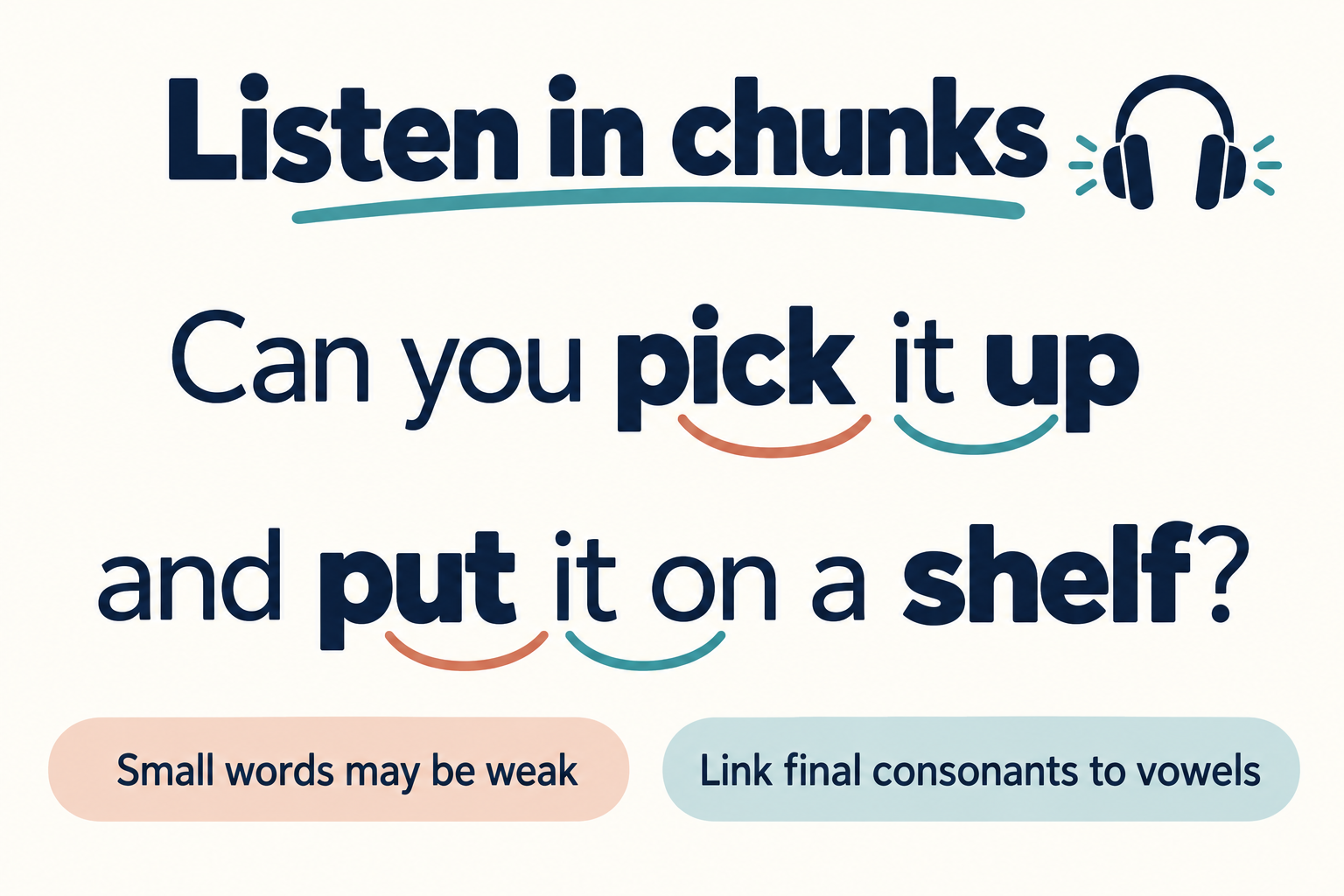
When a word ends in a consonant sound and the next begins in a vowel sound, the sounds often run together: pick‿it, turn‿off, put‿on. The small arc marks a link, not a new spelling. In ‘pick it up’, you can hear a flowing sequence instead of three isolated words. The final consonant still belongs to the original word. Linking does not change the grammar or the written form.
Look at the teaching image, then say its sentence slowly: ‘Can you pick it up and put it on a shelf?’ Links connect pick‿it, it‿up, put‿it and it‿on. PICK, UP, PUT and SHELF carry useful meaning. The words can, and and a may be less prominent. The image’s colours are only a visual aid; the explanation here contains the same information. Different speakers may place emphasis differently.
Listen for a meaningful chunk
A chunk is a group you can process together, such as ‘at the end of the day’. First listen for the situation: who is speaking, and what do they want? On the next listen, catch the stressed words. Then focus on the small words between them. If you hear ‘put … shelf’, ask which short words make a sensible instruction. Test ‘put it on a shelf’ against the recording instead of accepting a guess because it is grammatical.
The six comparison recordings use the same written sentence twice: a careful version followed by a natural version. A careful version is still real English. Neither version is ‘better’. Listen once without the transcript, write the words you think you hear, then reveal the transcript. Replay only the difficult chunk. Finally, return to the whole sentence so that a small sound does not distract you from the message.
Listen and learn
Clip 1: careful, then natural
Open audio separatelyRead the transcript
Careful: Please pick it up.
Natural: Please pick it up.
Listen and learn
Clip 2: careful, then natural
Open audio separatelyRead the transcript
Careful: Turn it off when you leave.
Natural: Turn it off when you leave.
Listen and learn
Clip 3: careful, then natural
Open audio separatelyRead the transcript
Careful: I want to check the list.
Natural: I want to check the list.
Listen and learn
Clip 4: careful, then natural
Open audio separatelyRead the transcript
Careful: Take a pen and a card.
Natural: Take a pen and a card.
Listen and learn
Clip 5: careful, then natural
Open audio separatelyRead the transcript
Careful: I can help with that.
Natural: I can help with that.
Listen and learn
Clip 6: careful, then natural
Open audio separatelyRead the transcript
Careful: Can you help? Yes, I can.
Natural: Can you help? Yes, I can.
Shadow for clear, comfortable speech
Shadowing means speaking with a recording or just after it. Choose one short chunk. Listen, pause and repeat it at a comfortable speed. Keep the important words clear and let the small words fit between them. Repeat with the recording, then say the message without it. Stop if rushing makes your speech unclear. Smooth phrasing is a more useful goal than perfect imitation.
Use this self-check: Can I explain the message? Can I identify the weak word in this context? Can I hear the linked boundary after seeing the transcript? Can another person understand my version? A recording of your own speech can help you compare rhythm, but it is optional. Connected-speech practice supports listening over time; one successful imitation does not prove that you will recognise every speaker.
Listen and learn
Short dialogue: at the welcome desk
Open audio separatelyRead the transcript
Maya: Can you help me at the welcome desk? I need to put these cards on a table.
Omar: Of course. Shall I pick up a pen for each person?
Maya: Yes, please. Put it on the card, and leave a little space for a name.
Omar: So, a card and a pen for everyone. Where do the spare cards go?
Maya: At the end of the table, next to the blue box. Thank you.
Check your understanding
Try each item before opening the answer. Read the explanation even when your answer is correct.
Answer on paper, then open the explanations below. Enable JavaScript to check answers here.
Your turn · self-review
Apply it and compare
Write or say your own answer first. The models are examples, not the only acceptable answers. Use the checklist to review your work; open responses are not automatically assessed.
Practice only. Your writing stays on this page; it is not submitted or saved.
-
Model answer and explanation
Possible links: put‿it and it‿on; the boundary in on‿the is not a consonant-to-vowel link. Put and table can carry the main emphasis. Check that all words remain understandable.
Related Guides






Continue learning this topic
Review an explanation, study examples or try a related practice test.