
Guide
B2 · Upper-intermediate
Grammar
Reporting Verbs: Suggest Doing, Advise Someone To and More
Choose a reporting verb that preserves the speaker’s intention and use its correct complement pattern.
10 min read
1,749 words
Updated Oct 28, 2026

On this page (12 sections)
B2 • About 25 minutes. Use common reporting-verb + -ing, + object + to and + that patterns. Handle insist on + -ing and deny/admit + -ing or that. Preserve intention when selecting a reporting verb. Check a learner dictionary when a verb supports several patterns.
This reference focuses on verb patterns. For tense changes in a report, review reported statements and backshift.
Meaning before grammar
A reporting verb tells the reader how to interpret someone’s words. “You should rest” can be reported as advice. “I will help you” may be a promise or an offer, depending on context. “I did not move the chairs” is a denial, not an admission. Choose the verb from the actual communicative intention before choosing its grammatical complement.
Reporting is not permission to strengthen a message. “Perhaps we could meet earlier” is a suggestion; “She ordered us to meet earlier” adds authority and force that the original did not necessarily contain. “I may be able to help” is not a promise to help. A grammatical report can still be false if its verb misrepresents certainty, commitment or agreement.
Use three checks: what was said, what speech act the context supports, and who is supposed to act. Then build a pattern that the chosen verb allows. Similar meanings do not guarantee identical complements. Advise someone to leave and suggest leaving can both recommend an action, but their structures differ.
Verb + -ing
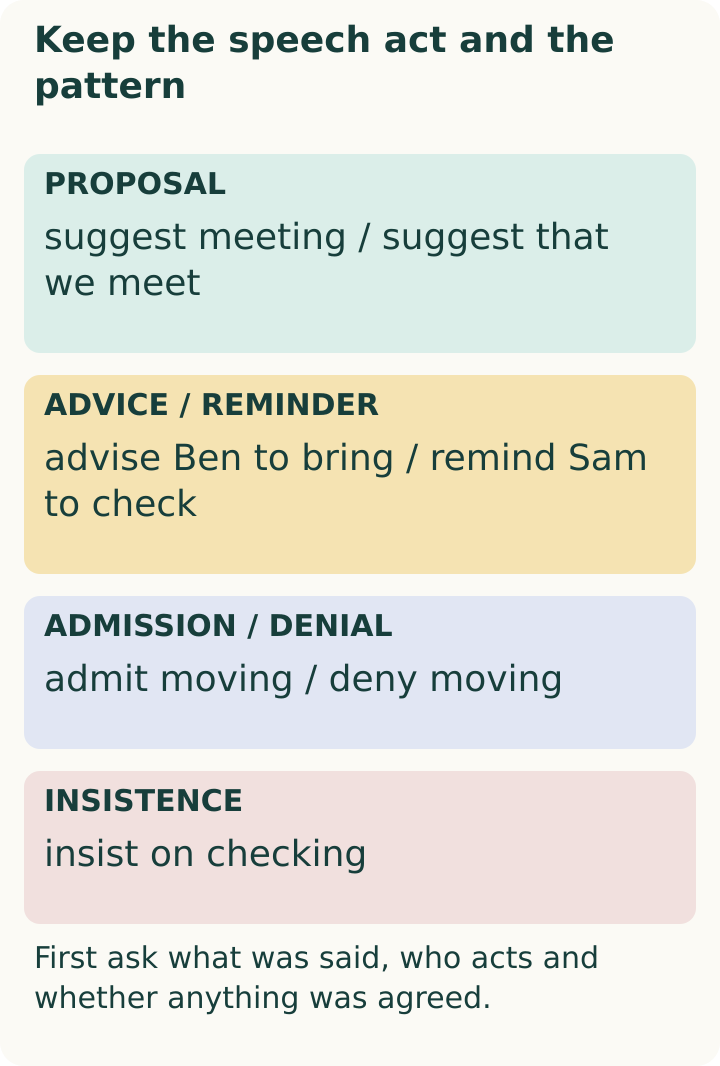
Suggest and recommend can take an -ing clause: “Mira suggested meeting earlier”; “Ben recommended taking a notebook.” The proposed action is meeting or taking, and the context identifies who would do it. With suggest, the -ing subject is not automatically the speaker. “Mira suggested meeting earlier” may mean the whole group should meet earlier.
Admit and deny also take -ing: “Ben admitted moving the chairs”; “Ben denied moving the chairs.” In these ordinary examples, Ben is the understood actor of moving. The two reporting verbs give opposite interpretations of whether he accepts the claim. Both also allow that-clauses: “Ben admitted that he had moved them”; “Ben denied that he had moved them.”
Be careful about time. “She admitted leaving early” can clearly refer to an earlier departure in context; “She admitted having left early” marks the earlier action explicitly. The perfect -ing form is available, not compulsory whenever the reporting verb is past. If the subject or timing becomes unclear, use a full that-clause rather than adding complexity for its own sake.
Verb + person + to-infinitive
Advise, encourage and remind commonly take a named object plus a to-infinitive: “She advised Ben to bring a coat”; “They encouraged us to join”; “I reminded Nia to check the time.” Ben brings the coat, we join, and Nia checks. The object identifies the person expected to perform the infinitive action.
Warn can use the same frame: “The organiser warned us not to use the damaged table.” Place not before to. Tell someone to gives an instruction: “The organiser told us to wait.” Compare that with a statement report: “The organiser told us that the room was ready.” These are different complements and different communicative jobs.
Do not omit an object when the intended pattern requires one: “She reminded to check the time” leaves out whom she reminded. Advise can also take -ing without a personal object, as in “They advised booking early”. That possibility does not make “They advised us booking early” the same standard pattern. Learn each frame as a unit and check a dictionary when changing it.
That-clauses and standard variation
Suggest and recommend can introduce a that-clause: “She suggested that we meet earlier”; “She suggested that we should meet earlier.” The base-form pattern, often called the mandative subjunctive, and the should-pattern are both standard. With a third-person subject, compare “She recommended that Ben arrive early” and “She recommended that Ben should arrive early.” The word that can be omitted: “She suggested we meet earlier.” The subject and verb still form the same content clause.
Indicative forms also occur in some varieties and contexts, for example “She suggested that we met earlier”. Their interpretation and naturalness depend on dialect and meaning, so this guide does not label every non-subjunctive that-clause wrong. In controlled proposal exercises, the base form and should-pattern give widely useful explicit models.
Suggest also means indicate rather than propose: “The evidence suggested that the door was already open.” That is a factual inference, not a recommendation that someone open the door. The reporting verb’s meaning determines the clause, so a simple rule that suggest always requires a base-form verb would be inaccurate.
Preserve the intended actor. “Mira suggested that Ben bring a notebook” names Ben. “Mira suggested bringing a notebook” may leave the actor recoverable from context, but it is not always equally precise. If the message assigns a task to one person, the that-clause can prevent ambiguity.
Prepositions matter
Insist on takes a noun or -ing form: “Nia insisted on a written plan”; “Nia insisted on checking the list.” Insist that is also possible: “Nia insisted that the list be checked.” Do not splice the frames into “insisted to checking”. The choice between them depends on what information you need to include.
Warn someone about introduces a danger or problem as a noun phrase or -ing clause: “They warned us about the loose step”; “They warned us about leaving bags near the exit.” Warn someone not to is often clearer for a specific prohibited action. Keep the speech act accurate: a warning highlights a risk, whereas a reminder draws attention to something already known or expected.
A practical dictionary routine is to find the verb, read the example frame, identify any compulsory object or preposition, and substitute your own content without changing that frame. Do not rely on the pattern of a synonym. Promise to, offer to, refuse to, admit doing and insist on doing belong to different structures.
Repair complements and misleading reports
“She suggested me to leave” is not the standard proposal pattern. Use “She suggested that I leave”, “She suggested that I should leave”, or “She suggested leaving” if the actor is clear. “She advised me to leave” is grammatical too, but it changes the reporting verb and may give the words a different force.
“He denied to move the chairs” needs denied moving or denied that he had moved. “She reminded him checking” needs reminded him to check. “They insisted on to meet” needs insisted on meeting. Repair the complement, then reread the original quotation to make sure the new report has not changed a suggestion into a decision.
Agreement is a separate factual claim. Four people discussing an idea does not prove all four accepted it. Meeting notes should distinguish suggestions, promises, objections and confirmed decisions. A precise reporter may use a shorter sentence, but must not compress away the difference between a proposed action and an agreed one.
Eight checks: apply the rule
Answer before you check. For typed answers, use the requested wording; valid listed variants are accepted. Read the explanation even if your answer is right.
Choose the pattern
Answer on paper, then open the explanations below. Enable JavaScript to check answers here.
Preserve the speech act
Answer on paper, then open the explanations below. Enable JavaScript to check answers here.
Repair without exaggerating
Answer on paper, then open the explanations below. Enable JavaScript to check answers here.
Your decision card
Meaning → actor → frame → source check. Suggest/recommend doing; advise/remind/encourage someone to do; warn someone not to do; admit/deny doing; insist on doing. Proposal alternative: suggest that we meet / that we should meet. A suggestion is not automatically an agreement.
Related learning
Companion resource: What Did Everyone Suggest? Reporting Verb Practice.
Related references for further study: Reported Speech: Statements; Gerunds and Infinitives: Common Verb Patterns; Clarifying and Checking Understanding in English.
Related Guides






Continue learning this topic
Review an explanation, study examples or try a related practice test.
- Practice test Achy from sitting at a desk all day? Try doing this — B1 English Listening Practice Test
- Practice test Achy from sitting at a desk all day? Try doing this — B1 English Grammar Practice Test
- Practice test Achy from sitting at a desk all day? Try doing this — B1 English Vocabulary Practice Test
- Course lesson Advanced passives and reporting – C1: Precision and Expression
- Course lesson Adverbs of frequency – A1–A2: Grammar Foundations
- Course lesson Reporting statements – B1–B2: Grammar in Context