
Guide
B1 · Intermediate
Grammar
Both, Either and Neither: Talking About Two Choices
Use both, either and neither to include, choose between or exclude two options. Includes noun patterns, paired connectors and ten explained checks.
7 min read
1,084 words
Updated Oct 28, 2026

On this page (7 sections)
1. Two options, three meanings
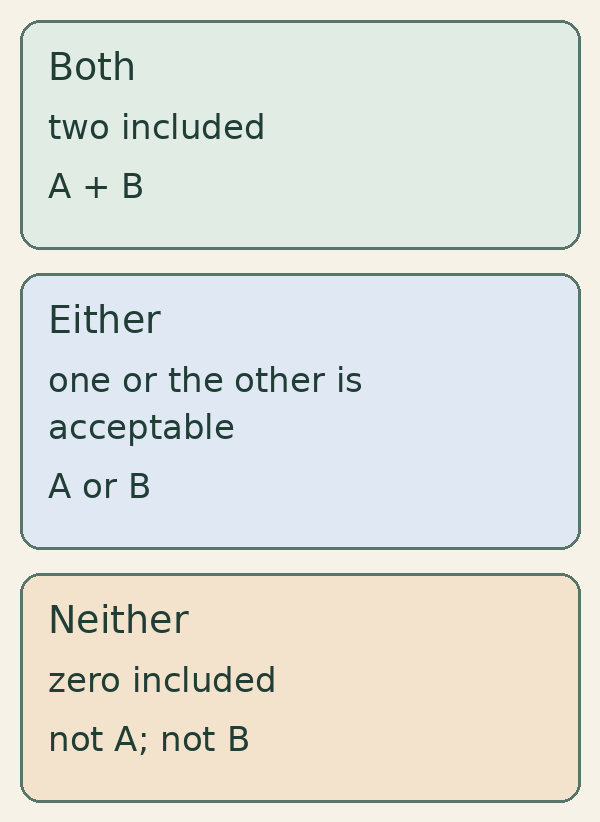
Both, either and neither help you talk about two choices. Two travel mugs, blue and green, have lids. Both mugs have lids. You need only one mug with a lid: Either mug is suitable. Neither mug can go in the dishwasher, so you must wash them by hand.
Both includes the two together. Either offers one or the other as an acceptable choice. Neither excludes the two. Keep the facts separate from your preference. You might prefer the green mug even when either mug meets the requirement.
2. Before nouns and pronouns
Before a noun or a pronoun
both mugs
Plural noun
Both mugs have lids.
either mug
Singular noun
Either mug is suitable.
neither mug
Singular noun
Neither mug is dishwasher-safe.
both of them
Object pronoun after of
Both of them have lids.
either of the mugs
One or the other
Either of the mugs is suitable.
neither of them
Not one and not the other
Neither of them is dishwasher-safe.
Both the mugs and both of the mugs are possible. Before an object pronoun, include of: both of them. Either of and neither of also take an object pronoun: either of us, neither of them. Avoid either of they.
3. Connect matching structures
Both…and joins two included items: We need both a table and a lamp. Either…or gives alternatives: You can bring either a table or a lamp. Neither…nor excludes both: We need neither a table nor a lamp. Make the two joined parts match in structure.
Compare “either in the hall or in the garden”. Both alternatives are place phrases. “Either work at home or work in the office” joins two actions. Do not add and when the pattern calls for or. For straightforward subjects, Both Ava and Ben are ready uses a plural verb. Mixed singular/plural subjects after either…or and neither…nor need more care and are outside this guide’s checks.
4. Negatives and replies
Neither already carries a negative meaning: Neither room works for us means Room A does not work and Room B does not work. In this standard written pattern, do not add an extra negative such as Neither room doesn’t work when you mean both options fail.
A short answer can repeat the word: “Which room has a screen?” “Both.” “Which room is quiet?” “Neither.” “Which room may I use?” “Either.” The question and facts make the answer clear. Conversational replies such as Me neither follow a different pattern; do not use them as models for every full sentence.
5. What about the verb?
Use a singular noun and verb in either room is and neither room has. With both rooms, use a plural verb: Both rooms are open. For careful edited writing, this guide also uses singular agreement in Either of the rooms is suitable and Neither of them has a screen.
Plural agreement after either/neither of + a plural group is common in speech and occurs in writing. Do not treat every example as equally wrong without considering style. Our single-answer checks avoid that variation. They use unambiguous singular nouns or focus on meaning instead.
6. Meaning and form checks
For each question, read the requirement as well as the facts.
Answer on paper, then open the explanations below. Enable JavaScript to check answers here.
7. Make a justified selection
Decision checklist: Are there exactly two options? Which requirement matters? Do both options meet it, does one meet it, or does neither meet it? If both qualify but only one is needed, either can express the free choice. If you describe the two together, use both.
A fair recommendation can separate suitability and preference: Both rooms have projectors, so either room meets that requirement. I prefer Room A because it is closer. Neither room holds twenty people. Each sentence makes a different claim, and all three can be true at the same time.
Try the paired room-selection lesson. It changes one requirement at a time so you can practise accurate language without confusing a preference with a factual limit.
Related Guides






Continue learning this topic
Review an explanation, study examples or try a related practice test.
- Practice test Nanotyrannus Skeleton “Jodi” Sells for $47.3 Million at Sotheby’s — B2 English Listening Practice Test
- Practice test Nanotyrannus Skeleton “Jodi” Sells for $47.3 Million at Sotheby’s — B2 English Grammar Practice Test
- Practice test Nanotyrannus Skeleton “Jodi” Sells for $47.3 Million at Sotheby’s — B2 English Vocabulary Practice Test