
Guide
A1 · Beginner
Reading
How to Read Event Posters in English: Place, Price and What to Bring
Read simple event posters for activity, place, price, entry conditions and equipment. Learn a clear scan routine and practise with six explained checks.
9 min read
1,485 words
Updated Oct 15, 2026
On this page (7 sections)
See the whole poster first
An event poster is a short text about something you can do or watch. You do not always read it like a story, from the first word to the last. First ask: What do I need to know? Then look for the words that answer your question. All people, places and events on this page are invented for English practice.
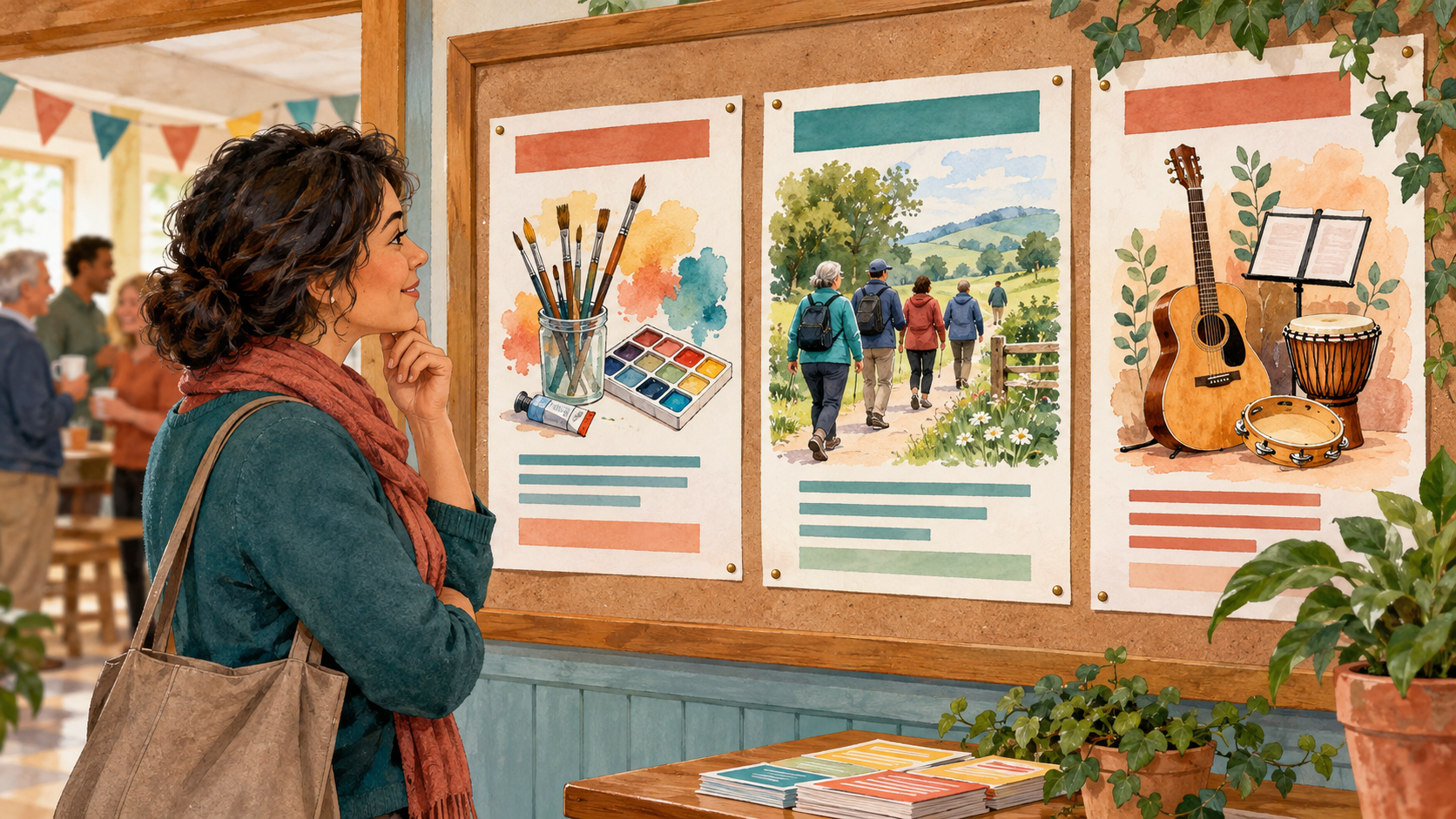
The title tells you the main activity. “Saturday, 11 a.m.” gives a day and time. The venue line tells you where to go. The last line tells you how to book. A big picture of a bird can help you notice the poster, but the written words give the practical facts. A picture cannot tell you the price or prove that equipment is available.
Before learning the poster words, review common everyday activity words.
Words that tell you what happens
A workshop is a session where you try a skill: you make a paper bird. At a talk, a speaker tells people about a subject: you listen to a talk about local trees. In a class, a teacher helps people learn: you practise drawing. A class can happen once or many times; check the poster rather than guessing.
At a show, you watch a performance. On a walk, you move on foot, often with a group. A club is a group of people who share an interest and meet for activities. “One workshop this Saturday” names one event. “Drawing class every Saturday” says the class repeats. You only need to notice this difference here.
Look at an action word as well as a title. “Try simple drum rhythms” is something you do. “Listen to local musicians” is something you hear. Both posters may have a picture of an instrument, but the activities are different.
Place, price and entry
Venue means the place where the event happens. A hall is a building or a large room. A room number helps you find one room inside a building. Copy both parts when you need them: Willow Hall, Room 2. A street or park name alone does not tell you a room number.
Free entry means you pay nothing to enter. “£3 per person” means each person pays £3. It does not mean £3 for your whole group. “Booking required” means you must arrange a place before you go. It does not mean that entry is free. Price and booking are separate facts.
Check what the price covers. “Free entry; drinks £1” means you can enter without paying, but a drink costs £1. Do not change “free entry” into “everything is free”. If a price is absent, write “not stated”. Do not invent a price from the picture.
Who can take part
“Beginners welcome” means people who are new to the activity can join. “No experience needed” has a similar meaning: you do not need to have done the activity before. “All levels” includes beginners and more experienced people. “For adults” tells you the group is adults.
“All welcome” is a friendly invitation, but still read the other lines. A poster can say “All adults welcome. Booking required.” You still need to book. A friendly heading does not remove a clear condition in the small print.
Unknown information is useful too. If a poster has no line about food, you cannot say that lunch is included. “Not stated” means the poster does not give an answer. It is different from “No”. Use the written details to make a choice, and identify any detail you would need to check.
What to bring and what is provided
Bring means take something with you to the event. Wear means have clothes or shoes on your body. Provided means available for you there. These small words change your plan, so read the full phrase, not only the object word.
Poster phrase | Your plan |
|---|---|
Bring a mat | Take your own mat with you. |
Wear comfortable shoes | Put comfortable shoes on. |
Tools provided | The event has tools for the activity. |
Bring a water bottle | Take a bottle of water with you. |
For the paper-bird workshop, paper and tools are provided, but you bring a bag. These are not opposite statements: they refer to different objects. Make two lists when a poster mentions several objects. Keep this two-list method beside the poster. The later diagram shows how poster facts connect to a person’s needs.
A worked poster-to-plan example
Rani is a fictional adult. She wants an indoor activity, it must be free, and she is a beginner. The paper-bird workshop fits. “Willow Hall, Room 2” gives an indoor place. “Free entry” meets her cost limit. “Beginners welcome” meets her experience need. These three details support the choice.
Rani writes: Paper workshop; Willow Hall, Room 2; free; bring a bag; book at the hall desk. She does not write “free lunch”, because the poster says nothing about lunch. She also does not write “no booking”, because that would conflict with “Booking required”.
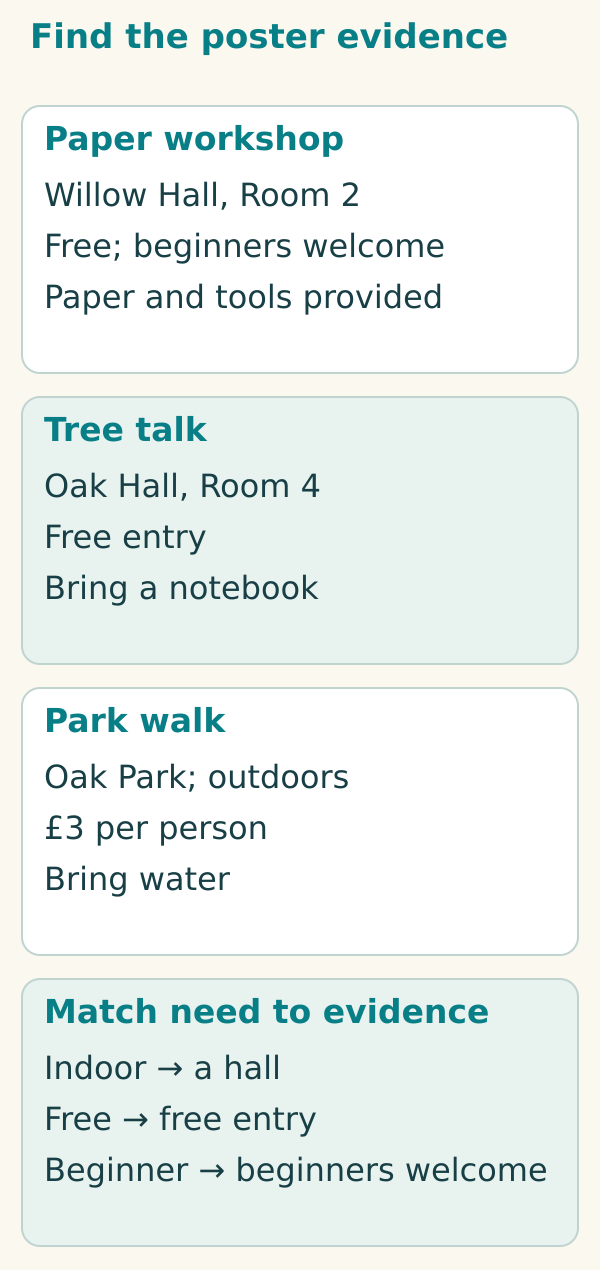
Six checks and a scan routine
Use the quick-check posters for questions 3–6. Choose the answer that meets every stated need, not just one. You can reread the posters. Each explanation identifies the words that support the answer.
Answer on paper, then open the explanations below. Enable JavaScript to check answers here.
Your scan routine: name your purpose; find the activity; check place and price; check who can join; separate what you bring from what is provided; read the final condition. Finish by checking what the poster does not say. A short accurate plan is better than a detailed plan with invented facts.
Your turn · self-review
Transfer task: your turn
Self-check: all five details match the worked poster; no food, transport or equipment promises are added. Equivalent wording is fine.
Practice only. Your writing stays on this page; it is not submitted or saved.
-
Model answer and explanation
Paper workshop at Willow Hall, Room 2. Entry is free. I need to book at the hall desk and bring a bag.
Next, use the paired lesson, Choose a Saturday Activity: Read Three Event Posters, to match new people to new events. Optional further practice: Everyday English Vocabulary for Daily Life; Time Prepositions: In, On and At; Read the Community Centre Timetable. Related drafts become available when released.
Related Guides






Continue learning this topic
Review an explanation, study examples or try a related practice test.
- Practice test UNLV Introduces a Minor in Teaching Mariachi as Demand for Instructors Grows — C2 English Listening Practice Test
- Practice test UNLV Introduces a Minor in Teaching Mariachi as Demand for Instructors Grows — C2 English Grammar Practice Test
- Practice test UNLV Introduces a Minor in Teaching Mariachi as Demand for Instructors Grows — C2 English Vocabulary Practice Test