
Guide
A1 · Beginner
Grammar
English Plural Nouns: Regular, Irregular and Unchanged Forms
A focused A1 reference for regular, irregular and unchanged plural nouns, with spelling decisions, agreement examples and ten explained checks.
9 min read
1,478 words
Updated Oct 14, 2026

On this page (7 sections)
If you need help with basic sentences, review the basic parts of an English sentence first.
1. Notice one and more than one
A noun names a person, an animal or a thing. Singular means one. Plural means more than one. At a donation table, one box needs one label; three boxes need three labels. The number changes the noun form even when the label is very short: 1 book, 2 books. You do not need a complete sentence to use a plural correctly.
Six everyday comparisons
a book → two books
One or more than one
One book is open. Two books are closed.
a cup → four cups
Add -s
A cup is on the table. Four cups are on the shelf.
a box → three boxes
Add -es
One box is empty. Three boxes are full.
a watch → two watches
Add -es
This watch is new. Those watches are old.
a toy → five toys
Keep the y
One toy is small. Five toys are large.
a baby → two babies
Change the y
A baby is asleep. Two babies are awake.
Start with meaning: how many things are there? Then choose the form. The number two already tells us more than one, but English normally marks the noun too. Write two books, not two book. Use a or an with one singular countable noun: a box, an apple. Do not write a boxes.
2. Choose -s or -es
For most common countable nouns, add -s: bag → bags, table → tables, chair → chairs. Leave the original spelling in place. The added ending does not need an apostrophe: three bags, not three bag’s. An apostrophe has other jobs, such as showing ownership.
Nouns ending in -s, -ss, -sh, -ch or -x commonly add -es: bus → buses; class → classes; dish → dishes; watch → watches; box → boxes. These examples all need an extra syllable when spoken. Focus here on spelling. Not every word ending in the letters ch follows the same sound pattern: stomach → stomachs is an exception to learn later.
Use the ending of the whole noun, not a letter in the middle. A basket contains the letters s and k but ends in -t, so basket becomes baskets. Compare a bus with a bus stop: two buses, but two bus stops. Stop is the main noun in the second expression.
3. When the spelling changes
When a consonant comes immediately before final -y, change y to i and add -es: baby → babies; city → cities; family → families. The consonant is the letter directly before y, not an earlier letter. When a vowel comes immediately before -y, keep the y and add -s: toy → toys; key → keys; day → days.
Some common nouns ending in -f or -fe change to -ves: leaf → leaves, knife → knives, life → lives. This is not a rule for every word ending in -f or -fe: roof → roofs, chef → chefs. Learn the plural with the word. Both scarves and scarfs are accepted plurals of scarf; scarves is used in this guide. Neither needs an apostrophe.
Words ending in -o are another reason to check a dictionary when unsure. Photo becomes photos, while tomato becomes tomatoes. Do not add a new general rule that every -o noun takes -es. Learning a small set accurately is more useful than guessing that one rule works for every word.
4. Useful irregular families
Some frequent plurals change more than an ending. Learn these as pairs: person → people; child → children; man → men; woman → women; foot → feet; tooth → teeth. Say three children, not three childs or three childrens. The form children is already plural.
People is the everyday plural of person: There is one person at the desk. There are six people in the room. Persons occurs in some formal or legal wording, but people is the useful default here.
Practise the pair in a phrase with a number: one child / two children; one foot / two feet. The spelling may change inside the word, so adding -s to the singular does not work. A short personal vocabulary list can keep singular and plural side by side.
5. Unchanged forms and countability limits
Sheep has the same singular and plural form: one sheep, six sheep. In everyday counting, fish usually does too: one fish, three fish. Fishes is possible when discussing different kinds of fish, especially in specialist contexts. For a simple everyday count, use fish.
The word can stay the same when it means more than one. Look at the number and verb: One sheep is near the gate. Two sheep are near the gate. The form alone does not tell you whether the speaker means one or several. This is why a complete example helps.
Not every noun can be counted directly. Furniture and information are normally uncountable: some furniture, useful information. Do not treat furnitures or informations as irregular plurals. To count, say two pieces of furniture or three pieces of information. First ask: can I count this noun? Then check its spelling.
Before you add -s, check whether a noun is countable.
Connect the noun to the rest of the sentence: The box is here. It is empty. The boxes are here. They are empty. A singular box takes is and it; plural boxes take are and they. Check the noun, pronoun and verb together.
6. Check and repair
Answer all ten questions. For corrections, type only the requested label or word. Read the explanation after checking.
Answer on paper, then open the explanations below. Enable JavaScript to check answers here.
7. Use and remember
Use this decision route: first ask whether the noun can be counted. If it can, decide whether you mean one or more than one. For a plural, check a known irregular or unchanged form; then consider a spelling change; otherwise use the ordinary -s or -es pattern. Finally check the nearby verb and pronoun.
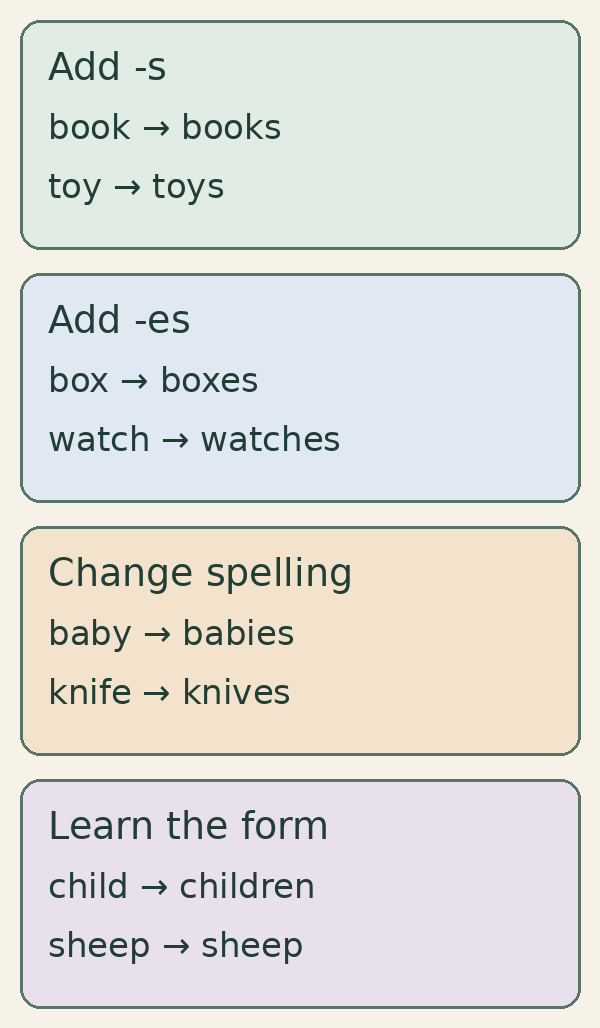
Four routes to a plural
Add -s
Most ordinary nouns
book → books; toy → toys
Add -es
Common -s, -sh, -ch and -x endings
bus → buses; box → boxes
Change the spelling
Consonant + y and selected f/fe nouns
baby → babies; knife → knives
Learn the form
Irregular or unchanged
child → children; sheep → sheep
To practise, choose five countable things near you. Write a singular phrase and a plural phrase for each. Model: a pen → three pens. Check the number, spelling and absence of an unnecessary apostrophe. Then try the paired donation-stocktake lesson when it is available.
Related Guides






Continue learning this topic
Review an explanation, study examples or try a related practice test.
- Practice test Question words: who, what, where, when, why, how, how often, and how many — A1 English Grammar Practice Test
- Practice test Past simple verb forms: regular, irregular, and spelling exceptions — A1 English Grammar Practice Test
- Practice test Past simple: regular and irregular verbs — A1 English Grammar Practice Test
- Course lesson Subject pronouns and possessive adjectives – A1–A2: Grammar Foundations
- Course lesson A, an and singular nouns – A1–A2: Grammar Foundations
- Course lesson Plural and uncountable nouns – A1–A2: Grammar Foundations