
Guide
A2 · Elementary
Grammar
Present Simple vs Present Continuous: Rules, Examples and Exercises
Learn present simple vs present continuous with A2 rules, examples and 16 exercises with explained answers. Compare routines, current actions and states.
14 min read
2,427 words
Updated Oct 14, 2026
On this page (20 sections)
Present simple vs present continuous is a useful comparison for A2 learners: one form often presents a routine or fact, while the other shows an activity in progress or a temporary situation. This guide gives clear examples, common mistakes and 16 original practice questions with explained answers. Read each situation carefully rather than choosing a tense from one signal word. This is self-study practice, not an official level test.
The main difference: your meaning comes first
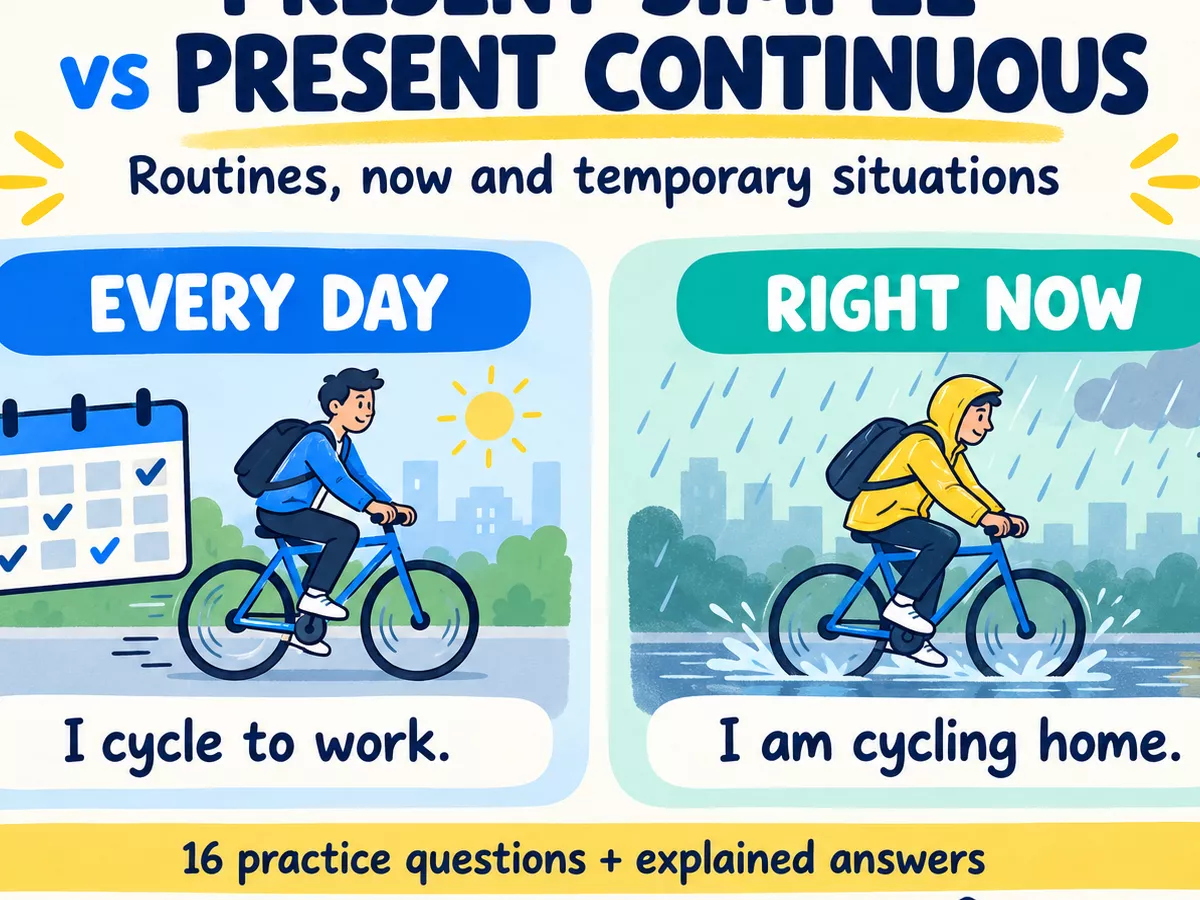
Use the present simple to describe what happens regularly, what is generally true or what you regard as your normal situation. I cycle to work describes a travel habit. Use the present continuous to show an action in progress: I am cycling home tells us what the speaker is doing now. The two sentences are not different levels of formality; they give different views of an action.
A tense is more than a clock label. Both forms can refer to the present, and continuous actions do not have to happen at the exact second you speak. Decide whether you are explaining a routine, describing an unfolding activity or emphasising a temporary situation. Time expressions support that decision, but they do not replace it.
Present simple: routines, facts and regular schedules
With I, you, we and they, use the base verb: I work, they read. With he, she and it, the affirmative normally needs -s or -es: she works, he watches. Some spellings change, as in study and studies. General facts can use the same form: This road connects two villages. A regular schedule also uses it: The library closes at six on weekdays.
Present simple negative with an action verb: We do not drive; Sara does not drive. Don't and doesn't are normal short forms.
Present simple question with an action verb: Do you drive? Does Sara drive? Use the base verb after does: Does she work?, not Does she works?
The verb be is different: She is at home; she is not at home; Is she at home? Do not add do or does to these be questions.
Review more patterns in the English Tenses Chart With Examples.
Present continuous: actions now and around now
Make the continuous with am, is or are plus the -ing form: I am waiting, she is waiting, they are waiting. Negatives add not after be: We are not waiting. Questions put be before the subject: Are they waiting? Keep both parts of the verb phrase; She working is incomplete.
Some actions unfold at the moment of speaking: Listen! Someone is knocking. Others belong to a period around now: I am reading a long novel this month does not mean the book is open at every moment. Temporary situations also fit: We are staying with relatives while builders repair our kitchen. The speaker presents that stay as limited rather than a usual home arrangement.
State meanings and changing meanings
Some verbs describe a state, such as knowledge, possession or an opinion, and usually take the simple form in that meaning. I know the address and These shoes belong to Mia are natural neutral statements. Do not turn this into an absolute rule that a whole verb can never be continuous. Meaning and context matter.
Compare I think your plan is useful, which gives an opinion, with I am thinking about your plan, which describes the activity of considering it. Have also changes meaning: I have a bicycle expresses possession, while I am having lunch describes an activity. This guide concentrates on ordinary A2 uses; expressive advertising and special narrative styles are not the target of the exercises.
Common mistakes to avoid
Check agreement first: My brother walks, not My brother walk. Then check the helper: They are running, not They running. In a simple negative, keep the base form after doesn't: She doesn't like it, not She doesn't likes it. In a continuous question, use be rather than do: Are you listening?, not Do you listening?
Do not treat always as an automatic command to use the simple tense, or now as proof that every verb must be continuous. A speaker can say I know the answer now because know still describes a state. Two forms can sometimes both be natural when the speaker presents a situation differently. The practice tells you the intended meaning when that distinction could affect an answer.
Use Clear Sentence Structure to review subjects and verb phrases.
Practice 1: routines and actions happening now
Choose the best answer from the options below each sentence. Read the complete situation before choosing the form.
Answer on paper, then open the explanations below. Enable JavaScript to check answers here.
Practice 2: temporary situations and verb meanings
Choose the form that matches the stated meaning. A temporary situation can be described in different ways; question 6 specifically asks you to highlight its temporary nature.
Answer on paper, then open the explanations below. Enable JavaScript to check answers here.
Practice 3: questions and negatives
Complete each gap with one option. Check the helper verb and subject, not just the time expression.
Answer on paper, then open the explanations below. Enable JavaScript to check answers here.
Practice 4: correct the form
Rewrite each sentence in its usual neutral form. Keep the meaning and all other words; change only the incorrect verb phrase.
Answer on paper, then open the explanations below. Enable JavaScript to check answers here.
Answers and explanations
Complete each exercise and choose Check my answers to reveal its answers and explanations. You can also open the complete answer key below for self-study.
Show the complete answer key (1–16)
Practice 1: routines and actions happening now — answers
drinks — Ben is he, so the present simple affirmative takes -s. The sentence describes a normal routine, not an action shown in progress.
is sleeping — This request refers to an action in progress now. Use is with the singular subject the baby, followed by sleeping.
begin — The present simple describes the regular timetable. Classes is plural, so use the base form begin rather than begins.
speak — A general ability is not an action being performed at this instant. Use the present simple base form with I.
Practice 2: temporary situations and verb meanings — answers
is running — Look and right now draw attention to an action in progress. Maya takes is; double the final n when writing running.
are staying — Are staying presents the visit as a temporary situation around now. We stay is also possible when a speaker presents an arrangement or fact, but it does not meet the requested continuous-form focus here.
think — Think expresses an opinion in this sentence, so the usual neutral choice is the present simple. It does not describe the activity of considering something.
am thinking — The speaker is actively considering the suggestion now. The activity meaning of think can use the continuous form; it is not a permanent ban on that verb.
Practice 3: questions and negatives — answers
walk — After does, the main verb stays in its base form. Does already shows the third-person singular agreement.
are — The continuous question needs are before you and laughing after the subject. Do belongs to a present simple question, not this be-plus-ing form.
doesn't — Use does not or doesn't plus eat for a present simple negative with she. Isn't cannot directly support the base verb eat in this structure.
aren't — This continuous negative uses are not or aren't before watching. The plural subject children takes are, not is.
Practice 4: correct the form — answers
I am reading a short email at the moment. — A continuous verb phrase needs am plus an -ing form. Read becomes reading; do not remove am when describing this action in progress.
Does she work on Saturdays? — A question with does uses the base form work. The repeated -s on works would mark the agreement twice.
Those keys belong to me. — Belong describes possession here, not an activity. The usual neutral form is present simple; the plural keys takes belong.
My sister usually takes the bus. — The subject my sister is singular, so add -s in the present simple affirmative. Usually describes her regular travel habit.
Check your learning
Choose Check my answers at the end of each exercise to see your score and explanations, up to 16 points in total. Accepted alternatives also count. Record your first attempt, then use Try again to practise mistakes. This is practice, not a CEFR level test, and your answers are not saved.
For a meaning mistake, decide whether the sentence describes a routine, a state, an action now or a temporary situation.
For a form mistake, underline the subject and check the helper verb and the main verb ending.
Write one routine and one current activity about yourself, then revisit any missed questions without the key.
Put the distinction into your own sentences
Write two short sentences about the same activity: one routine and one action happening now. For example, describe your usual reading habit and the book you are reading this week. Underline the subject and the full verb phrase. Ask whether your tense choice reflects the meaning you intended, and check any spelling change before you compare with the examples above.
Frequently asked questions
Does the present continuous always mean this exact second?
No. It can describe a temporary situation or a project around now, even when you are not doing it at the moment of speaking. I am learning to drive this month describes a current project. In this guide, use the complete situation to identify the meaning.
Can I use think and have in the continuous?
Yes, when the meaning is an activity rather than the state meaning being practised. I am thinking about the problem describes considering it; I am having breakfast describes eating. I think it is good expresses an opinion, and I have a bicycle expresses possession.
Should I use do/does or am/is/are in a question?
Use do or does with the base verb for present simple action questions: Does she work here? Use am, is or are before the subject for present continuous questions: Is she working now? The verb be also makes simple questions without do: Is she at home? Do not mix the two patterns.
Related Guides





Continue learning this topic
Review an explanation, study examples or try a related practice test.
- Practice test Yes/No questions, short answers, and simple conversation responses — A1 English Grammar Practice Test
- Practice test Question words: who, what, where, when, why, how, how often, and how many — A1 English Grammar Practice Test
- Practice test Past simple verb forms: regular, irregular, and spelling exceptions — A1 English Grammar Practice Test
- Course lesson Present perfect or past simple – B1–B2: Grammar in Context
- Course lesson Present perfect simple and continuous – B1–B2: Grammar in Context
- Course lesson Present simple for everyday routines – A1–A2: Grammar Foundations