
Guide
B1 · Intermediate
Grammar
Present Perfect Simple or Continuous? Results, Activities and Duration
Choose present perfect simple or continuous from the intended focus: completed results, activity, duration and present evidence. Includes 12 explained checks.
9 min read
1,510 words
Updated Nov 1, 2026

On this page (7 sections)
“I have read three chapters” reports a completed result. “I have been reading for an hour” reports an activity and its duration. Both connect an earlier time with now, but they answer different questions. This B1 guide helps you choose the focus you need. Allow about 20 minutes. You should know have/has + past participle. If that form is new to you, review present perfect simple before comparing the two forms.
Same time connection, different focus
Imagine a reader closing a book for a short break. “I have read three chapters” tells us how many chapters are finished. “I have been reading for an hour” tells us what has occupied the reader’s time. The continuous sentence alone does not tell us how many chapters are complete. The simple sentence alone does not tell us how long the reading took.
Neither form is automatically better or more advanced. Start with the information the listener needs: a completed count, an achieved result, an activity, or a period of activity. A time phrase such as for an hour is useful evidence, but it does not choose the tense by itself.
Build the continuous form
Use have or has + been + an -ing form. I/you/we/they have been working. He/she/it has been working. In a negative, put not after have or has: “We have not been waiting long.” Contractions are common: haven’t, hasn’t, I’ve and she’s. In “She’s been working”, ’s means has.
For a question, put have or has before the subject: “Have you been waiting?” “How long has she been studying?” Keep been and the -ing form. Do not write “has being studying” or “has been study”. Compare the simple form: “She has studied three units.” That uses a past participle, not been + -ing. You can also locate both perfect forms in the tense chart and compare their example sentences.
Completed results and quantities
Use the simple when the intended message is a completed quantity: “We have painted three chairs.” In this context, three chairs are finished. “How many chairs have you painted?” asks for that completed count. “We have been painting chairs” emphasizes the work and does not itself give a finished total.
A completed result can matter without a number: “I have found the missing key.” The finding has happened and the key is now available. “I have been looking for the key” describes the search; it does not say that I found it. Avoid using the continuous as proof that a task is finished.
Ongoing activity and present evidence
“We have been painting the fourth chair for an hour, and we are still working on it” explicitly tells us that the activity continues. “Your hands are blue.” “Yes, I have been painting, but I stopped five minutes ago” describes a recently stopped activity with present evidence. The continuous is possible in both situations.
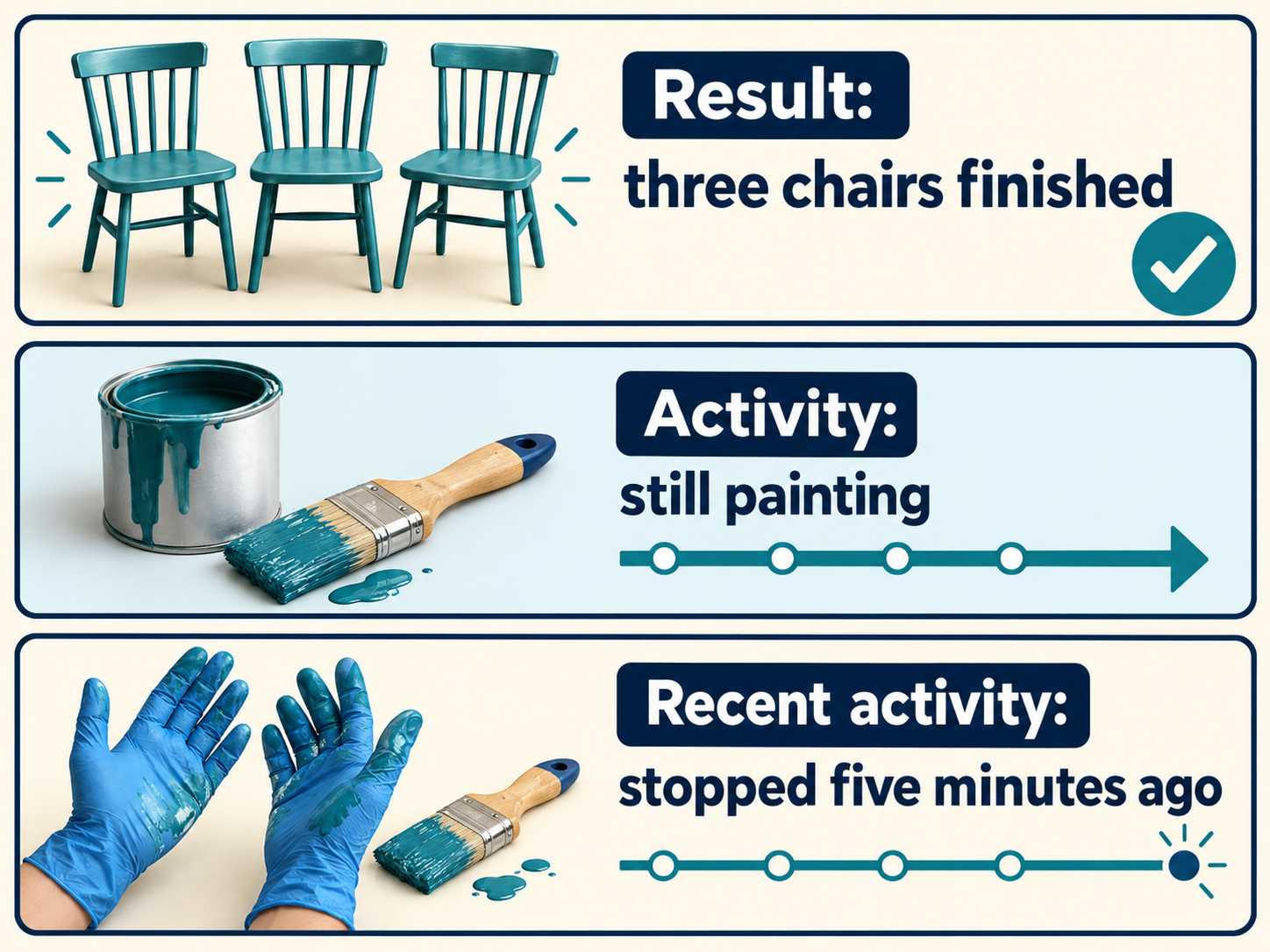
Do not infer a precise start time, completion, or continuation at this exact second from the continuous form alone. Read the surrounding facts. In “It has been raining; the paths are wet”, the wet paths are current evidence, but we need more context to know whether rain is still falling.
Overlap and stative meanings
Some verbs allow both forms naturally. “I have lived here for five years” and “I have been living here for five years” can describe a situation that continues now. The simple presents the fact; the continuous puts more attention on the continuing situation and can sound more temporary in a suitable context. It does not necessarily mean the person plans to leave.
Work and study also allow overlap: “She has worked here since May” and “She has been working here since May” can both be correct. Do not mark one wrong without a reason in the context. With ordinary knowledge, use the simple: “I have known Lee for years”, not “I have been knowing Lee”. Other verbs and meanings have their own limits.
For measures a length of time: for two hours. Since gives a starting point: since nine o’clock. Both can appear with simple or continuous forms when the meaning allows them. “I have known Lee since 2020” is simple even though the situation continues.
Choose with sufficient context
For each question, follow the stated focus. If the context permits both forms, choose the answer that says so.
Answer on paper, then open the explanations below. Enable JavaScript to check answers here.
Write a clear progress update
Your turn · self-review
Use it yourself
Make your own answer before opening the model. Other accurate answers are possible. Use the checklist to review meaning and form.
Practice only. Your writing stays on this page; it is not submitted or saved.
-
Model answer and explanation
I have designed two posters. I have been designing the third for an hour. I have been cutting paper, so there are scraps on the table, but I stopped five minutes ago. Checklist: finished count in simple; continuing activity with its duration; recently stopped activity clearly identified. Other accurate wording is possible.
Before choosing, ask: What result is complete? What activity matters? Does the context say it continues or has stopped? Can both forms be natural? Use the paired room-refresh lesson to practise those decisions in a full update.
Related Guides






Continue learning this topic
Review an explanation, study examples or try a related practice test.
- Practice test Places Around Town Words — A1 English Vocabulary Practice Test
- Practice test Clothes and Weather Words — A1 English Vocabulary Practice Test
- Practice test Finding the Library on Green Street — A1 English Listening Practice Test
- Course lesson Present perfect or past simple: Choosing the right tense – B1–B2: Grammar in Context
- Course lesson Present perfect: For, since, already, yet and just – B1–B2: Grammar in Context
- Course lesson Present perfect simple or continuous: Result or duration? – B1–B2: Grammar in Context