
Guide
A2 · Elementary
Grammar
Place and Movement: In, On, At, To, Into and Out Of
Separate location from destination and boundary-crossing movement. Includes paired diagrams, everyday phrases and six explained checks.
7 min read
1,128 words
Updated Nov 10, 2026

On this page (9 sections)
Where is it, or where is it going?
The parcel is in the van. The courier puts it into the van. Both sentences mention the same place, but they describe different things. The first gives a location; the second describes movement across a boundary. This distinction helps you explain where objects and people are and how they move.
There is no single preposition for every place. The best choice depends on whether you mean an inside space, a surface, a point, a destination or a movement. Learn the meaning with a whole phrase rather than translating one word on its own.
1. In: inside an area or space
Use in when you see something as inside a space: in a box, in the room, in the building, in a city. The keys are in my bag. The parcel is in the van. The walls or edges can be physical, like a box, or imagined, like the boundary of a city.
In describes position. It does not itself tell us that an object entered the space. The parcel is in the box could describe a parcel that has been there all day. To describe the crossing clearly, use a movement verb and into.
2. On: touching a surface
Use on for something supported by or attached to a surface: on the table, on a shelf, on the wall. The parcel is on the shelf. The picture is on the wall. A surface does not have to be horizontal. We can also say on the ceiling.
An object can have more than one correct location description: The parcel is on a shelf in the room. On explains its relationship to the shelf; in explains its relationship to the room. The words answer different levels of the same question.
3. At: a point or activity location
Use at when you treat a place as a point or meeting location: at the door, at the bus stop, at reception. Meet me at the entrance. The courier is at the door. You are identifying the place, without explaining its inside shape.
At a building often focuses on location or activity: She is at the library. In the library specifically says she is inside. At does not always mean outside. Context tells us more. Similarly, at the desk can mean sitting or working there; on the desk means on its surface.
4. To: a destination
Use to after many movement verbs to show where someone or something goes: walk to the door, drive to the depot, take the parcel to the office. Compare The courier walks to the door with The courier waits at the door. To gives the destination; at gives the position.
To does not necessarily say that someone enters a place. She walks to the shop tells us the destination. She walks into the shop specifically describes crossing the entrance. Choose the detail you need, and do not add a movement preposition to a static sentence such as She is at the shop.
5. Into and out of: crossing a boundary
Into describes movement from outside to inside: Put the keys into the bag. The courier carries the parcel into the hall. Out of describes the reverse: Take the keys out of the bag. The courier lifts the parcel out of the van.
The diagrams show three comparisons: standing at the door versus walking to the door; being in a room versus walking into it; being in a box versus moving out of it. Arrows show movement, and the captions repeat the meaning in words. Into is one word here. Out of is two words.
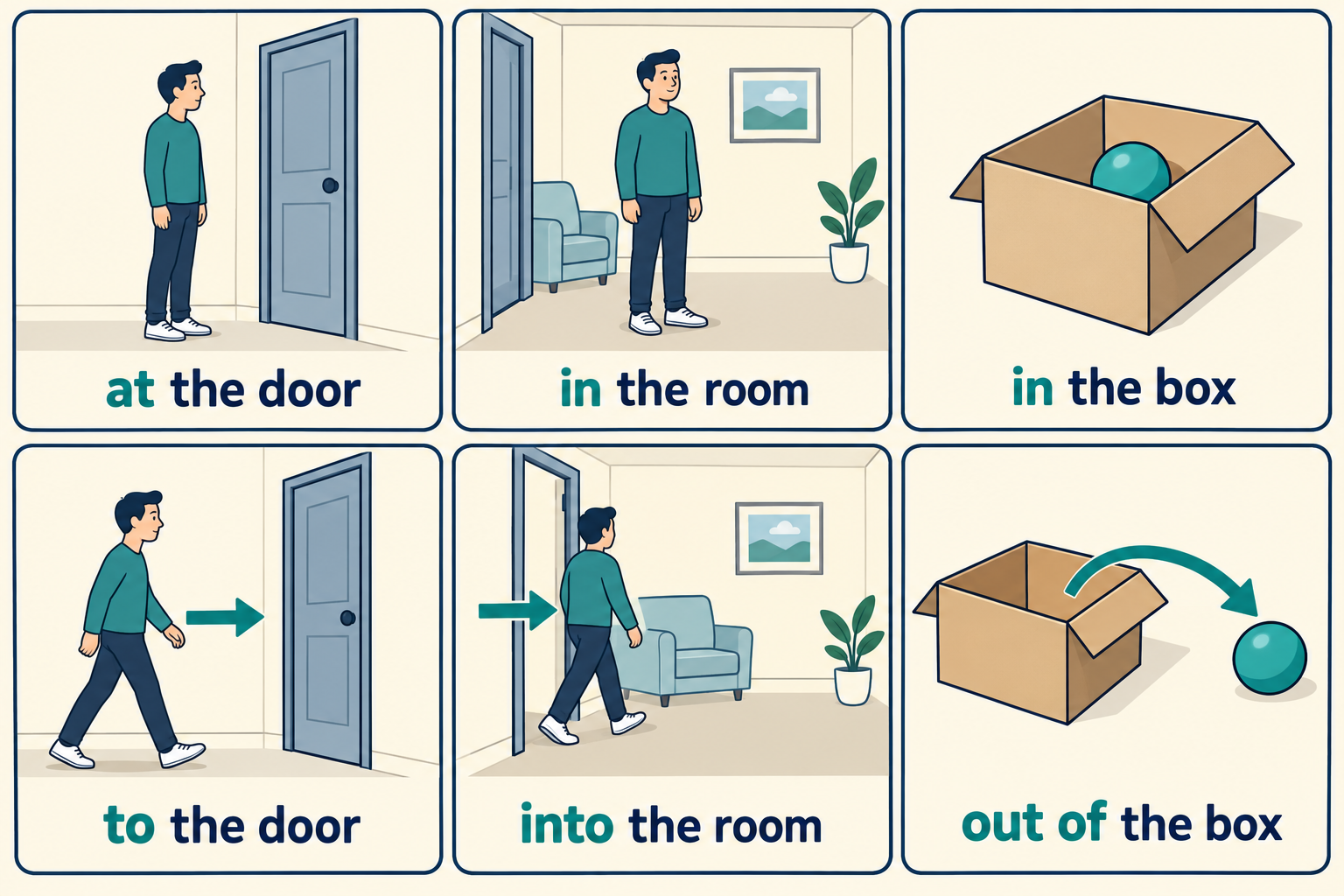
In is also natural with some placement verbs: Put it in the bag. Into makes the boundary-crossing especially clear. Do not assume every verb near in is wrong. For learning this contrast, compare a clear state, It is in the box, with a clear movement, It goes into the box.
6. Learn useful everyday phrases
Say at home for a location, and go home or come home for movement. Do not add to in go home. With common public transport, we usually say on the bus or on the train. With a car or taxi, we normally say in the car or in a taxi. These are useful conventional phrases, so learn them together.
The phrase can change with context. Get on the bus means board it; get into the car describes entering the car. A toy bus can be in a box, and a bag can be on the roof of a car. Think about the actual relationship rather than matching a noun to only one preposition.
Quick check: six questions
Answer on paper, then open the explanations below. Enable JavaScript to check answers here.
Describe a short journey
Choose an object near you. Say where it is, move it, then say its new location. Model: The pen is on the desk. I put it into my bag. Now it is in my bag. Check that your movement sentence and final location agree.
Related Guides






Continue learning this topic
Review an explanation, study examples or try a related practice test.
- Practice test Chicago entrepreneur turns empty downtown office space into vertical gardens — B2 English Listening Practice Test
- Practice test Chicago entrepreneur turns empty downtown office space into vertical gardens — B2 English Grammar Practice Test
- Practice test Chicago entrepreneur turns empty downtown office space into vertical gardens — B2 English Vocabulary Practice Test
- Course lesson There is and there are: Describing places – A1–A2: Grammar Foundations
- Course lesson At, in and on: Prepositions of time and place – A1–A2: Grammar Foundations