
Guide
A2 · Elementary
Grammar
Must, Have To and Should: Rules and Advice
Learn must, have to and should for rules and advice. Compare mustn’t with don’t have to, practise past obligation and try six explained checks.
6 min read
1,001 words
Updated Nov 2, 2026

On this page (8 sections)
Understand the message before choosing a form
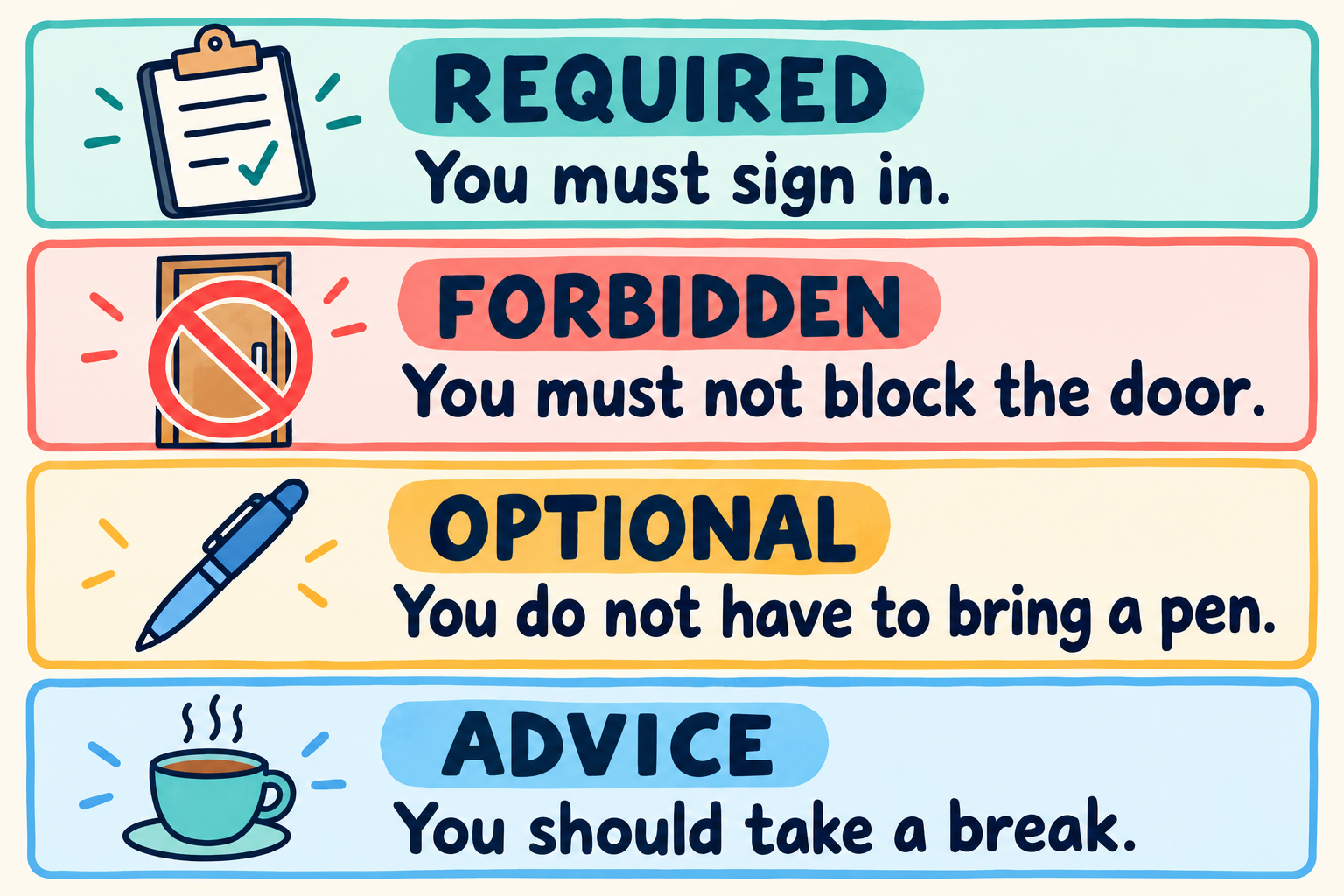
A rule tells you what is required or forbidden. Advice tells you what is a good idea. An optional action is your choice. This guide helps you separate these meanings in signs, instructions and everyday conversations. By the end, you can explain a rule, describe an obligation in the past and give simple advice.
Compare these messages: You must show your card. You mustn’t use your phone here. You don’t have to print your ticket. You should arrive a little early. The negative forms do not all mean the same thing.
Must and have to: something is necessary
Use must + the base verb: I must finish this today. You must keep this door clear. Must does not change with he or she: She must show her card. Do not add to after must.
Have to also describes obligation: I have to sign in. She has to sign in. We often use it for practical rules and circumstances. Must can express a speaker’s strong instruction or an official rule. There is overlap: “Visitors must sign in” and “Visitors have to sign in” can describe the same requirement. Do not treat “internal versus external obligation” as an absolute rule.
Positive: I/you/we/they have to wait; he/she/it has to wait.
Question: Do you have to wait? Does she have to wait?
After do or does, use have, not has: Does he have to book?
Must question: Must I book? This is possible; Do I have to book? is common in everyday conversation.
Mustn’t: the action is forbidden
Mustn’t is the short form of must not. You mustn’t park here means parking here is not allowed. The instruction is to avoid the action. Use the base verb after it: You mustn’t block the exit, not “mustn’t to block”.
Don’t have to: there is no obligation
You don’t have to bring a pen means a pen is not necessary. You can bring one if you want. With he or she, use doesn’t have to: She doesn’t have to work on Saturday. This does not mean she is forbidden to work.
Should and shouldn’t: advice
Use should + base verb for a recommendation: You should save your work. Use shouldn’t for advice against an action: You shouldn’t wait until the last minute. These forms usually leave a choice; they are weaker than a clear rule. If an action is compulsory, do not describe it only as advice.
Should does not take -s or to: He should ask, not “he should asks” or “he should to ask”. A useful question is: Should I call first?
Past obligation: had to
For a necessary action in the past, use had to with all subjects: Yesterday we had to use the other entrance. She had to show her ticket. Ask Did you have to wait? The negative is didn’t have to: We didn’t have to pay means payment was unnecessary. It does not, by itself, tell us whether we paid.
Six quick checks
Choose or type an answer. Read the explanation after checking; for typed answers, use the requested wording.
Answer on paper, then open the explanations below. Enable JavaScript to check answers here.
Use it and check yourself
Your turn · self-review
Write a clear rule and a helpful tip
Write your own two sentences, then compare these models. There is more than one possible answer.
Practice only. Your writing stays on this page; it is not submitted or saved.
-
Model answer and explanation
You must leave the desk clean.
-
Model answer and explanation
You should ask where the printer is.
Did I distinguish forbidden from optional?
Did I use a base verb after must or should?
Did I choose have/has to correctly?
Did I use had to for a past obligation?
Related Guides






Continue learning this topic
Review an explanation, study examples or try a related practice test.
- Practice test First-Time Homebuyers Are Scarce, but More Are Paying Cash — B1 English Listening Practice Test
- Practice test First-Time Homebuyers Are Scarce, but More Are Paying Cash — B1 English Grammar Practice Test
- Practice test First-Time Homebuyers Are Scarce, but More Are Paying Cash — B1 English Vocabulary Practice Test
- Course lesson Degrees of certainty: Must be, may have and likely to – C1: Precision and Expression
- Course lesson Conditional inversion: Had I, were I and should you – C1: Precision and Expression
- Course lesson Must, need to and be allowed to: Rules and permission – B1–B2: Grammar in Context