
Guide
B1 · Intermediate
Grammar
Past Perfect: Show What Happened Before Another Past Event
Use past perfect to look back from a past event. Learn had + participle, compare clear past-simple sequences and practise 12 explained checks.
8 min read
1,315 words
Updated Oct 31, 2026

On this page (7 sections)
Past perfect looks back from a point in the past. It shows that another event was already complete then. Learn had + past participle, compare it with past simple, and try 12 checks. This B1 guide takes about 20 minutes.
Two past points, one viewpoint
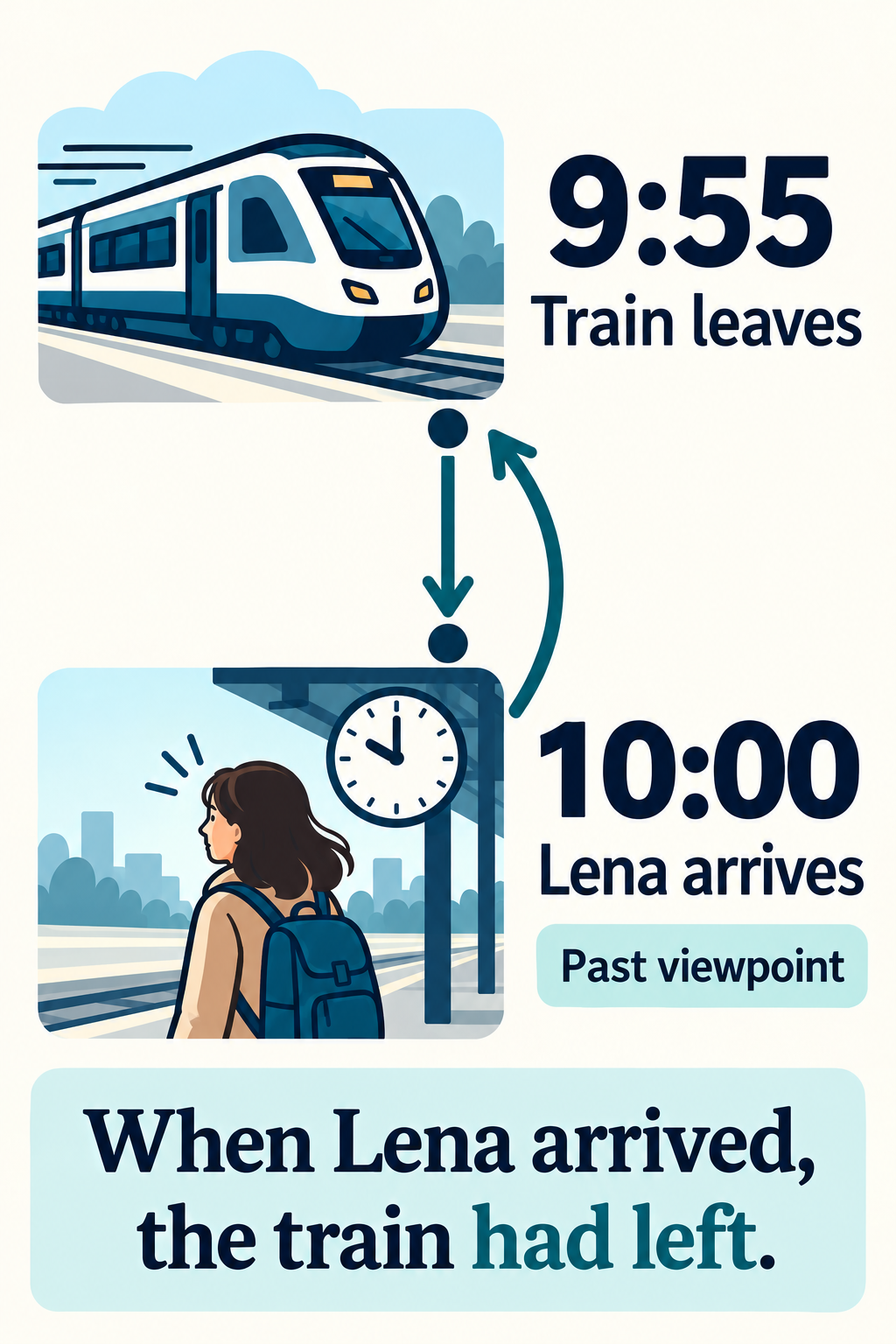
The café closed at six. I arrived at six fifteen. Start the story at my arrival: “When I arrived, the café had closed.” My arrival is the past point I am looking from. The closure happened earlier. Past perfect helps the reader see that step backwards.
Build had + participle
Positive: I/you/she/we/they had finished. Negative: had not finished, or hadn’t finished. Question: Had you finished? Had is the same for every subject. Put it before the subject in a question. Do not add did to a past-perfect question.
Some participles end in -ed: finished, checked, opened. Others must be learned: go → gone; eat → eaten; see → seen; write → written; leave → left; send → sent. The participle after had is not always the ordinary past form: had gone, not had went.
Compare “We had breakfast” with “We had eaten breakfast”. In the first sentence, had is the past form of have and means ate or took part in breakfast. In the second, had is an auxiliary and eaten is the participle. Had by itself does not always mean past perfect. To compare had + participle with other tense forms, see where past perfect fits in the tense chart.
Move backwards from a past point
The order of telling can differ from the order of events: “I reached the cinema at eight. The film had started at seven forty-five.” The second sentence goes backwards from the arrival. Already often emphasizes completion before that point, but it is optional: “The film had already started.”
By the time helps establish a later point: “By the time we got home, the rain had stopped.” The stopping happened before our arrival. Before and after can also make the relationship explicit. Identify the two events rather than choosing a tense only because you see one time word.
Past simple may be enough
When you tell events in time order, past simple is often clear: “I opened the door, walked in and sat down.” There is no need to put every early action into past perfect. All three are main events moving the story forwards.
“After I finished the report, I sent it” is clear because after gives the order. “After I had finished the report, I sent it” is also possible and highlights the earlier completion. Do not mark either version wrong without a context or a task that asks for one particular form.
Once you have established an earlier time, you may continue a longer description with past simple when the viewpoint stays clear. Use past perfect to help the reader, not as a rule that every earlier event must always contain had.
Separate neighbouring grammar
Past continuous shows an activity in progress around a past moment: “I was walking to the café when it began to rain.” Past perfect shows a prior completed event: “I reached the café, but it had closed.” These are different relationships.
Present perfect looks back from now; past perfect looks back from a past point. Third conditional sentences also use past perfect, but they imagine a different past. This guide tells what actually happened. Keep factual sequencing separate from imagined regret while you practise.
Sequence and choose
Answer on paper, then open the explanations below. Enable JavaScript to check answers here.
Tell a clear short story
Your turn · self-review
Use it yourself
Make your own answer before opening the model. Other accurate answers are possible. Use the checklist to review meaning and form.
Practice only. Your writing stays on this page; it is not submitted or saved.
-
Model answer and explanation
I arrived at the café at 6:15, but it had closed at six. I walked to another café at 6:20. Check the later past point, the earlier closure and the return to past simple for the next main event.
Draw a timeline before writing. Circle the past point where your story starts. Use had + participle when you look back to an earlier completed event, then return to past simple for the next main action. Try this with “The Missed Connection: Reconstruct What Had Already Happened”.
Related Guides






Continue learning this topic
Review an explanation, study examples or try a related practice test.
- Practice test New Mexico’s Alien Throne Rock Formation Collapses After Heavy Rain — B2 English Listening Practice Test
- Practice test New Mexico’s Alien Throne Rock Formation Collapses After Heavy Rain — B2 English Grammar Practice Test
- Practice test New Mexico’s Alien Throne Rock Formation Collapses After Heavy Rain — B2 English Vocabulary Practice Test
- Course lesson Present perfect or past simple: Choosing the right tense – B1–B2: Grammar in Context
- Course lesson Present perfect: For, since, already, yet and just – B1–B2: Grammar in Context
- Course lesson Present perfect simple or continuous: Result or duration? – B1–B2: Grammar in Context