
Guide
B1 · Intermediate
Grammar
English Question Word Order: Be, Do, Have and Modal Verbs
Choose be, do, have or a modal for direct English questions. Follow a clear word-order method and practise 12 questions with explained answers.
10 min read
1,768 words
Updated Oct 15, 2026

On this page (7 sections)
A useful question begins with a gap: something you do not know. This B1 guide shows how to choose the helping verb and arrange an ordinary direct question. You will practise questions with be, do, have and modal verbs, then check twelve answers. Allow about 20 minutes. You should already know basic present and past verb forms. For a short refresh, see A1 English Grammar for Everyday Communication.
Decide what information is missing
Compare two information needs. “Is the workshop on Saturday?” checks a fact and invites yes or no. “When is the workshop?” asks for a time or date. The structure is similar, but the information question puts when at the front. Choose your question word from the answer you want: a person (who), a thing or activity (what), a place (where), a time (when), a reason (why), or a manner (how). What time asks for a clock time; how much asks for an amount or price.
Start with the meaning rather than translating each word from another language. If you already know that the class is on Saturday, “Is it on Saturday?” does not obtain the missing room number. “Which room is the class in?” does. In ordinary conversation, a short preposition often stays at the end: “Who do you work with?” This guide focuses on questions asking about an object or other detail, not questions in which who itself is the subject.
Find an existing helper
Look at a possible statement first. If be is the main verb, move it before the subject: “The room is open” becomes “Is the room open?” Add where for a place: “Where is the room?” Do not add do to this pattern. “Does the room be open?” is not the ordinary present-tense question.
If the statement already contains an auxiliary, move its first auxiliary before the subject. In “They are waiting”, are is the helper: “Are they waiting?” In “You have booked a place”, have helps form the present perfect: “Have you booked a place?” Keep the main verb in its original form after that helper. Booked remains the past participle; it does not become book merely because the sentence is a question.
A modal such as can, could, will or should also goes before the subject: “You can bring a friend” becomes “Can you bring a friend?” The verb after a modal is the base form: bring, not brings or to bring. When there is more than one helper, only the first moves: “They have been waiting” becomes “Have they been waiting?”
Add do when needed
A statement in the present simple or past simple may have a main verb but no existing helper: “They work here.” For an ordinary yes/no or object question, add do, does or did. Use do with I, you, we and they in the present: “Do they work here?” Use does with he, she or it: “Does Lena work here?” Use did for the past: “Did Lena work here last year?”
The helping verb now carries the tense and person information. The main verb uses its base form: “Where does Lena work?”, not “Where does Lena works?”; “When did she leave?”, not “When did she left?” The past meaning has not disappeared: did already tells us that the question concerns the past. This is why two marks of the same tense or person create a common error.
Do can also be a main verb meaning perform an activity. In “What do you do after class?”, the first do is the helper and the second do is the main verb. Two occurrences are possible because they have different jobs. The rule is about their functions, not about avoiding repeated words.
Build the direct-question sequence
For an ordinary information question, use this live-text path: question word or phrase → auxiliary/modal or be → subject → remaining verb and details. Example: What time → does → the workshop → finish? A yes/no question has no opening question phrase: Does → the workshop → finish at eight?
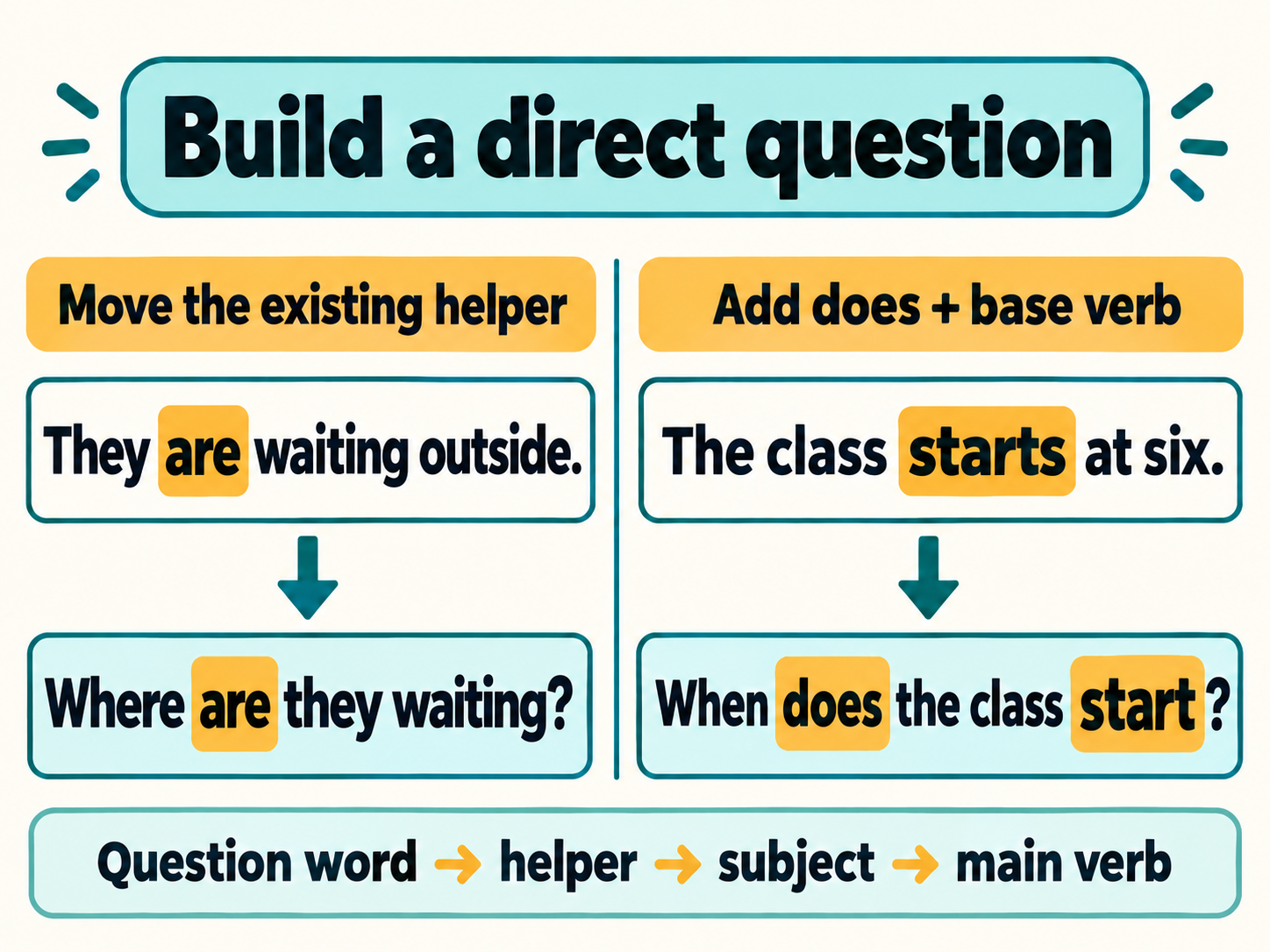
Diagram examples: “They are waiting outside.” → “Where are they waiting?” Move the existing auxiliary are before they; keep waiting. “The class starts at six.” → “When does the class start?” Add does before the class and change starts to base start. In both information questions, the order is question word, helper, subject, then main verb.
Say the result once to check it. “Where / have / you / put the keys?” has the perfect helper have and participle put. “Why / did / the organiser / change the room?” has did and base change. “How / can / we / get there?” has modal can and base get. A long subject is still one unit: “What time does the evening pottery course finish?” Do not split the subject by putting does inside it.
Exceptions and boundaries
If who or what is itself the subject, the ordinary pattern is different: “Who called?” asks which person performed the action. “Who did you call?” asks which person received your call. The dedicated subject-and-object-question guide develops that contrast. Do not insert did into a neutral subject question just because you see who.
This page teaches direct questions. Embedded questions such as “Do you know where the room is?” use a different order inside the second clause. Question tags such as “The room is open, isn’t it?” check or confirm a statement. Keep those patterns separate while you learn the direct-question path.
Reorder and diagnose
Questions 1–4: choose the correctly formed direct question. Questions 5–8: type the words in the correct order. Questions 9–12: correct the question while keeping its intended meaning. Capital letters and a final question mark make your written question easy to read.
Answer on paper, then open the explanations below. Enable JavaScript to check answers here.
Ask a real information question
Choose a real activity you might enjoy. Write one question about a missing fact and one yes/no question. First identify the likely statement, then choose its helper. Finally check that your question would produce useful new information rather than repeat a fact you already know.
Your turn · self-review
Use it yourself
Make your own answer before opening the model. Other accurate answers are possible. Use the checklist to review meaning and form.
Practice only. Your writing stays on this page; it is not submitted or saved.
-
Model answer and explanation
How much does the gardening session cost? What time does it finish? Self-check: each question targets a missing fact; does precedes the subject; cost and finish are base forms. “What is the price?” is also accurate and uses be.
Next, use this method with a deliberately incomplete pottery-course listing in “Before You Join the Course: Ask for the Missing Details”. Return to the decision tree whenever you add a helper or change the main verb.
Related Guides





Continue learning this topic
Review an explanation, study examples or try a related practice test.
- Practice test Pope Leo XIV to Have Surgery for Small Lung Nodule — B1 English Listening Practice Test
- Practice test Pope Leo XIV to Have Surgery for Small Lung Nodule — B1 English Grammar Practice Test
- Practice test Pope Leo XIV to Have Surgery for Small Lung Nodule — B1 English Vocabulary Practice Test
- Course lesson Present simple questions and negatives – A1–A2: Grammar Foundations
- Course lesson Reporting questions and requests – B1–B2: Grammar in Context
- Course lesson Past questions and negatives – A1–A2: Grammar Foundations