
Guide
B1 · Intermediate
Grammar
Make vs Do: Rules, 24 Collocations and 12 Exercises
Learn when to use make or do with 24 common collocations, example sentences and 12 exercises with answers. Compare meanings, fix mistakes and check verb forms.
8 min read
1,376 words
Updated Oct 10, 2026
On this page (17 sections)
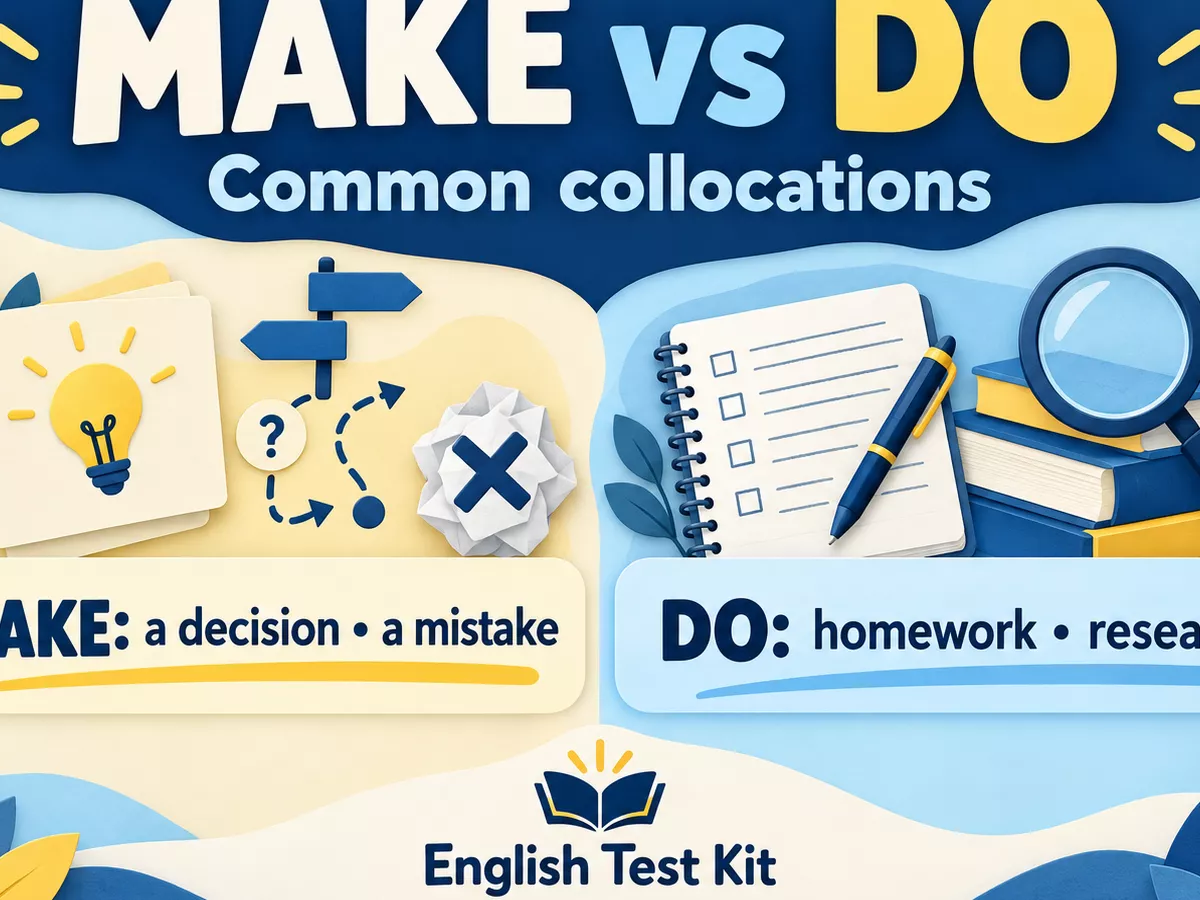
Use do homework and do research, but make a decision and make progress. Do often describes an activity; make often describes a result, though the pattern has exceptions. This B1 guide compares 24 common make and do collocations with meanings and examples, then gives you 12 exercises with explained answers.
A useful starting point, not a complete rule
Do often focuses on an activity or task: do homework, do research, and do the laundry. Make often focuses on producing something or reaching an outcome: make coffee, make a plan, and make a decision. This distinction helps you notice patterns, but it cannot predict every phrase. Learn each combination in context.
For example, make the bed means arrange its sheets and blankets, not construct a new piece of furniture. Do your best means try as hard as you can. Both are useful expressions to learn as complete units.
Common collocations with make
Collocation | Meaning | Example |
|---|---|---|
make a decision | choose what to do | We must make a decision before Friday. |
make a mistake | do something incorrectly | I made a mistake in the address. |
make an effort | try hard | She made an effort to learn everyone’s name. |
make progress | improve or move forward | Regular practice helps you make progress. |
make a plan | decide future steps | Let us make a plan for our group project. |
make a suggestion | offer an idea | Can I make a suggestion about the lesson? |
make a promise | say you will definitely do something | Do not make a promise you cannot keep. |
make a phone call | telephone someone | I need to make a phone call before we leave. |
make a list | write a set of items | Make a list of the things you need. |
make coffee | prepare coffee | I make coffee before the first meeting. |
make the bed | arrange the bed covers | He makes the bed each morning. |
make a difference | have a meaningful effect | Your encouragement can make a difference. |
Common collocations with do
Collocation | Meaning | Example |
|---|---|---|
do homework | complete school tasks | I do homework after dinner. |
do research | investigate a subject | The students did research about local history. |
do the housework | complete household cleaning tasks | We share the housework at the weekend. |
do the laundry | wash clothes | I need to do the laundry tonight. |
do the shopping | buy the things you need | My brother does the shopping on Saturdays. |
do the dishes | wash plates and other eating utensils | Let us do the dishes after lunch. |
do some exercise | be physically active | I do some exercise before work. |
do your best | try as hard as you can | Just do your best in the interview. |
do someone a favour | help someone with a task | Could you do me a favour? |
do a job | complete a piece of work | He did a good job repairing the chair. |
do business | carry out commercial activities | The company does business with local shops. |
do harm | cause damage or injury | Careless advice can do harm. |
Same situation, different meaning
Situation | What you say | Meaning |
|---|---|---|
Breakfast | make breakfast / have breakfast | Make means prepare the meal; have means eat it. |
A course project | do research / make a presentation slide | Do refers to investigating; make refers to creating a slide. |
A room | do the housework / make the bed | The phrases describe related household tasks but use different verbs. |
An agreement | make a promise / keep a promise | Make refers to giving your word; keep refers to doing what you promised. |
Common mistakes
Say do homework, not make homework; make a mistake, not do a mistake; and make progress, not do progress. Homework, research, and progress are uncountable in these phrases. Say some homework, some research, or good progress rather than a homework, a research, or a progress.
Change the grammar, keep the partnership
Verb | Present | Past simple | Past participle | -ing form |
|---|---|---|---|---|
make | make / makes | made | made | making |
do | do / does | did | done | doing |
The noun stays in the collocation while the verb changes: “She makes a plan”, “She made a plan”, and “She has made a plan”. When do is also a question helper, both forms can appear: “Did you do your homework?” Did marks the past; the main verb after it is do, not did.
Practice: 12 questions
Exercise 1: choose make or do (1–6)
Complete each sentence with make or do in the base form.
Answer on paper, then open the explanations below. Enable JavaScript to check answers here.
Exercise 2: use the correct verb form (7–12)
Use make or do in the form needed by the sentence. Pay attention to the time expression and the subject.
Answer on paper, then open the explanations below. Enable JavaScript to check answers here.
Answers and explanations
Complete each exercise and choose Check my answers to reveal its answers and explanations. You can also open the complete answer key below for self-study.
Show the complete answer key (1–12)
Check the reason as well as the answer. For rewriting tasks, the answers are models; another natural sentence with the same meaning may also be correct.
Answers 1–6
do — Homework is work you do. It is uncountable: not a homework.
make — Make a decision means choose between options.
do — Do someone a favour means help them with a small task.
make — The usual phrase is make a mistake or make mistakes.
do — Research is an activity you do; no a is needed before research here.
make — Make an effort means try hard to do something.
Answers 7–12
did — Do the laundry is the phrase; yesterday requires past simple did.
makes — Make coffee means prepare it; she takes the third-person form makes.
made — Make progress is the phrase; last month requires made.
did — Do your best means try as hard as you can; yesterday requires did.
doing — Are requires the -ing form doing in this present continuous sentence.
done — Have already takes the past participle done; do the shopping is the expression.
Frequently asked questions
What is the difference between make and do?
Do often focuses on an activity or task, while make often focuses on a product or result. The distinction is a useful guide, not a rule for every expression: learn make the bed and do your best as complete phrases.
Is it make homework or do homework?
Use do homework. Homework is uncountable, so you can say I did my homework or I did some homework, not I made a homework.
How do make and do change in the past?
The past simple and past participle of make are both made. For do, use did in the past simple and done after have or has: I did the shopping; I have done the shopping.
Build your own make-and-do notebook
Choose three make expressions and three do expressions. Write one true sentence for each. Then turn two sentences into the past and two into questions. Check the phrase and the grammar separately.
Continue with 50 Common Collocations in English
Related Guides





Continue learning this topic
Review an explanation, study examples or try a related practice test.
- Practice test Higher borrowing costs make homes, cars and education harder for many households to afford — B2 English Listening Practice Test
- Practice test Higher borrowing costs make homes, cars and education harder for many households to afford — B2 English Grammar Practice Test
- Practice test Higher borrowing costs make homes, cars and education harder for many households to afford — B2 English Vocabulary Practice Test
- Course lesson Rules, necessity and advice – A1–A2: Grammar Foundations