
Guide
B2 · Upper-intermediate
Grammar
Would Rather, Would Prefer and It’s Time: Preferences and Action
Choose would rather, would prefer and it is time patterns by subject relationship, intended time and conversational purpose.
9 min read
1,480 words
Updated Oct 21, 2026

On this page (9 sections)
B2 · 26 minutes · 8 explained checks. Work through the examples, try the questions, then use the final checklist. All people, venues and notices in this resource are fictional.
Choose the preference, the person and the time
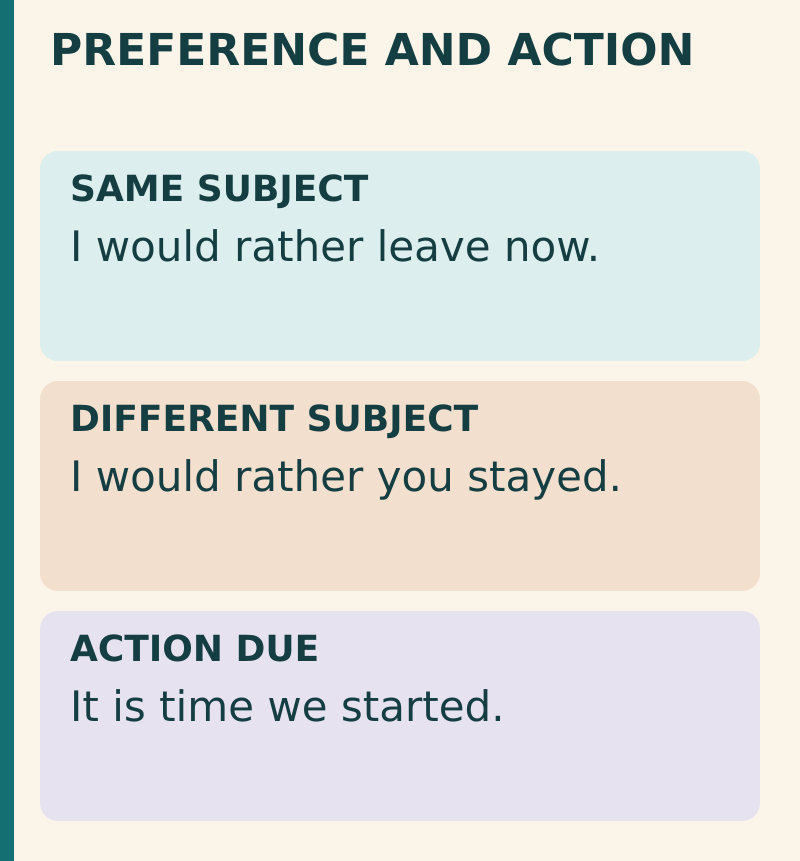
Would rather, would prefer and it is time help us discuss choices and actions. Their forms depend on who acts and what the speaker means. “I would rather leave now” expresses my preference about my own action. “I would rather you stayed” expresses my preference about your action. “It is time we left” says that leaving is due now.
The past form in stayed or left does not necessarily refer to a past event. In these patterns it can mark a present or future preference or the speaker’s view that action is due. Establish the context first. This focused reference covers preferences and timely action; wishes and past regrets are a separate topic. Do not choose a tense simply because the word tomorrow or yesterday appears somewhere nearby.
Same subject: would rather + base form
When the person expressing the preference is also the person doing the action, use would rather plus a base verb: “I would rather work at home today.” In conversation, I’d rather is common. For a negative preference, put not before the main verb: “I’d rather not stay late.” Do not add to or an -ing ending in this pattern.
Use than to compare actions: “I’d rather walk than take the bus.” The second action also uses a base form. You can omit an obvious repeated verb: “I’d rather have tea than coffee.” A preference does not automatically mean the other option is impossible or forbidden. It tells the listener which choice the speaker favours in the current context.
Different subject: would rather + past clause
When you prefer someone else to do something, use a clause with that person as its subject: “I’d rather you called tomorrow.” The past form called expresses a preference about tomorrow, not a report of yesterday’s call. A negative is “I’d rather you didn’t call during the meeting.” The subject you belongs inside the preference clause.
Compare “I’d rather not call” with “I’d rather you didn’t call.” In the first, I would be the caller; in the second, you would. This subject check prevents an apparently small edit from changing the requested action. Different varieties and registers may use other preference constructions, but the past-clause pattern is a dependable model for this present/future meaning. A past-perfect clause can express an earlier preference or regret, but it is outside this lesson’s practice scope.
Would prefer: infinitives and explicit actors
Would prefer commonly takes a to-infinitive for a specific choice: “I’d prefer to meet on Tuesday.” With another person’s action, an object plus to-infinitive is useful: “I’d prefer you to send the notes first.” Put not before the infinitive when negating that action: “I’d prefer you not to call during the meeting.” Do not transfer the bare-infinitive rule from would rather into would prefer.
A clause alternative is also natural: “I’d prefer it if you sent the notes first.” Present forms occur in some contexts, but the past form is a useful polite model. For general preferences, prefer can take nouns or -ing forms, as in “I prefer tea to coffee” and “I prefer walking to driving.” This guide’s specific-action exercises mainly use would prefer + to so that the comparison with would rather stays clear.
Compare alternatives without mixing frames
Two reliable patterns are “I’d rather leave early than stay late” and “I’d prefer to leave early rather than stay late.” In the second, rather than introduces the less preferred alternative; would prefer still selects to leave. Another valid phrasing is “I’d prefer an early departure to a late one,” where the comparison uses noun phrases.
Do not force every natural preference into one identical shape. “I’d prefer not to travel tonight” and “I’d rather not travel tonight” express similar practical choices with different verb frames. The purpose of comparison is to choose a well-formed pattern while keeping actor, action and contrast unchanged. It is not to rank one expression as always more polite than another.
It is time: action due now
“It is time to start” directly says the moment for starting has arrived. “It is time we started” uses a past clause with present relevance and can suggest that the action is due or overdue. “It is time for us to start” makes the actors explicit in a for + object + to-infinitive pattern. These are different grammatical routes to a similar practical message.
“High time” and “about time” can add stronger criticism or impatience, depending on context. A colleague who says “It’s about time you replied” may sound more pointed than someone asking “Could you reply today?” Tone, relationship and situation matter; no structure guarantees courtesy. When giving another adult a preference rather than an instruction, make room for their response. “I’d prefer to meet earlier, if that works for you” clearly presents a choice.
Eight checks and a time/subject audit
For every sentence, identify who has the preference, who performs the action and when it should happen. Then select the frame: rather + base for the same subject; rather + subject + past form for another subject’s present/future action; prefer + to-infinitive or object + to-infinitive; time + past clause or to-infinitive.
Finally inspect the negative. “I’d rather you didn’t leave” is a preference for your staying. “I’d prefer not to leave” is a preference about my own departure. If a rewrite changes the person or reverses the negative, it fails even if its grammar is smooth. The questions below keep contexts explicit so the intended answer does not depend on guessing an unstated relationship.
Check your understanding
Choose the best answer for the stated purpose. In short answers, type only the requested words. For open rewrites, compare meaning as well as form: other well-formed answers may be possible. Each submitted answer reveals an explanation.
Answer on paper, then open the explanations below. Enable JavaScript to check answers here.
Your final check
Read the complete sentence or source again. Check the actor, action, time, quantities, conditions and intended meaning. Explain why your version works rather than memorising its surface form. Revisit any question whose explanation differs from your reasoning.
Optional next step: explore wish, if only and regrets in the existing grammar course. This guide has focused on preferences and action due now.
Related Guides






Continue learning this topic
Review an explanation, study examples or try a related practice test.
- Practice test Difficult times in agriculture are making it tough for the next generation of farmers — C2 English Listening Practice Test
- Practice test Difficult times in agriculture are making it tough for the next generation of farmers — C2 English Grammar Practice Test
- Practice test Difficult times in agriculture are making it tough for the next generation of farmers — C2 English Vocabulary Practice Test
- Course lesson Future time clauses – B1–B2: Grammar in Context
- Course lesson Checkpoint: time and possibility – B1–B2: Grammar in Context
- Course lesson Unreal time and preferences – C1: Precision and Expression