
Guide
B1 · Intermediate
Grammar
Compound Nouns: Coffee Cups, Bus Stops and Other Everyday Things
Understand everyday compound nouns by finding the head, checking purpose versus contents and forming clear plurals. Includes ten explained checks.
7 min read
1,186 words
Updated Oct 29, 2026

On this page (7 sections)
1. Find the main thing
A compound noun combines words to name one thing, person, place or idea. In bus stop, the main thing is a stop. Bus tells you what it is for. A shoe shop is a shop, not a shoe. A coffee cup is a cup, not a kind of coffee.
In many everyday noun + noun compounds, the final noun is the head: the word that names the main thing. Start at the end, then ask how the earlier word helps identify it. This is a useful pattern, not a rule that explains every English compound.
2. What does the first noun tell you?
The first noun can show purpose: a coffee cup is designed for coffee; a coat rack holds coats. It can show material: a paper bag is made of paper. It can show a usual location or connection: a kitchen table is a table used in a kitchen.
To see another type of word partnership, compare compound nouns with common collocations.
The relationship is not always predictable. A bus driver drives a bus, but a bus ticket does not drive anything. Learn the whole phrase with a short definition. Do not translate every compound by putting of between its words; that can change the meaning.
3. Compound or of phrase?
Purpose, material or contents?
a coffee cup
A kind of container
The empty coffee cup is on the shelf.
a cup of coffee
A serving or contents
I ordered a cup of coffee.
a paper bag
A bag made of paper
This paper bag is empty.
a bag of paper
A bag containing paper
The bag of paper contains scraps for recycling.
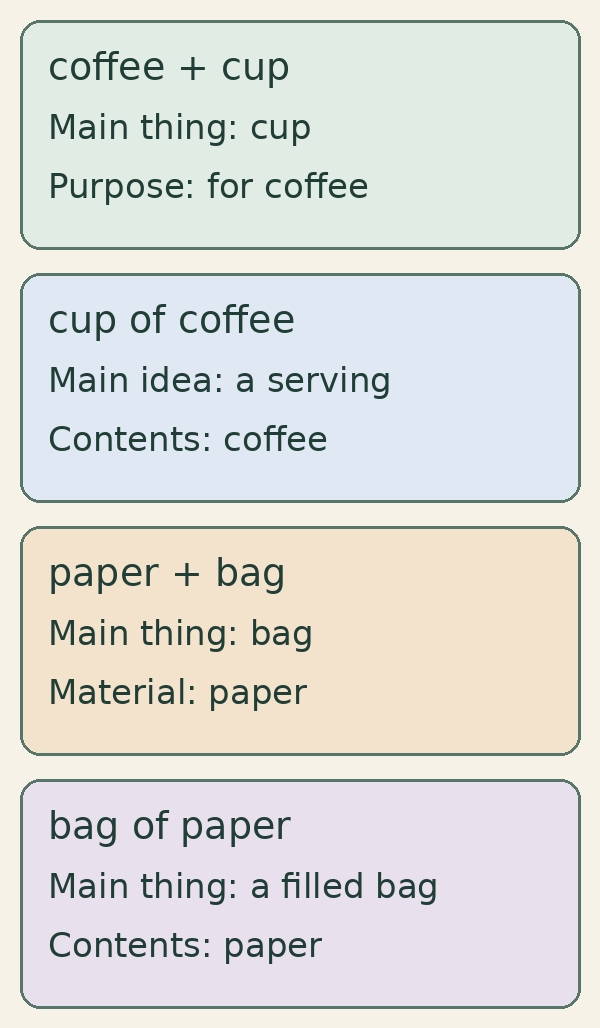
A coffee cup can be empty or contain another drink. Its usual purpose helps name the object. A cup of coffee normally means a quantity or serving of coffee. Similarly, a paper bag need not contain paper. Keep the physical object and its contents separate when writing labels.
An of phrase is not always wrong. It is often exactly what you need to describe contents: a box of pencils, a bowl of soup. Decide what you mean rather than choosing a shorter phrase automatically.
4. Singular modifiers and plural heads
The noun modifier usually stays singular while the head becomes plural: two bus stops, three shoe shops, six coffee cups. In three bicycle repair stations, stations is the plural head. Bicycle helps describe the type of repair; it does not become bicycles.
There are established exceptions with plural-looking modifiers, including sports centre and clothes shop. Do not turn a useful tendency into “the first noun can never end in s”. Check a learner’s dictionary when a phrase is unfamiliar. A spelling you have seen in a shop name may also be a special business name rather than a model for ordinary grammar.
5. Spelling and useful stress clues
Compounds can be open, closed or hyphenated: bus stop, toothbrush, check-in. Spacing is partly a dictionary and house-style matter, and some forms vary. Teacup is commonly written as one word; tea cup also occurs. Copy a reliable current dictionary form consistently rather than inventing a spelling rule from one example.
Many common compounds have stronger stress on an earlier part, but this is a tendency, not a reliable test for every compound. Meaning, context and dictionary information matter too. This reading guide does not ask you to identify a compound from stress alone. When practising pronunciation, use the dictionary’s recording or an established word-stress lesson.
6. Build and check noun phrases
Use meaning, word order and the head noun to answer ten checks.
Answer on paper, then open the explanations below. Enable JavaScript to check answers here.
7. Make labels that help readers
For a useful label, name the main thing first in your thinking. Ask what sort of thing it is, choose a familiar compound, then check the plural head. Before publishing a new or unfamiliar label, check its spelling and meaning in a learner’s dictionary.
Try this edit: “two bicycles repair stations” → “two bicycle repair stations”. Stations is the main noun and takes the plural ending. Bicycle tells the reader what is repaired. A longer phrase, “two stations for repairing bicycles”, is also clear. A compound is not always the only good answer.
The paired workshop lesson asks you to label actual places and containers from a setup note. Use the head-noun test, but also check the purpose or contents. A grammatically neat label still needs to name the right thing.
Related Guides






Continue learning this topic
Review an explanation, study examples or try a related practice test.
- Practice test First-Time Homebuyers Are Scarce, but More Are Paying Cash — B1 English Listening Practice Test
- Practice test First-Time Homebuyers Are Scarce, but More Are Paying Cash — B1 English Grammar Practice Test
- Practice test First-Time Homebuyers Are Scarce, but More Are Paying Cash — B1 English Vocabulary Practice Test
- Course lesson Subject pronouns and possessives: I and my – A1–A2: Grammar Foundations
- Course lesson Plural and uncountable nouns: One, two or some? – A1–A2: Grammar Foundations