
Guide
B2 · Upper-intermediate
Grammar
Advanced Comparisons: Much Better, Twice as Fast and The More
Express the size of a difference, proportion and linked change accurately.
10 min read
1,678 words
Updated Oct 31, 2026
On this page (12 sections)
B2 • About 23 minutes. Use much/far/a little/slightly with comparatives and by far with superlatives. Express transparent proportions using twice/half as...as without ambiguous times-more wording. Describe gradual change with comparative + and + comparative. Use the comparative..., the comparative... for linked changes without claiming causation.
How large is the difference?
A basic comparative tells you which of two things has more of a quality: faster, quieter, more comfortable. A modifier tells you how large the difference seems: slightly faster, much quieter, far more comfortable. Begin with a clear comparison base. “The new route is faster” leaves the reader asking faster than which route, at what time and by what measure.
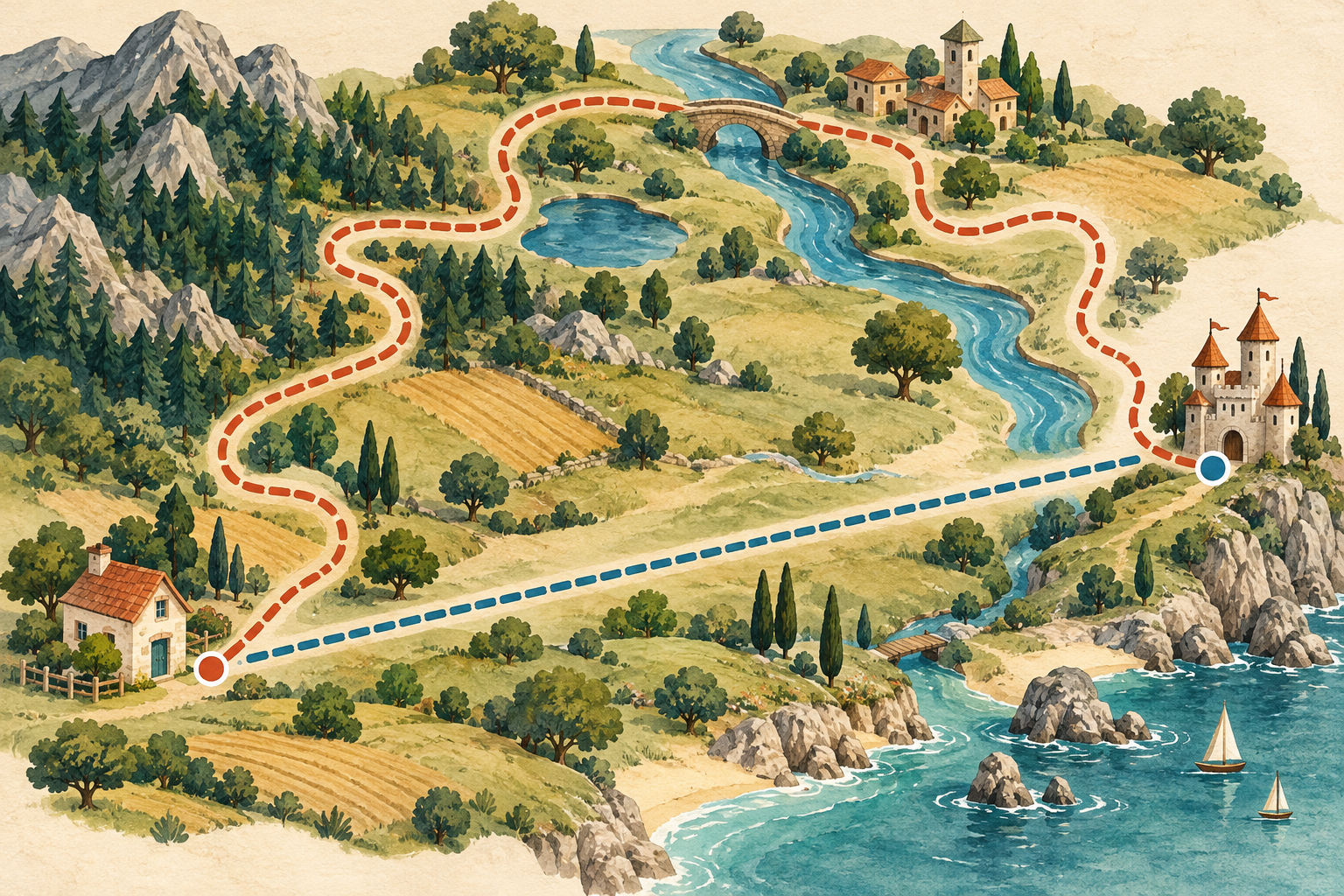
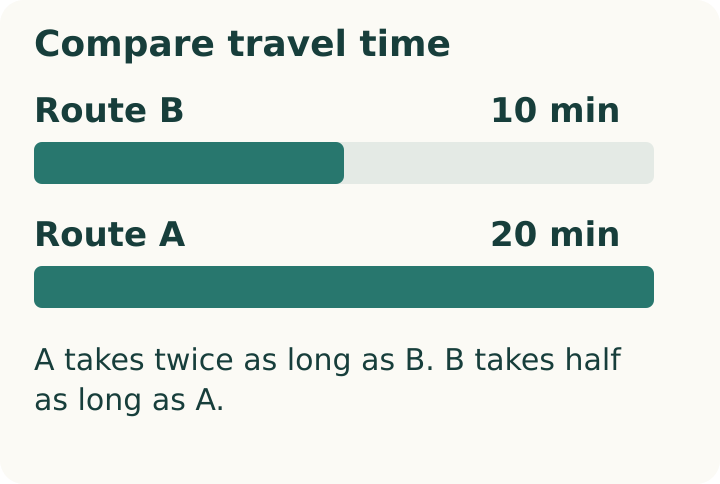
Use fictional journey times: Route A takes twenty minutes, Route B takes ten, and Route C takes nineteen. C is a little quicker than A; B is much quicker than A. Slightly, a little and a bit suggest a small difference. Much, far and a lot can emphasise a larger difference. These words are not fixed mathematical bands, so more than one modifier may be reasonable in a context.
If precision matters, give the numbers. “Route B takes ten minutes, compared with twenty for Route A” tells the reader more than “Route C is much better”. Better could mean time, scenery, accessibility or price. Name the quality being compared before deciding how strongly to describe it.
Modifiers and form boundaries
Use much better or far better with a comparative. Very normally modifies a plain adjective: very good, very quiet. Do not combine the ordinary frames into very better or much good. With a superlative, by far can emphasise the gap: “This is by far the quietest room.” It is not the same frame as far quieter than the other room.
Comparatives formed with more take the modifier before more: much more comfortable, slightly more expensive, far more detailed. Do not add another comparative marker to a form that already has one: much easier, not much more easier. Some adjectives allow alternative comparative forms, but that does not license stacking two markers together.
Compare too and enough with these modifiers. “The bag is much heavier” describes a difference. “The bag is too heavy for this shelf” says a limit is exceeded. A large difference does not automatically mean something is unsuitable, and a small difference can still cross a strict limit. State the limit separately when it matters.
Proportional comparisons: keep the quantity visible
If Route A takes twenty minutes and Route B takes ten, A takes twice as long as B. B takes half as long as A. The base changes when the direction changes: twenty divided by ten is two; ten divided by twenty is one half. Write the comparison in words after checking the arithmetic.
Use the transparent frame twice/three times/half as + adjective or adverb + as. “The new waiting time is twice as long as the old one” compares duration. “The machine processes twice as many cards as before” compares a count over a stated period. Both the quantity and the comparison period must match. If Machine X sorts twenty cards per minute and Machine Y sorts ten in the same test, X is twice as fast as Y at that task.
Avoid using “twice as fast” as a careless substitute for “twice as long”. A twenty-minute wait is longer than a ten-minute wait, not faster. Speed, time and distance are different quantities. If you do compare speed, make sure the task and distance are comparable; this guide’s ratio exercises stay with minutes or counts.
Expressions such as “two times more” can be interpreted inconsistently. “Twice as many” or “an increase from five to ten” is easier to audit. For a practical update, transparent wording is more valuable than a compact phrase whose mathematical meaning is disputed.
Change over time
Repeated comparatives describe a developing trend: busier and busier, colder and colder, more and more crowded. “The café became busier and busier between ten and noon” describes gradual change across that interval. Do not add than to this pattern: busier and busier than is not the intended trend frame.
Use a sequence rather than two unrelated impressions. At ten, a fictional café has four people in its queue; at eleven, eight; at noon, sixteen. In that observed period, the queue gets longer and longer. If the next observation falls to three, an account of the whole period needs to mention the reversal instead of claiming uninterrupted growth.
Choose the form that matches the adjective: longer and longer, more and more crowded. More and more people describes an increasing number directly. Fewer and fewer empty seats describes a decreasing count. Be explicit about whether you are discussing people, minutes, seats or an impression of crowding.
Linked change: the more … the more
The + comparative clause can link two changing quantities: “The longer the queue grew, the longer the wait became.” “The earlier we leave, the quieter the roads usually are” connects departure time with an observed pattern. Each half needs an appropriate comparative; the two forms do not have to be the same word.
Compare increasing and decreasing quantities: “The busier the café became, the fewer empty seats there were.” Fewer suits a countable plural, seats. “The more carefully we read, the less likely we are to miss a detail” uses more carefully for an action and less likely for an outcome. The first the is part of the linked-comparative construction, not an ordinary definite article.
The construction can sound like a rule, but grammar does not establish cause. A short observation log may show a queue growing while waits increase. It does not prove that queue length alone caused every extra minute. Use “In these observations…” or “During this period…” to keep a limited pattern from becoming an unsupported universal claim.
Precision and comparison repairs
“The café was twice as fast at eleven” is unclear if the evidence is waiting time. Replace it with “The wait at eleven was twice as long as at ten.” “The queue was longer than ten minutes” compares a number of people or physical length with duration. Name the same quantity on both sides: “The wait was longer than ten minutes” or “The queue had more than ten people.”
“This route is better” may be adequate if everyone already knows that travel time is the criterion. In a standalone report, add the base and measure: “This route is quicker than Route A in the morning.” Check that both observations use the same conditions before implying a reliable advantage.
Finally, separate three layers: the observed numbers, the grammatical comparison, and the conclusion. Numbers can support a ratio without supporting a cause. A valid comparative can describe the data without predicting tomorrow. Write only the conclusion the evidence can carry.
Eight checks: apply the rule
Answer before you check. For typed answers, use the requested wording; valid listed variants are accepted. Read the explanation even if your answer is right.
Choose a modifier and frame
Answer on paper, then open the explanations below. Enable JavaScript to check answers here.
Interpret the proportion
Answer on paper, then open the explanations below. Enable JavaScript to check answers here.
Link change accurately
Answer on paper, then open the explanations below. Enable JavaScript to check answers here.
Your decision card
Measure → base → degree or ratio → time window → evidence limit. 20 minutes versus 10: twice as long. 10 versus 20: half as long. Linked change describes an observed pattern; it does not automatically prove a cause.
Related learning
Companion resource: As the Queue Grew: Comparing Degree and Change.
Related references for further study: Comparatives and Superlatives: Comparing Everyday Choices; Too and Enough: Describing Limits and What You Need; Hedging and Degrees of Certainty.
Related Guides






Continue learning this topic
Review an explanation, study examples or try a related practice test.
- Practice test Places Around Town Words — A1 English Vocabulary Practice Test
- Practice test Clothes and Weather Words — A1 English Vocabulary Practice Test
- Practice test Finding the Library on Green Street — A1 English Listening Practice Test
- Course lesson Advanced passives: Reporting beliefs and expectations – C1: Precision and Expression
- Course lesson Some, any, much and many: Talking about quantity – A1–A2: Grammar Foundations
- Course lesson Concession: Much as, however and no matter – C1: Precision and Expression