
Guide
B2 · Upper-intermediate
Listening
Polite Disagreement and Diplomatic Language
Disagree clearly and respectfully in English. Acknowledge concerns, explain reasons, offer alternatives and keep necessary boundaries.
9 min read
1,512 words
Updated Nov 5, 2026

On this page (7 sections)
Be clear about the point you disagree with
A constructive disagreement gives the other person something specific to respond to. ‘That’s ridiculous’ judges the idea without explaining the problem. ‘I’m concerned that the timetable leaves no time to test the equipment’ identifies a practical issue. You can disagree firmly while keeping the focus on the proposal, evidence or consequence rather than making a judgement about the person who suggested it.
Diplomatic language is not a promise to agree, and it does not guarantee that the other person will react well. Its purpose is to make your position understandable while leaving room for discussion. The amount of directness you need depends on your relationship, the setting, urgency and the consequences of a mistake. A quick safety warning should not be hidden inside a long polite introduction.
Acknowledge a real point
An acknowledgement shows that you have understood part of the other person’s view. ‘I can see why a shorter event would be easier to organise’ recognises a reason without accepting the whole plan. ‘You’re right that the smaller room costs less’ agrees with one specific fact. Only say this if you believe the fact is correct. False praise or fake agreement can make the disagreement less honest.
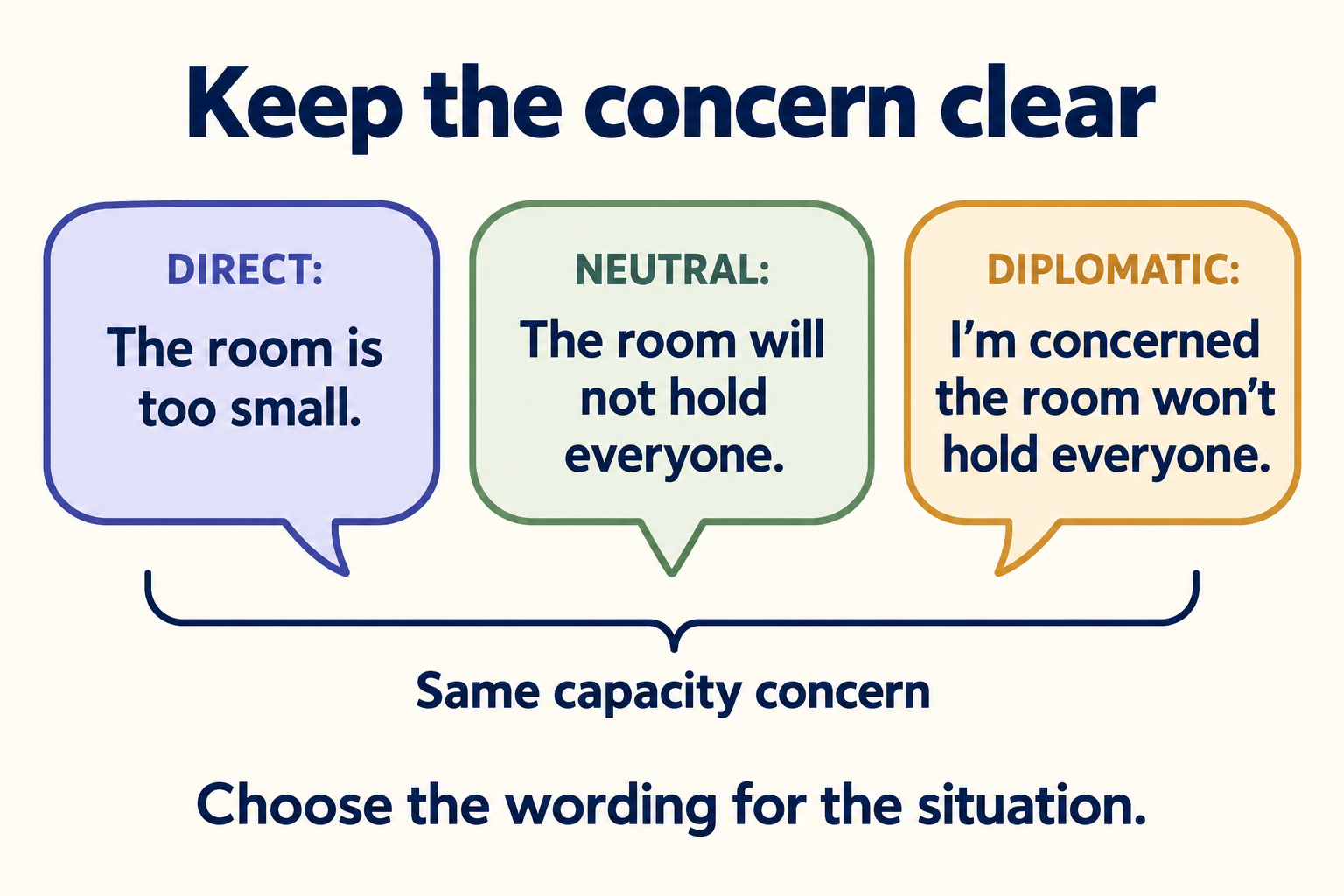
Follow the acknowledgement with your concern: ‘My concern is that it won’t hold everyone.’ But can introduce the contrast, but it is not obligatory: ‘I understand the cost issue. I’m worried about capacity.’ Do not memorise one long sentence and use it in every situation. Brief, natural language often sounds more respectful than an elaborate formula that avoids naming the problem.
State a reason with the right strength
Useful openings include ‘I’m not sure that will work because…’, ‘I see it differently…’ and ‘I don’t think that option meets our needs.’ Choose the one that reflects your position. If you are certain that a deadline is impossible, ‘I’m not sure’ may understate the problem. ‘We cannot finish the checks by Tuesday’ is clearer. You can add a calm explanation rather than weakening the message until its meaning is lost.
Separate an observation from an assumption about motives. ‘The plan includes no breaks’ is something the group can check. ‘You don’t care about the volunteers’ makes a personal accusation that may be unsupported. Ask about the design before judging intention: ‘Could we include a break between sessions?’ The question proposes a concrete improvement and lets the other person explain a constraint you may not know about.
Use questions and alternatives honestly
A genuine question invites an answer: ‘How would we manage the extra guests?’ It is different from a disguised insult such as ‘Did you even think about the guests?’ The grammar alone does not make a question diplomatic. Tone, wording and whether you are willing to hear the answer all affect how it is received. For difficult conversations, prepare the actual information you need before choosing the phrase.
Offer a workable alternative where possible: ‘Could we use the larger room for the first hour and move outside afterward?’ or ‘What if we invite fewer people for a trial session?’ Explain how it addresses the concern. You do not have to supply a solution to every unacceptable request, but a relevant option can help a group move from competing positions toward a decision.
Keep a boundary visible
Some situations need a clear limit: ‘I can help on Saturday morning, but I’m not available in the evening.’ That statement is courteous and direct. If someone continues to press, repeat the boundary rather than adding weaker and weaker possibilities: ‘I understand that you need more help. My availability is still Saturday morning only.’ An acknowledgement does not cancel the limit.
Do not use maybe when you mean no. ‘Maybe I could stay late’ can sound like an offer. If you have not agreed to the task, say what is and is not possible. In professional situations, explain practical constraints without sharing private information you do not want to disclose: ‘I can complete either the poster or the booking form today. Which should take priority?’
Listen to delivery, then adapt
The tone-comparison clips use paired responses to the same concern. A slower pace, an even volume and a pause can support a thoughtful response, but there is no single universal ‘polite voice’. Cultural expectations and individual communication styles vary. Do not treat a speaker’s accent as evidence that they are rude. Judge the words, the conversational situation and what the response accomplishes.
Listen and learn
Comparison 1: a room-capacity concern
Open audio separatelyRead the transcript
Direct: No. That room is too small.
Diplomatic: I can see why the room is convenient. I am concerned that it will not hold everyone.
Listen and learn
Comparison 2: a deadline concern
Open audio separatelyRead the transcript
Direct: We cannot finish by Tuesday.
Diplomatic: I do not think Tuesday gives us enough time for the checks. Could we aim for Thursday?
Listen and learn
Comparison 3: an availability boundary
Open audio separatelyRead the transcript
Direct: I am not available on Sunday.
Diplomatic: I understand you need help. I am not available on Sunday, but I can help on Saturday morning.
When you practise, keep four elements in view: a truthful acknowledgement if useful, your actual position, a specific reason and a relevant next step. Not every response needs all four. After speaking, give the other person time to answer. You can then summarise the remaining difference: ‘We agree on the budget; we still need to decide how many sessions it can support.’ This keeps the discussion focused without pretending it is resolved.
Check your understanding
Try each item before opening the answer. Read the explanation even when your answer is correct.
Answer on paper, then open the explanations below. Enable JavaScript to check answers here.
Your turn · self-review
Apply it and compare
Write or say your own answer first. The models are examples, not the only acceptable answers. Use the checklist to review your work; open responses are not automatically assessed.
Practice only. Your writing stays on this page; it is not submitted or saved.
-
Model answer and explanation
“I don’t think we can run three sessions with the volunteers available. Could we run two shorter sessions instead?” This removes the insult but preserves the disagreement and reason.
-
Model answer and explanation
“I understand that there is a lot to finish. I can stay until six, but I’m not available after that. I can complete the labels before I leave.” Only offer the labels if that is genuinely feasible. Self-check: clear limit, relevant reason or context, no false agreement, no personal judgement.
Related Guides






Continue learning this topic
Review an explanation, study examples or try a related practice test.
- Practice test At the University of Maryland, a historic campus farm remains a classroom — C2 English Listening Practice Test
- Practice test At the University of Maryland, a historic campus farm remains a classroom — C2 English Grammar Practice Test
- Practice test At the University of Maryland, a historic campus farm remains a classroom — C2 English Vocabulary Practice Test