
Guide
A2 · Elementary
Grammar
Adjective or Adverb? Describe People, Things and Actions
Choose adjectives for people and things and adverbs for actions. Practise linking verbs, good/well, fast and hard/hardly in twelve explained checks.
7 min read
1,140 words
Updated Oct 30, 2026

On this page (7 sections)
For more words to practise with, build a useful set of descriptive adjectives.
1. What is being described?
A careful driver drives carefully. Careful describes the person; carefully describes the action. To choose an adjective or an adverb, first ask what you want to describe. Do not add -ly simply because a word comes after a verb.
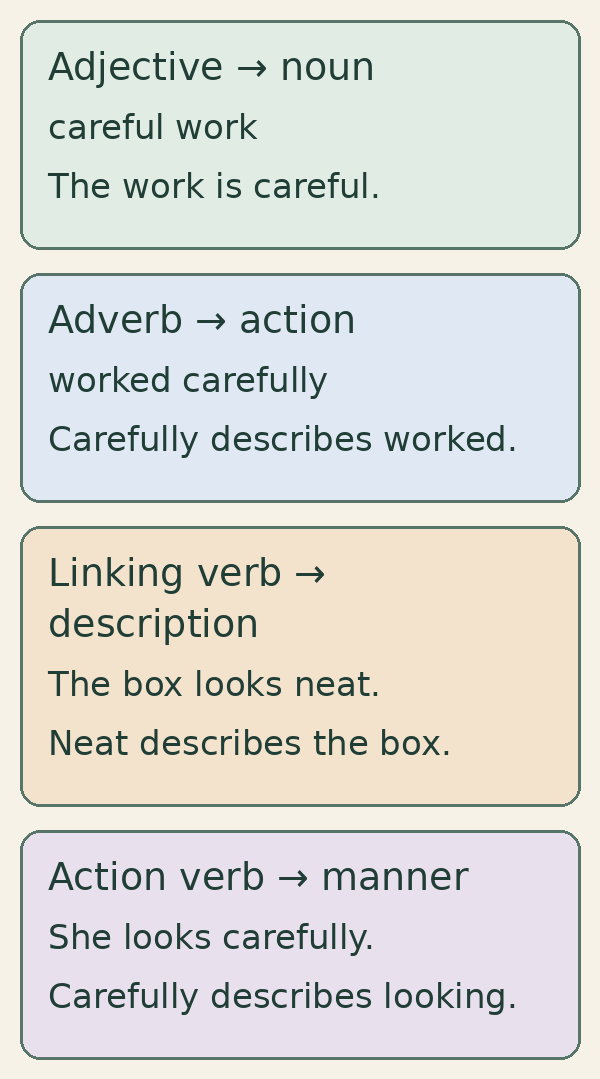
An adjective can describe a noun: careful work, a neat box, a slow bus. A manner adverb tells us how an action happens: work carefully, fold neatly, move slowly. The meaning comes first; then choose the form.
2. Form common manner adverbs
Many manner adverbs add -ly to an adjective: careful → carefully, quiet → quietly, slow → slowly. Some spellings change: easy → easily; happy → happily; gentle → gently. Learn a small useful set and practise the words in complete sentences.
Adjectives and adverbs do different jobs even when they share a meaning. “Her explanation was clear” describes the explanation. “She explained it clearly” describes the action. Do not write “a carefully explanation”: the noun needs an adjective here.
Not every word ending in -ly is an adverb. Friendly is usually an adjective: a friendly neighbour. To describe an action, a phrase such as in a friendly way is often useful. A dictionary can show the word’s class and a natural example.
3. Forms that need care
Good is usually an adjective and well is its common adverb partner: a good singer / sings well. Fast can be both: a fast train / moves fast. Do not add -ly to make fastly. Hard also has both jobs: hard work / works hard.
Hardly has a different meaning: almost not. “She works hard” means she puts in a lot of effort. “She hardly works” means she does almost no work. The ending changes the meaning, so these are not interchangeable.
Well can also be an adjective meaning healthy: “I am well.” That is a different use from “I write well.” This guide focuses on describing work and actions, but the health meaning explains why well can sometimes follow be.
4. After a linking verb
After a linking verb, an adjective often describes the subject: The soup smells good. The box looks neat. The learner seems tired. Here the verb connects the subject with a description; it does not name an action performed in a good or neat way.
The same verb can have another job. Compare “She looks tired” with “She looks carefully at the map.” Tired describes her condition. Carefully describes how she uses her eyes. In “She smells the soup carefully”, carefully describes an action; in “The soup smells good”, good describes the soup.
Ask what the word describes instead of learning “always adjective after looks”. The meaning of looks in the whole sentence matters.
5. Where the adverb goes
A safe position for a manner adverb is after the verb or its object: She spoke clearly. She folded the paper carefully. Avoid putting it between a verb and a short direct object: She folded carefully the paper is not the usual neutral order.
Other positions can be possible for emphasis or style: She carefully folded the paper. Do not assume every position sounds equally natural in every sentence. For everyday writing, start with the clear default and then check a reliable example if you want another position.
6. Choose meaning, then form
For each item, identify the thing or action being described.
Answer on paper, then open the explanations below. Enable JavaScript to check answers here.
7. Apply the distinction
Decision checklist: What is described? A noun or a subject after a linking verb usually needs an adjective. An action often needs an adverb. Is the form regular, or is it good/well, fast/fast or hard/hard? Does adding -ly change the meaning? Finally, check the word order.
Try a pair: The instructions are clear. The tutor explains the task clearly. The first sentence describes instructions; the second describes explains. Another pair is Her work is careful. She works carefully. Both versions can praise the same activity while using different grammar.
In feedback, describe what you can observe: folded neatly, clear instructions, a rough edge. The paired craft-workshop lesson practises precise comments about actions and results.
Related Guides






Continue learning this topic
Review an explanation, study examples or try a related practice test.
- Practice test Three People Injured in Shooting at Des Moines Post Office — B1 English Listening Practice Test
- Practice test Three People Injured in Shooting at Des Moines Post Office — B1 English Grammar Practice Test
- Practice test Three People Injured in Shooting at Des Moines Post Office — B1 English Vocabulary Practice Test
- Course lesson Adverbs of frequency: Always, sometimes and never – A1–A2: Grammar Foundations
- Course lesson Wish and if only: Regrets and things you'd change – B1–B2: Grammar in Context
- Course lesson Articles: General ideas, specific things and institutions – B1–B2: Grammar in Context