
Guide
C1 · Advanced
Reading
Hedging and Degrees of Certainty
Calibrate English claims to evidence with may, likely, appear and tend to. Distinguish findings, interpretations and forecasts without over-hedging.
8 min read
1,381 words
Updated Nov 6, 2026

On this page (7 sections)
Start with the evidence and the scope
A precise claim says what the available evidence supports, for whom and under which conditions. Hedging is language that limits a claim’s strength or scope when certainty is incomplete. It is not simply a way to sound academic. If a record shows that eighteen people attended a session, ‘Eighteen people attended’ can be appropriate. ‘Eighteen people may possibly have attended’ adds uncertainty that the record may not justify.
Before choosing a phrase, separate the observation from the interpretation. ‘Twelve of twenty respondents preferred the evening session’ reports a result within a named group. ‘Evening sessions are more convenient for residents’ interprets what the result means and extends it beyond those respondents. The second claim needs a limitation, further evidence or both. Adding might does not repair a misleading description of who was surveyed.
Use possibility words with a clear purpose
May, might and could commonly present a possibility: ‘The lower response rate may reflect the survey’s timing.’ The modal identifies an explanation that is plausible but not established. Other explanations remain possible. These words do not map neatly to fixed percentages, and their strength varies with context, emphasis and the rest of the sentence. Avoid a made-up rule such as ‘might always means a thirty-percent chance’.
The modal does not by itself explain why a claim is uncertain. Add the relevant limitation: ‘The new arrangement may help some commuters, although the survey did not ask about travel time.’ This tells the reader both the possible implication and the gap in the evidence. Do not accumulate may, perhaps, possibly and seems in one sentence unless each contributes a distinct meaning; usually one well-chosen qualifier is enough.
Distinguish likelihood from appearance
Likely and unlikely express a judgement about probability or expectation: ‘The hall is likely to be busy during the festival.’ That judgement should have a basis, such as previous attendance and current bookings. It is not a guarantee. Be likely to and it is likely that are useful patterns. Avoid treating likely as a more impressive replacement for may when the evidence does not support the stronger expectation.
Appear and seem mark an impression or an inference from available information: ‘The revised form appears easier to complete.’ The reader may ask: easier according to what evidence? A short usability trial can support ‘appeared easier for the trial participants’, but not automatically ‘is easier for everyone’. These verbs are useful when the observation is indirect or provisional; they should not hide whose judgement is being reported.
Use tend to for a pattern, not a single event
Tend to describes a general tendency while allowing exceptions: ‘Weekend visitors tend to stay longer than weekday visitors.’ A repeated pattern is needed to support it. One person staying for an extra hour does not establish a tendency. If you have only one observation, report that observation. If you have several observations from one small setting, keep the setting visible: ‘In this four-week trial, weekend visitors tended to stay longer.’
Quantifiers also change claim strength. All, none, always and never have broad scope and need suitable evidence. Some, several, many and most describe different amounts and should match the data. ‘Most respondents’ means more than half of the respondents; it does not mean most residents. Retain exact numbers when they help the reader assess a small sample. ‘Six of eight’ is often more informative than a confident-sounding percentage alone.
Keep cause separate from association
If satisfaction rose after a timetable changed, the sequence alone does not prove that the timetable caused the improvement. Staffing, weather, respondent differences or other changes may matter. ‘Satisfaction was higher in the later survey’ reports the comparison. ‘The new timetable may have contributed’ offers a possible explanation. ‘The timetable caused the increase’ requires a stronger design and evidence than two descriptive surveys usually provide.
A forecast is also different from a finding. ‘Respondents said they would attend’ reports stated intentions. ‘Attendance will rise’ predicts future behaviour. Intentions may support planning, but people may behave differently later. Use a forecast only with an appropriate signal: ‘Attendance could increase if these intentions translate into bookings.’ The condition tells the reader what still has to happen.
Calibrate the whole sentence
A good revision can narrow the population, name the time period, change the causal verb or add a limitation. Compare ‘The new system is better’ with ‘In the pilot, fourteen of nineteen users completed the task faster with the new system.’ The revised sentence is more confident about what was measured and more limited about everything else. Hedging is therefore not always a weaker verb; precision can do the work.
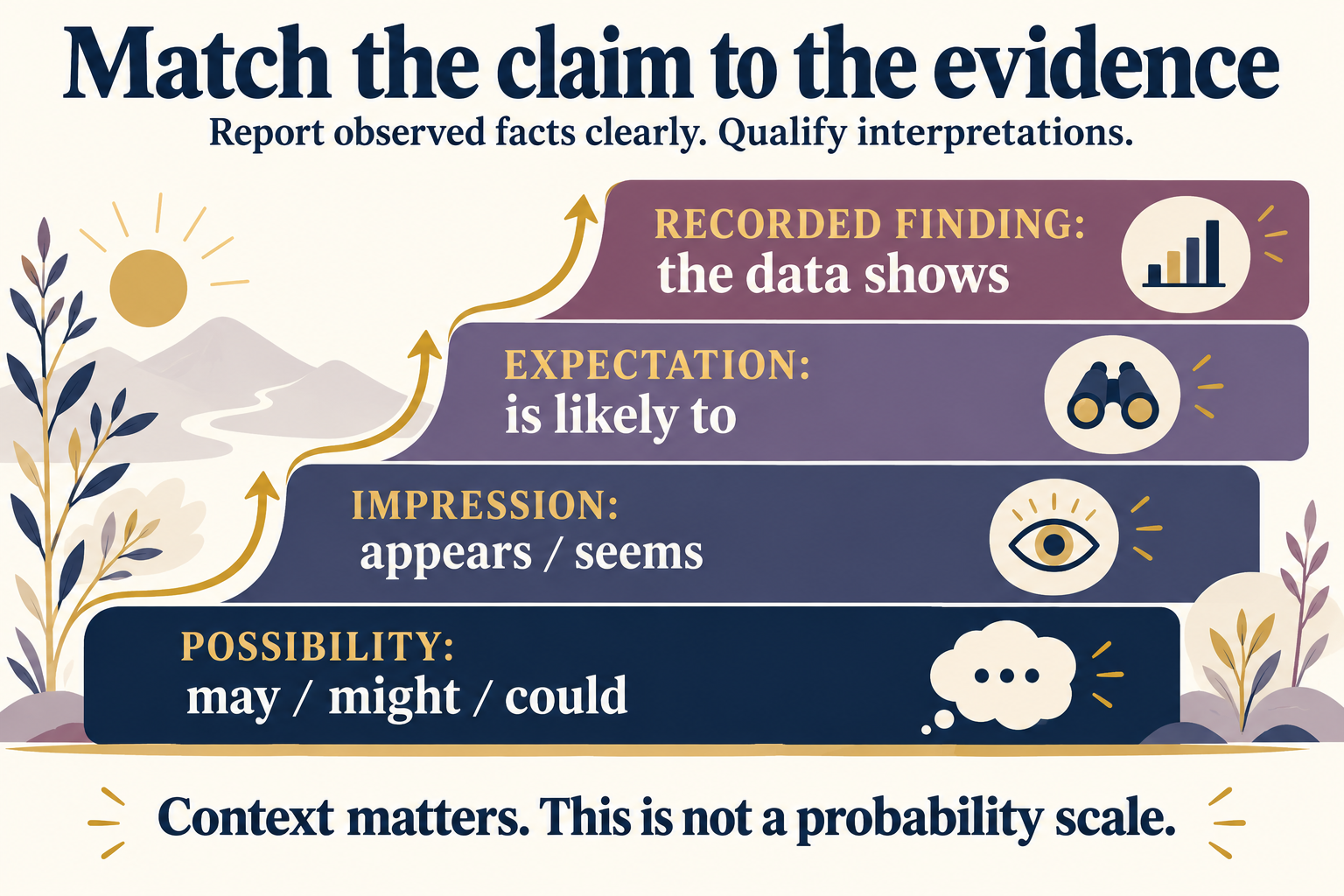
Use this final check: What was actually observed? Who or what does the evidence cover? Is the sentence a finding, interpretation or forecast? Does the qualifier match the uncertainty? Have I kept a useful conclusion? ‘Nothing can be concluded’ may be as misleading as ‘This proves everything’ when the data supports a modest result. The teaching ladder illustrates contextual expressions; it is not a numerical probability scale.
Check your understanding
Try each item before opening the answer. Read the explanation even when your answer is correct.
Answer on paper, then open the explanations below. Enable JavaScript to check answers here.
Your turn · self-review
Apply it and compare
Write or say your own answer first. The models are examples, not the only acceptable answers. Use the checklist to review your work; open responses are not automatically assessed.
Practice only. Your writing stays on this page; it is not submitted or saved.
-
Model answer and explanation
“Eighteen of thirty respondents to the voluntary survey preferred later opening. This suggests interest among those who responded, but it does not establish the preferences of all residents.” The count is stated confidently; the interpretation and population remain limited.
-
Model answer and explanation
“Finding: Nine of twelve trial users completed the revised form without help. Interpretation: The revised form appears manageable for most people in this trial. Forecast: Support requests could fall if the wider user group has a similar experience.” Self-check: no invented causal proof; no universal population claim; one useful qualifier per uncertain claim; a visible condition for the forecast.
Related Guides






Continue learning this topic
Review an explanation, study examples or try a related practice test.
- Practice test At the University of Maryland, a historic campus farm remains a classroom — C2 English Listening Practice Test
- Practice test At the University of Maryland, a historic campus farm remains a classroom — C2 English Grammar Practice Test
- Practice test At the University of Maryland, a historic campus farm remains a classroom — C2 English Vocabulary Practice Test