
Lesson
B1 · Intermediate
Grammar
Who Helped Whom at the Open Day? Rebuild the Event Record
Rebuild a fictional open-day record with subject and object questions. Read the evidence, ask who did what, and practise two short conversations.
8 min read
1,366 words
Updated Oct 20, 2026

On this page (7 sections)
An open-day record has lost some names. Read the account, identify each missing role, and ask questions to rebuild the record. This B1 lesson takes about 35 minutes. There are 12 short checks and two conversation tasks. All six volunteers and their actions are fictional.
Meet the event team
The adult volunteers are Nina, Omar, Sara, Ben, Inez and Leo. Nina arranges invitations; Omar helps with the welcome area; Sara prepares the displays; Ben welcomes visitors; Inez shows newcomers around; Leo checks the entrance. These roles introduce the team, but use the account below as evidence for individual actions.
Read the incomplete record
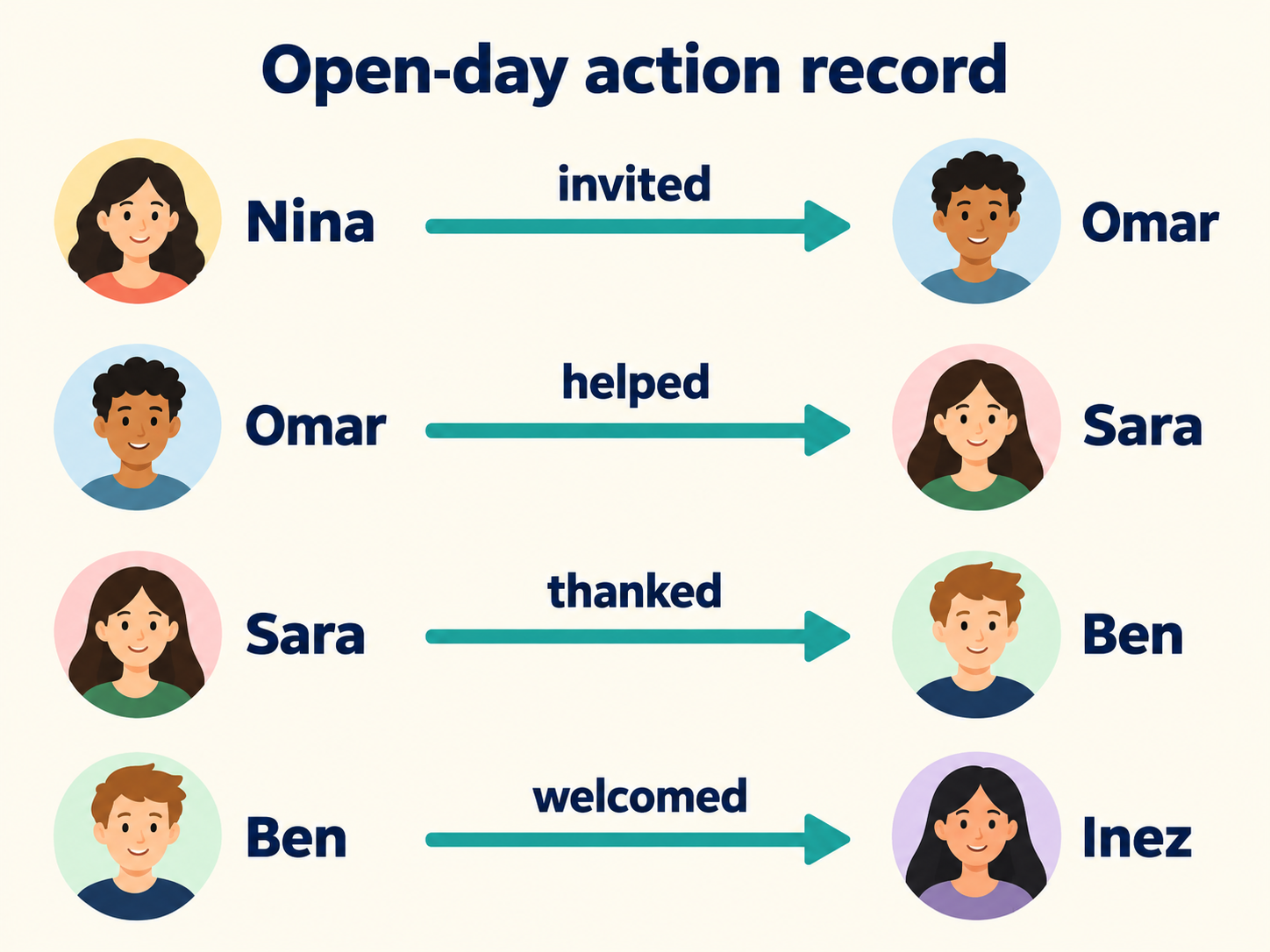
The incomplete record: A. ___ invited Omar. B. Omar helped ___. C. ___ thanked Ben. D. Ben welcomed ___. E. ___ guided Leo. F. Leo called ___. G. ___ gave Sara a map. H. Omar brought ___ a tray of cups. Four gaps name people performing actions; four name people receiving them. Every answer is stated in the account.
Choose the missing role
Answer on paper, then open the explanations below. Enable JavaScript to check answers here.
Ask and match
For questions 5–8, type the question that would fill the specified gap. Use who and keep the known person and action. For 9–12, choose the complete answer supported by the account.
Answer on paper, then open the explanations below. Enable JavaScript to check answers here.
Interview another volunteer
Your turn · self-review
Use it yourself
Make your own answer before opening the model. Other accurate answers are possible. Use the checklist to review meaning and form.
Practice only. Your writing stays on this page; it is not submitted or saved.
-
Model answer and explanation
Who guided Leo? Who did Inez guide? Who gave Sara a map? Who did Nina give a map to? Full answers: Inez guided Leo. Nina gave Sara a map. Checklist: keep the direction of each action; use past guided/gave for subject questions and did + guide/give for object questions. “Whom” is acceptable for the object questions.
-
Model answer and explanation
A: Who thanked Ben? B: Sara thanked Ben. A: Who did Leo call? B: Leo called Nina. Checklist: four turns; one subject and one object question; each answer agrees with the original account; no invented event is presented as evidence.
Review the pattern
Restore all eight gaps: A Nina; B Sara; C Sara; D Inez; E Inez; F Nina; G Nina; H Leo. Read every completed line as actor → action → receiver. G has an additional object, the map; the question here asks about the giver, not the thing given.
A subject question keeps the ordinary past verb: “Who invited Omar?” An object question keeps the known subject and uses did + base verb: “Who did Omar help?” Both questions can start with who. That first word alone does not tell you which pattern you need. The full answer makes the role clear.
Transfer to your own fictional event
For the first fact, possible questions are “Who invited Max?” and “Who did Ava invite?” Answer both with “Ava invited Max.” If your answer turns into “Max invited Ava”, you have reversed the roles. Correct the meaning before checking the grammar again.
Related Lessons




Continue learning this topic
Review an explanation, study examples or try a related practice test.
- Practice test Schools Experiment With AI but Struggle to Measure Its Effect on Students — C1 English Listening Practice Test
- Practice test Schools Experiment With AI but Struggle to Measure Its Effect on Students — C1 English Grammar Practice Test
- Practice test Schools Experiment With AI but Struggle to Measure Its Effect on Students — C1 English Vocabulary Practice Test
- Course lesson Past perfect and earlier events – B1–B2: Grammar in Context