
Lesson
B1 · Intermediate
Grammar
Two Rooms, One Meeting: Explain Which Options Work
Compare two room fact cards, test changed requirements and write a justified meeting recommendation with 12 scored checks and two modelled tasks.
7 min read
1,156 words
Updated Oct 29, 2026

On this page (7 sections)
1. Read the meeting brief
A fictional local-history group needs one meeting room for twelve people from 6 to 7 p.m. It needs a projector and a quiet hour for recording a discussion. The organiser must compare two rooms and explain the choice.
Answer each separate scenario using the requirement it states. If a question says “capacity only”, do not add a quiet-time requirement that the question leaves out. For the final recommendation, use the complete original brief.
2. Compare the two fact cards
Room A: This room seats twelve people and has a projector. Chairs stand around a round table. The room is quiet from 6 to 7 p.m. A music activity starts nearby at seven, so it is not a quiet option from 7 to 8. Both time slots are available for use.
Room B: This room seats fourteen people and has a projector. Chairs stand in rows. An exercise activity nearby makes it noisy from 6 to 7 p.m. That activity finishes at seven, and the room is quiet from 7 to 8. Both time slots are available for use.
The complete fact cards
Room A
12 seats; projector
Quiet 6–7 p.m.; noisy 7–8 p.m.
Room B
14 seats; projector
Noisy 6–7 p.m.; quiet 7–8 p.m.
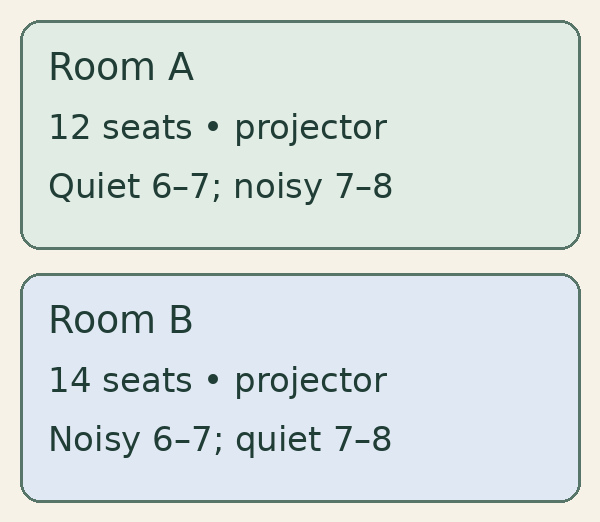
Round-table seating and rows are facts, but the original brief does not require either arrangement. Do not turn your personal preference about seating into a condition that the group never stated.
3. Which choices remain?
Six scenarios change the requirement. Use only the condition in each question.
Answer on paper, then open the explanations below. Enable JavaScript to check answers here.
4. Repair the planning messages
Complete three patterns, then repair three messages.
Answer on paper, then open the explanations below. Enable JavaScript to check answers here.
5. Give the recommendation
Your turn · self-review
Explain the final choice
Write your own answer first. Then compare it with the model and checklist. Natural alternatives are welcome when they preserve the facts.
Practice only. Your writing stays on this page; it is not submitted or saved.
-
Model answer and explanation
Both rooms have a projector and enough seats for twelve people, so either room meets those two requirements. However, we also need quiet from six to seven. Room A is quiet then, while Room B is noisy. I recommend Room A for the original meeting. Neither room holds eighteen people, so we should check the group size again if more people want to join.
-
Model answer and explanation
Organiser: Could we move the meeting to seven and use Room B? It has a projector, seats fourteen and is quiet then. Member: Yes, Room B meets our needs at that time, so that alternative works.
Self-check: compare facts rather than preferences; use Room A for the original time; explain why either fits only the capacity/equipment part; keep singular room after either/neither; make the changed-time reply match B’s quiet hour. Other natural wording is welcome when it preserves these facts.
6. Review fair alternatives
Key 1–6: Both; Either; Neither; Room A only; Either room is large enough; Neither room is large enough. The capacity questions deliberately exclude the quiet-time condition. The final recommendation must include it.
Key 7–12: and; or; has; us; rooms; is. Neither is already negative in meaning. A sentence can be grammatical but factually wrong: Either room is quiet from six to seven is false because B is noisy then. Both rooms have projectors is true, but it does not settle every other requirement.
7. Transfer to everyday decisions
Transfer: Bus A and Bus B both stop at a fictional museum. Bus A arrives at 9:10; Bus B arrives at 9:25. You need one bus and must arrive by 9:30. Either bus meets that deadline. If the deadline changes to 9:00, neither does. Both buses still serve the museum.
Before recommending an option, name the requirement and check each option against it. Then choose the language. A preference is useful, but it should not replace the factual explanation.
Related Lessons





Continue learning this topic
Review an explanation, study examples or try a related practice test.
- Practice test New National Education Association President Calls for a Less Partisan Focus in Education — C2 English Listening Practice Test
- Practice test New National Education Association President Calls for a Less Partisan Focus in Education — C2 English Grammar Practice Test
- Practice test New National Education Association President Calls for a Less Partisan Focus in Education — C2 English Vocabulary Practice Test