
Lesson
B2 · Upper-intermediate
Grammar
The Missing Picnic Box: Past Modal Practice
Use a fictional evidence log to separate past explanations, missed chances and useful hindsight.
10 min read
1,748 words
Updated Oct 28, 2026

On this page (9 sections)
B2 • About 30 minutes. Select a modal from the evidence and communicative purpose. Distinguish what happened from what might have happened. Separate an unrealised option from an uncertain explanation. Write constructive hindsight without unsupported accusations.
Read the evidence log
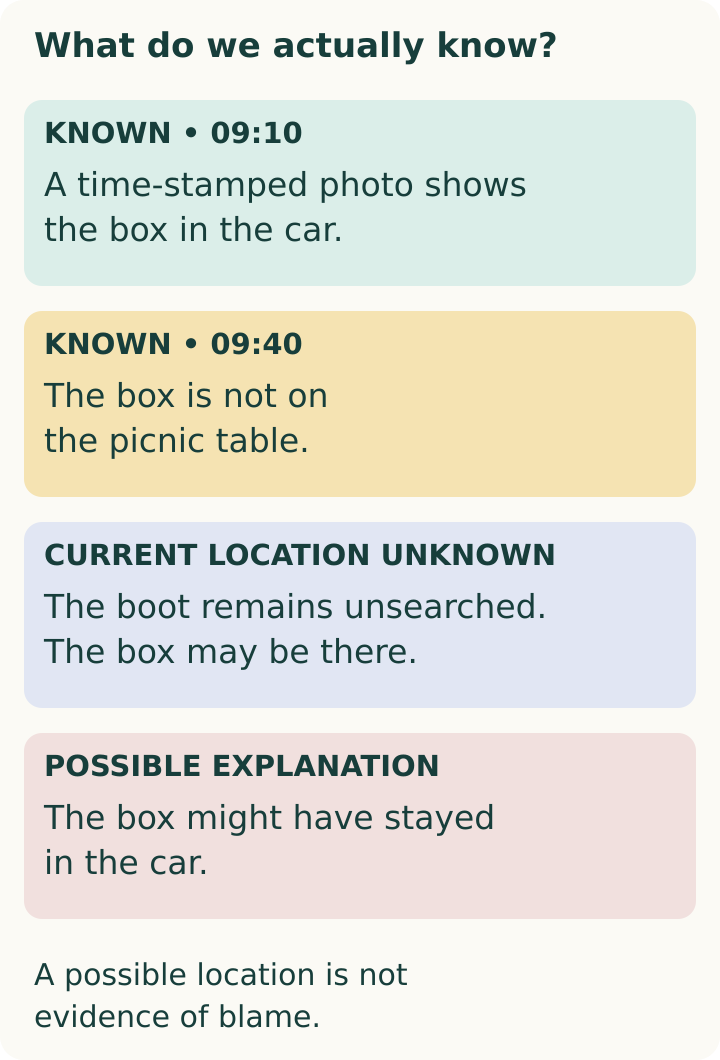
The community picnic story is fictional. At 8:45, Sara packed a blue box with cups and napkins. At 9:10, a genuine time-stamped photograph showed the closed box in the back of Jules’s car. Jules drove to the park and arrived at 9:35. At 9:40, the group noticed that the box was not on their picnic table. The table had been brought into the park at 9:30, so the box could not have been sitting on that table in the park at nine. Nobody had checked the car’s boot since the group arrived. Sara wrote, “The box could have stayed in the car. Let’s look there before deciding what happened.” Jules replied, “We could have checked every bag before leaving, but we were in a hurry and did not.” The organiser said, “The delivery of extra drinks should have arrived by now; the estimate was 9:30. I have not confirmed it.” No message says that anyone stole the box. No message confirms the drinks delivery. The group has a location question to investigate, not evidence of deliberate wrongdoing.
Five confirmed facts: packed at 8:45; photographed in the car at 9:10; car arrived at 9:35; box absent from the table at 9:40; boot not yet checked. Unknowns: current box location, who last handled it after the photo, and whether the extra drinks arrived.
Separate facts from explanations
Facts are explicitly recorded. Inferences interpret those facts. The blue box was in the photographed location at 9:10; it may still be in the car, but the photo alone cannot establish its location thirty minutes later. If you write a modal perfect, make the relevant time visible and match the strength to the evidence.
The opportunity sentence supplies its own outcome: the group did not check every bag. The drinks sentence supplies only an expectation. For open answers, may have, might have and could have can all be suitable ways of keeping an explanation cautious. The controlled choices below specify the intended job so that you can explain your selection.
Explanation checks
Choose the interpretation supported by the exact evidence.
Answer on paper, then open the explanations below. Enable JavaScript to check answers here.
Opportunity or explanation?
Use the continuation, not could have alone.
Answer on paper, then open the explanations below. Enable JavaScript to check answers here.
Helpful hindsight and expectation
Choose the job and wording that fit the log.
Answer on paper, then open the explanations below. Enable JavaScript to check answers here.
Repair the group message
Repair a form or reduce an unsupported claim.
Answer on paper, then open the explanations below. Enable JavaScript to check answers here.
Write, compare and revise
Your turn · self-review
Independent writing
Write your own response first, then compare the model and use the self-review checklist below. The model is one possible answer, not a script to copy.
Practice only. Your writing stays on this page; it is not submitted or saved.
-
Model answer and explanation
The blue picnic box was in Jules’s car at 9:10, as the time-stamped photograph shows. It was not on our table at 9:40, and nobody has checked the boot since we arrived. The box might have stayed in the car, so that is a sensible place to look first. We should have checked the bags before leaving, and we should have confirmed who was carrying the box into the park. Those checks would have made the handover clearer. We do not yet know who last moved it or where it is now. The extra drinks should have arrived according to the estimate, but their delivery still needs confirmation.
Self-review and transfer
The model quotes a known time and location, gives a cautious possibility and names two useful hindsight checks. Its second hindsight point is a suggested improvement, not a claim that the source recorded a particular handover. Check whether your update distinguishes evidence from recommendation. Remove any statement about theft, motive or current location unless the log supports it. Replacing must with might can reduce certainty, but you must also remove invented details.
Related learning
Companion resource: Past Modals: Must Have, Might Have, Could Have and Should Have.
Related references for further study: Library Rules: Must, Have To and Should Practice; How Sure Can We Be About This Claim?; Why the Event Started Late: Third Conditional Practice.
Related Lessons




Continue learning this topic
Review an explanation, study examples or try a related practice test.
- Practice test Question words: who, what, where, when, why, how, how often, and how many — A1 English Grammar Practice Test
- Practice test Past simple verb forms: regular, irregular, and spelling exceptions — A1 English Grammar Practice Test
- Practice test Past simple: regular and irregular verbs — A1 English Grammar Practice Test
- Course lesson Present perfect or past simple – B1–B2: Grammar in Context
- Course lesson Past perfect and earlier events – B1–B2: Grammar in Context
- Course lesson Telling a story with past tenses – B1–B2: Grammar in Context