
Lesson
A2 · Elementary
Grammar
The Reading-Club Rota: Give Everyone a Clear Task
Read a six-person rota, separate individual and group jobs, and write a clear reading-club reminder with 12 scored checks and two modelled tasks.
8 min read
1,268 words
Updated Oct 26, 2026

On this page (7 sections)
1. Set up the club evening
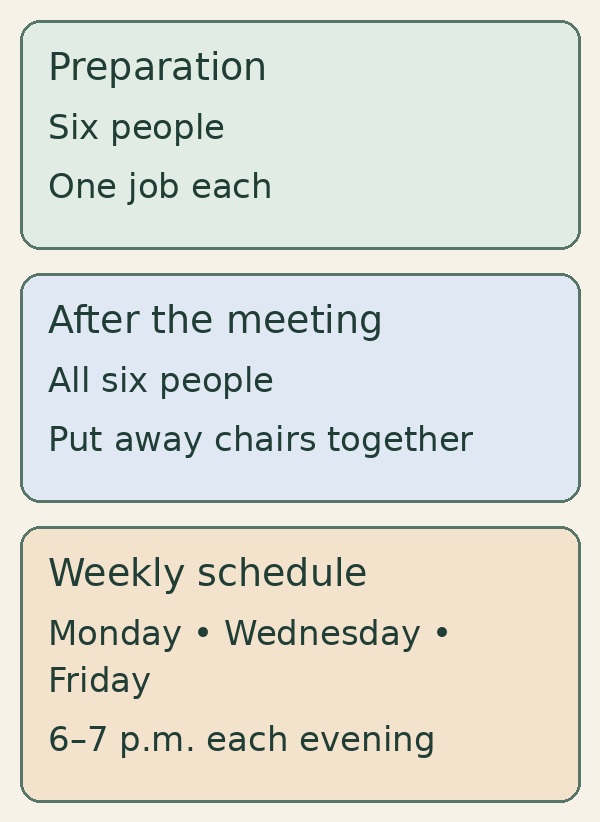
Six adults run a fictional reading club: Ava, Ben, Mira, James, Noor and Lee. Meetings are on Monday, Wednesday and Friday each week, from 6 to 7 p.m. The organisers need clear instructions about individual jobs, shared jobs and the full weekly schedule.
A rota is a plan that shows who does each job. Today, Ava checks the books; Ben puts out cups; Mira checks the lights; James fills the water jug; Noor opens the door; Lee writes the meeting title. All six volunteers put away the chairs together after the session.
2. Read the rota and note
Organiser’s note: Thank you for helping with this week’s reading club. Each volunteer has one preparation job. Please check your own task before the meeting begins. Ava checks the books, Ben puts out the cups, Mira checks the lights, James fills the water jug, Noor opens the door and Lee writes the meeting title. Every session needs enough books and drinking water for the group. Each of you should also bring a notebook. All of us put away the chairs after the discussion, so please stay until seven. The club meets on Monday, Wednesday and Friday every week. These are three separate evenings; the room is not open all day. There is a two-day gap between the first two meetings and between the second and third. The weekend gap is longer. Please read all the task cards, then keep the one with your name. If a card is unclear, ask before changing anyone’s job.
Three-session rota
Monday
6–7 p.m.
All six volunteers attend.
Wednesday
6–7 p.m.
All six volunteers attend.
Friday
6–7 p.m.
All six volunteers attend.
3. Check coverage
Check what each statement covers.
Answer on paper, then open the explanations below. Enable JavaScript to check answers here.
4. Fix the organiser’s wording
Complete the four patterns, then repair four errors.
Answer on paper, then open the explanations below. Enable JavaScript to check answers here.
5. Write the final rota note
Your turn · self-review
Write the final rota note
Write your own answer first. Then compare it with the model and checklist. Natural alternatives are welcome when they preserve the facts.
Practice only. Your writing stays on this page; it is not submitted or saved.
-
Model answer and explanation
Each volunteer has one preparation job. Ava checks the books. Ben puts out the cups. Mira checks the lights. All six volunteers put away the chairs together.
-
Model answer and explanation
Each volunteer has one preparation job, and every session needs books and drinking water. Please check your task card and bring a notebook. All of us put away the chairs after the discussion. Meetings are from six to seven on Monday, Wednesday and Friday every week. We do not meet all day or every two days across the whole week. Please keep the card with your name.
Self-check: include the correct people, jobs and meeting times; use singular nouns after each/every; use has after each of; include the shared chair job; distinguish the weekly pattern from every two days. Each volunteer and Every volunteer are both acceptable for the general rule.
6. Audit the answers
Key 1–4: every one of the six volunteers; the complete group; all three named evenings; no, only 6–7 p.m. Key 5–8: has; of; one; no. Key 9–12: volunteer; has; us; We meet from six to seven on Monday, Wednesday and Friday.
The schedule needs both the correct days and the correct duration. A clear complete sentence is “We meet from six to seven on Monday, Wednesday and Friday.” Do not invent meetings on Sunday to make every two days fit.
Each and every often overlap. A model with each does not make a correct alternative with every wrong. Judge the meaning and the complete pattern. “Every one of the volunteers” and “Each of the volunteers” are both possible; “Every of the volunteers” is not.
7. Transfer the plan
Transfer to a fictional gardening club. Four adults each bring one pair of gloves. All four fill the water containers together. The club meets every Saturday, not all Saturday. Write one individual instruction, one group instruction and one time sentence.
Model: Each gardener brings a pair of gloves. All of them fill the containers together. The club meets every Saturday. Check that the time words match the actual plan before sending an instruction.
Related Lessons





Continue learning this topic
Review an explanation, study examples or try a related practice test.