
Lesson
B1 · Intermediate
Reading
Which Volunteer Role Fits? Compare Three Adverts
Compare three original volunteer adverts and explicit adult profiles through eighteen checks on duties, requirements, schedules and missing information.
11 min read
1,854 words
Updated Oct 25, 2026

On this page (10 sections)
B1 • 32 minutes • 18 scored checks. Compare three original volunteer adverts and explicit adult profiles through eighteen checks on duties, requirements, schedules and missing information.
Three roles at a community festival
Read three original adverts from a fictional community festival. The profiles describe adults and contain only availability, task-related skills and preferences. Use the stated details to make each match.
Each advert has a different fixed time and a different main activity. Read every condition before matching a profile. A preference such as editing experience is not the same as an essential skill. Keep missing details in a separate note rather than filling them from assumptions.
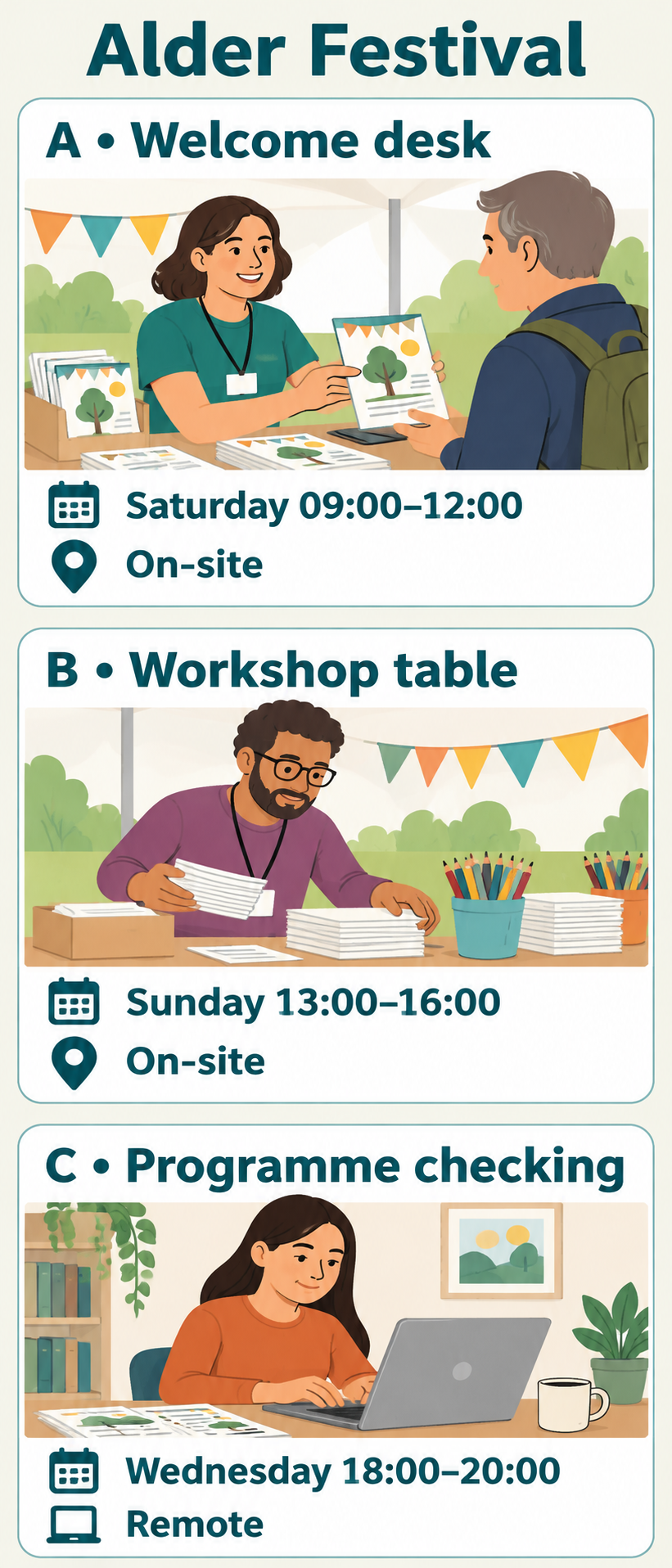
Advert A • Welcome desk
Welcome-desk volunteer. Help visitors at the fictional Alder Community Festival. Duties include greeting adults, checking the printed programme and directing general questions to the information team. Clear spoken English is essential. Experience at a welcome desk is desirable, not required. We provide a short orientation on the festival layout; orientation means an introduction to the place and tasks. The shift is Saturday, 09:00–12:00, on-site in the main hall. The day and time are fixed. You do not need to bring a computer. To express interest in this classroom example, read the fictional role form. The advert gives no information about travel expenses.
Advert B • Workshop table
Workshop-table volunteer. Support the fictional Alder Community Festival’s craft team by preparing paper packs, arranging pencils and counting remaining materials. Accurate counting is required. Previous craft experience is useful but optional. Training is provided for packing the materials, so no packing experience is necessary. The shift is Sunday, 13:00–16:00, on-site in the workshop room. This is the only shift described in this advert. The materials are supplied by the festival. An inventory is a list of the things available; helpers use a simple printed inventory during the shift. The next step in this classroom example is to read the fictional role form. No meal arrangements are stated.
Advert C • Programme checking
Programme-checking volunteer. Help the fictional Alder Community Festival team check its written programme before the event. Duties include comparing room names with the supplied list and marking spelling differences for the editor. Careful written English is essential. You must be available on Wednesday, 18:00–20:00. The work is remote using a supplied shared text document; no festival-site visit is part of this task. Editing experience is preferred, not compulsory. A briefing is a short explanation of a task, and a written briefing is provided before the shift. The next step in this classroom example is to read the fictional role form. Equipment-loan arrangements are not mentioned.
Profile | Explicit information |
|---|---|
Lea | Adult; available only Saturday 09:00–12:00; clear spoken English; prefers greeting visitors; no welcome-desk experience. |
Owen | Adult; available only Sunday 13:00–16:00; accurate at counting; prefers organising materials; no packing experience. |
Suri | Adult; available only Wednesday 18:00–20:00; careful written English; prefers remote text tasks; no editing experience. |
Find the advert sections
Find the purpose of each quoted excerpt. Duties name actions. Requirements identify needed skills or conditions. A schedule supplies days and times. The next step tells an interested reader what to read or do next in the stated process.
Some schedule sentences also express a requirement with must. In that case, classify the quoted information by what it supplies: Wednesday, 18:00–20:00 is the schedule detail. Read the choices carefully; the exercise distinguishes this from an experience requirement.
Answer on paper, then open the explanations below. Enable JavaScript to check answers here.
Compare requirement strength
Compare essential, required, desirable, optional and preferred. Essential and required state compulsory conditions in these texts. Desirable and preferred are explicitly qualified as not required or not compulsory. B states that training covers packing, not every possible festival task.
Use the local glosses too: orientation is an introduction to place and tasks, inventory is a list of available things, and briefing is a short task explanation. These words help you understand support provided without guessing a training length or an equipment policy.
Answer on paper, then open the explanations below. Enable JavaScript to check answers here.
Match the fictional profiles
Choose one advert for each fictional profile. Check the day and exact time first, then the stated skill or preference. Each intended match is unique because the other two adverts conflict with the profile's only available time.
A correct reading match is not a guarantee that a real person would receive a role. It simply means the supplied details fit. After choosing, check the two quoted pieces of evidence in the explanation and identify the time conflict in the tempting alternatives.
Answer on paper, then open the explanations below. Enable JavaScript to check answers here.
Identify what is not stated
For each information check, distinguish three possibilities: a fact is stated, its opposite is stated, or the text does not decide the issue. No information about expenses does not mean expenses are definitely refused. Fixed day and time, however, is an explicit limit.
Remote work tells you where the task is performed, not who provides a computer. Read C's equipment sentence before making that inference. Keep this difference clear in your summary.
Answer on paper, then open the explanations below. Enable JavaScript to check answers here.
Review evidence and alternatives
Use the final three short answers to locate exact evidence phrases. Then review all eighteen checks: four excerpt classifications, five requirement checks, three matches, three information checks and three evidence answers. Compare the words required and preferred wherever you made a mistake.
When an alternative fails, name the conflict rather than criticising the fictional person. For example, a Sunday-only profile does not match a Saturday shift. That sentence stays within the text. It makes no assumption about character, motivation or willingness to change plans.
Answer on paper, then open the explanations below. Enable JavaScript to check answers here.
Create a role comparison card
Write 60–80 words comparing A and C for a fictional reader who is free for either shift but prefers remote written work. Include each role's duty, an essential skill and its hours. Explain which better matches that preference, and name one detail that remains unknown.
Use phrases such as according to the advert, fits the stated preference and is not mentioned. Avoid promising selection or inventing pay, expenses or equipment. Check the model after writing your own comparison.
Your turn · self-review
Your transfer task
Write your own response first, then open the model and compare. Checklist: 60–80 words; both duties and hours; correct essential skills; preference-based conclusion; one genuine unknown.
Practice only. Your writing stays on this page; it is not submitted or saved.
-
Model answer and explanation
Advert A involves greeting visitors on-site on Saturday from 09:00 to 12:00 and requires clear spoken English. Advert C involves checking written programme details remotely on Wednesday from 18:00 to 20:00 and requires careful written English. C better fits the stated preference for remote written work, although both shifts fit the reader’s availability. Editing experience is preferred rather than compulsory. C does not mention equipment loans.
Related Lessons






Continue learning this topic
Review an explanation, study examples or try a related practice test.
- Practice test Saving for a Starter Home Now Takes Twice as Long — B1 English Listening Practice Test
- Practice test Saving for a Starter Home Now Takes Twice as Long — B1 English Grammar Practice Test
- Practice test Saving for a Starter Home Now Takes Twice as Long — B1 English Vocabulary Practice Test