
Lesson
B2 · Upper-intermediate
Grammar
The Weekend We Had Planned: Future-in-the-Past Practice
Read a plan and later diary to distinguish past expectations from actual outcomes.
10 min read
1,752 words
Updated Oct 26, 2026

On this page (9 sections)
B2 • About 30 minutes. Match original future plans with a later report. Distinguish intentions, schedules and imminent actions. Avoid inferring cancellation without evidence. Retell changed plans from a consistent past viewpoint.
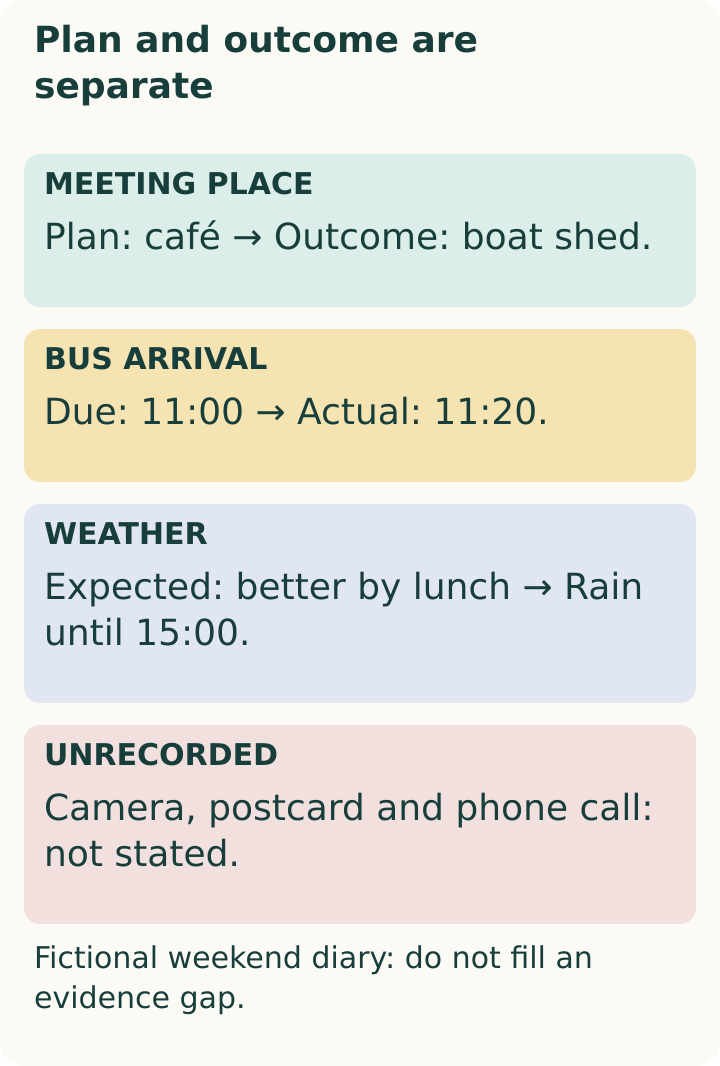
Friday plan and Monday diary
Friday plan, 18:00. Nia and I are going to spend Saturday near Lake Rowan. We will leave home at ten and take the local bus. The bus is due to arrive at the lake at eleven. We are going to meet Ellis at the café at eleven fifteen. Nia says the weather will improve by lunchtime. I am going to bring a picnic, and Ellis is going to bring a camera. The gallery is scheduled to open at two. We hope to look inside before returning home. I also intend to buy a postcard, but that is not essential to our plan. Nia plans to call her sister after lunch.
Monday diary. At ten on Saturday, we were about to leave when Ellis called. The café was closed for maintenance, so we agreed to meet by the boat shed instead. We left home at ten ten and caught a later bus. It reached the lake at eleven twenty. Nia had thought the weather would improve by lunchtime, but rain continued until three. I had been going to bring a picnic, but I left it at home and we bought sandwiches. Ellis met us by the boat shed at eleven thirty. The gallery opened at two as scheduled, and we visited it. We returned home at five. This entry does not record whether Ellis brought his camera, whether I bought a postcard, or whether Nia made her call.
Keep a three-column grid: original plan, expectation as reported from the past, actual outcome. Some rows have no confirmed outcome. A named plan is evidence of intention, not proof of completion. All places and events are fictional.
Retell without filling the gaps
In this lesson, use the Friday plan to establish intentions and the Monday diary to establish outcomes. For example, “We were going to meet at the café” records the original location; “but we met by the boat shed” records the change. Both parts matter. Avoid adding disappointment, blame or extra events that the diary does not mention.
Notice the past anchor in each report. Friday’s will becomes would when reporting the expectation from that past viewpoint. Scheduled arrangements may use was due to or was scheduled to. Were about to fits the moment at the door. These forms are not interchangeable with a habitual would about repeated childhood visits.
What was expected?
Match the Friday plan to a faithful past-viewpoint report.
Answer on paper, then open the explanations below. Enable JavaScript to check answers here.
What actually happened?
Use the Monday diary, including its explicit limits.
Answer on paper, then open the explanations below. Enable JavaScript to check answers here.
Choose the precise form
Choose the form that matches the stated kind of expectation.
Answer on paper, then open the explanations below. Enable JavaScript to check answers here.
Repair the retelling
Choose a correction that preserves viewpoint and evidence.
Answer on paper, then open the explanations below. Enable JavaScript to check answers here.
Write, compare and revise
Your turn · self-review
Independent writing
Write your own response first, then compare the model and use the self-review checklist below. The model is one possible answer, not a script to copy.
Practice only. Your writing stays on this page; it is not submitted or saved.
-
Model answer and explanation
On Friday, we were going to meet Ellis at the café near Lake Rowan on Saturday. At ten, we were about to leave when he called to say the café was closed. We changed the meeting point to the boat shed and left home at ten ten. The bus was due to arrive at eleven, but our later bus reached the lake at eleven twenty. Nia had thought the weather would improve by lunchtime; in fact, it rained until three. I had planned to bring a picnic, but I left it at home, so we bought sandwiches. The gallery opened at two, and we visited it. Ellis intended to bring a camera, but the diary does not say whether he did.
Self-review and transfer
The model separates planned and actual location, scheduled and actual arrival, and forecast and observed weather. It uses were going to, were about to, was due to and would. Check that every outcome comes from the diary. Then draw an arrow from each past anchor to the later expected event. A correct sentence can still be an inaccurate report if it silently turns a plan into a completed action.
Related learning
Companion resource: Future in the Past: Was Going To, Would and Was About To.
Related references for further study: The Broken Printer: B1 Future Forms in Messages; Our Street Then and Now: Used To and Would Practice; An Unexpected Visitor: A2 Past Continuous Listening.
Related Lessons




Continue learning this topic
Review an explanation, study examples or try a related practice test.
- Practice test Travel Plans in France May Be Affected by Weekend Demonstrations — B2 English Listening Practice Test
- Practice test Travel Plans in France May Be Affected by Weekend Demonstrations — B2 English Grammar Practice Test
- Practice test Travel Plans in France May Be Affected by Weekend Demonstrations — B2 English Vocabulary Practice Test
- Course lesson Present perfect or past simple – B1–B2: Grammar in Context
- Course lesson Past perfect and earlier events – B1–B2: Grammar in Context
- Course lesson Telling a story with past tenses – B1–B2: Grammar in Context