
Lesson
A2 · Elementary
Grammar
Enough Helpers for the Event? Read a Supplies Update
Read two organisers’ updates about the same supplies, choose quantity phrases by context, and write a clear event plan with explained answers.
8 min read
1,404 words
Updated Oct 26, 2026
On this page (7 sections)
1. Read the event brief
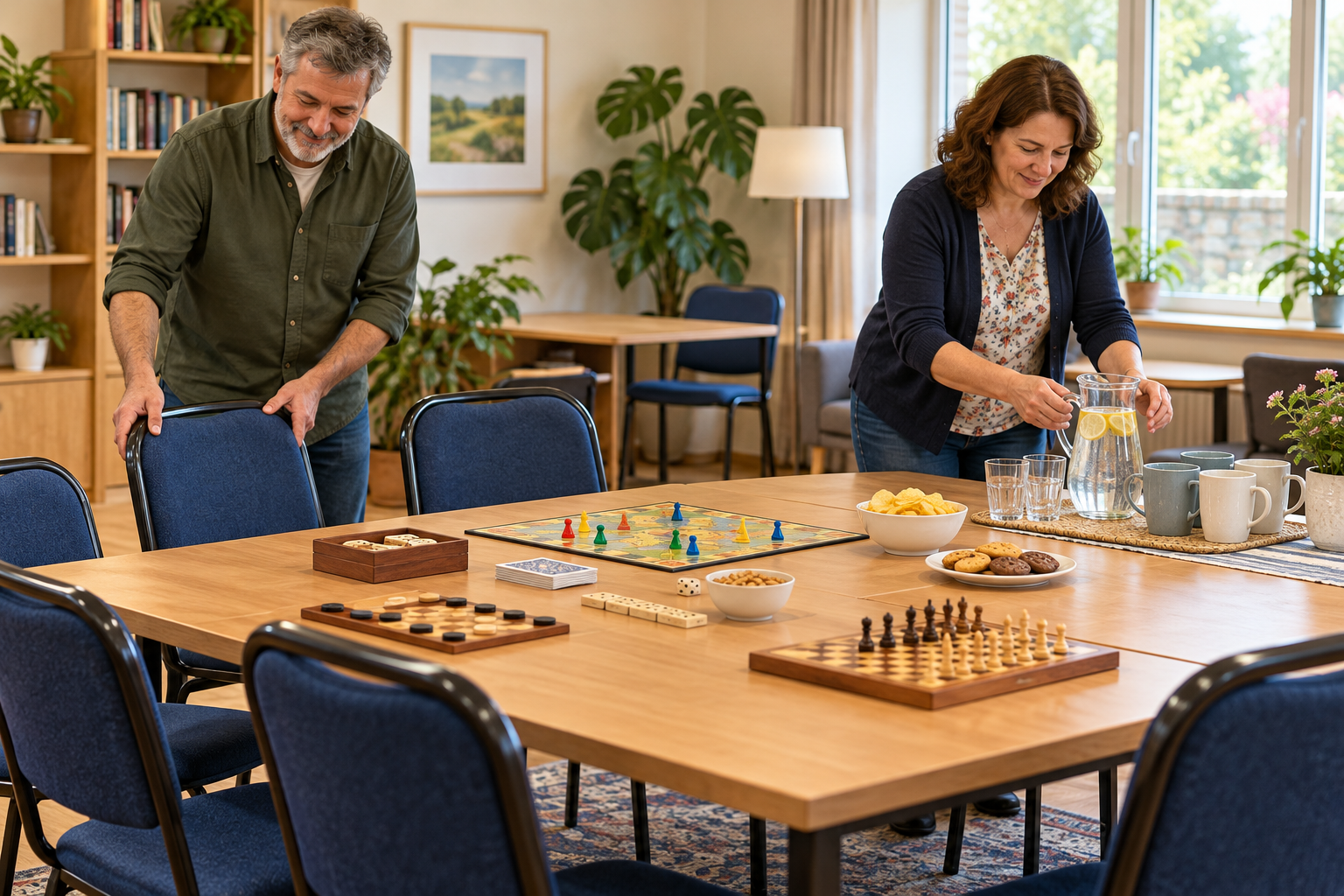
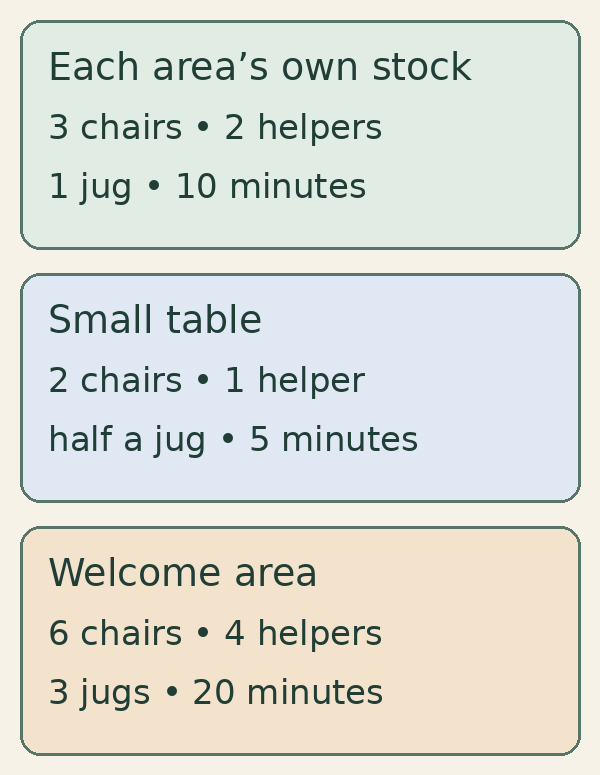
You help plan a fictional neighbourhood board-game afternoon. Each area has its own separate set of three spare chairs, two different helpers and one jug of water. Both organisers have ten minutes before the first activity. Supplies and helpers are not shared between the areas. One organiser is preparing a small table; another is preparing a larger welcome area. Their needs are different.
Small table needs: two extra chairs, one helper, half a jug of water and five minutes. Welcome area needs: six extra chairs, four helpers, three jugs of water and twenty minutes. You do not need to estimate anything. All the facts are stated.
2. Compare two updates
Update A, from Jo: We have a few spare chairs, so our two extra guests can sit at the small table. A few helpers are free, and we only need one of them. There is a little water for the short activity; half a jug is enough for us. We also have a little time before we start, so we can check the cards. Please keep the remaining chair available for the next group. Our small table is ready. We can use what is here without taking supplies promised to another activity.
Update B, from Ren: We have few spare chairs for the welcome area. Six more people need seats, and three chairs will not be enough. We also have few spare helpers for the four jobs here. There is little water for this larger group, so we need two more jugs. We have little time before the first activity, and setting up the whole area takes twenty minutes. Please ask for more supplies and simplify the welcome activity. The small table can still open first while we finish preparing this larger space.
Equal sets; different needs
Chairs: 3 available
Small table needs 2
Welcome area needs 6.
Helpers: 2 available
Small table needs 1
Welcome area needs 4.
Water: 1 jug available
Small table needs half a jug
Welcome area needs 3 jugs.
Time: 10 minutes
Small table needs 5 minutes
Welcome area needs 20 minutes.
3. Check the message
Match each message to its meaning. Use the stated need as evidence.
Answer on paper, then open the explanations below. Enable JavaScript to check answers here.
4. Complete and repair
Complete or repair eight sentences. Keep the writer’s intended meaning.
Answer on paper, then open the explanations below. Enable JavaScript to check answers here.
5. Write the useful update
Your turn · self-review
Write the useful update
Write your own answer first. Then compare it with the model and checklist. Natural alternatives are welcome when they preserve the facts.
Practice only. Your writing stays on this page; it is not submitted or saved.
-
Model answer and explanation
Each area has its own supplies. Jo has a few spare chairs and a little time, so the small table can open first. Ren has few chairs for six extra guests and little time for a full setup. Please bring three more chairs and two more jugs of water to the welcome area. Give Ren two more helpers and ten extra minutes, too. Keep Jo’s remaining supplies with the small table for its next group.
-
Model answer and explanation
The welcome area has little water for its group: one jug is available, but three are needed. Please bring two more jugs before opening that area.
Self-check: match quantities to the correct area; use few with plural nouns and little with uncountable nouns; use the version with a when showing a useful amount; give a clear next step. A different practical plan is acceptable if it respects the stated needs and does not promise resources that do not exist.
6. Review the evidence
Key 1–4: useful for the small table; more helpers are needed; a short check; one jug is available but three are needed. These answers follow the needs, not just the amount. Key 5–10: a few; few; a little; little; a few jugs of water; Only a few chairs are left. Key 11–12: a little water; a few spare chairs.
Some sentences could be grammatical with another quantity phrase but would carry a different message. “We have few chairs” and “We have a few chairs” are both grammatical. The tasks ask you to preserve a particular writer’s meaning, so the positive result or stated shortage matters.
7. Try the planning checklist
For a new plan, write four notes before your message: the noun; what is available; what is needed; whether the amount helps or creates a problem. Then choose the phrase. Do not use little as an automatic replacement for few.
Optional transfer: a fictional reading group has three spare books. Two late arrivals need one book each. Model: We have a few spare books, so both late arrivals can borrow one. If eight people need books instead, Few spare books are available, so we need more fits the changed need.
Related Lessons



Continue learning this topic
Review an explanation, study examples or try a related practice test.
- Practice test Netflix cuts 6% of workforce as growth slows and programming unit is reorganized — C2 English Reading Practice Test
- Practice test What People Aged 50 and Older Need to Know About Flu Shots — C1 English Reading Practice Test
- Practice test At Least 12 Injured in Shooting Near Florida A&M Stadium — B2 English Listening Practice Test
- Course lesson For, since, already and yet – B1–B2: Grammar in Context
- Course lesson Past perfect and earlier events – B1–B2: Grammar in Context