
Lesson
B1 · Intermediate
Grammar
If Our Town Had More Space: Second Conditional Practice
Compare imagined town improvements, complete 12 second-conditional checks, and write an 80–100-word proposal with model answers.
9 min read
1,565 words
Updated Nov 8, 2026
On this page (10 sections)
Your goal
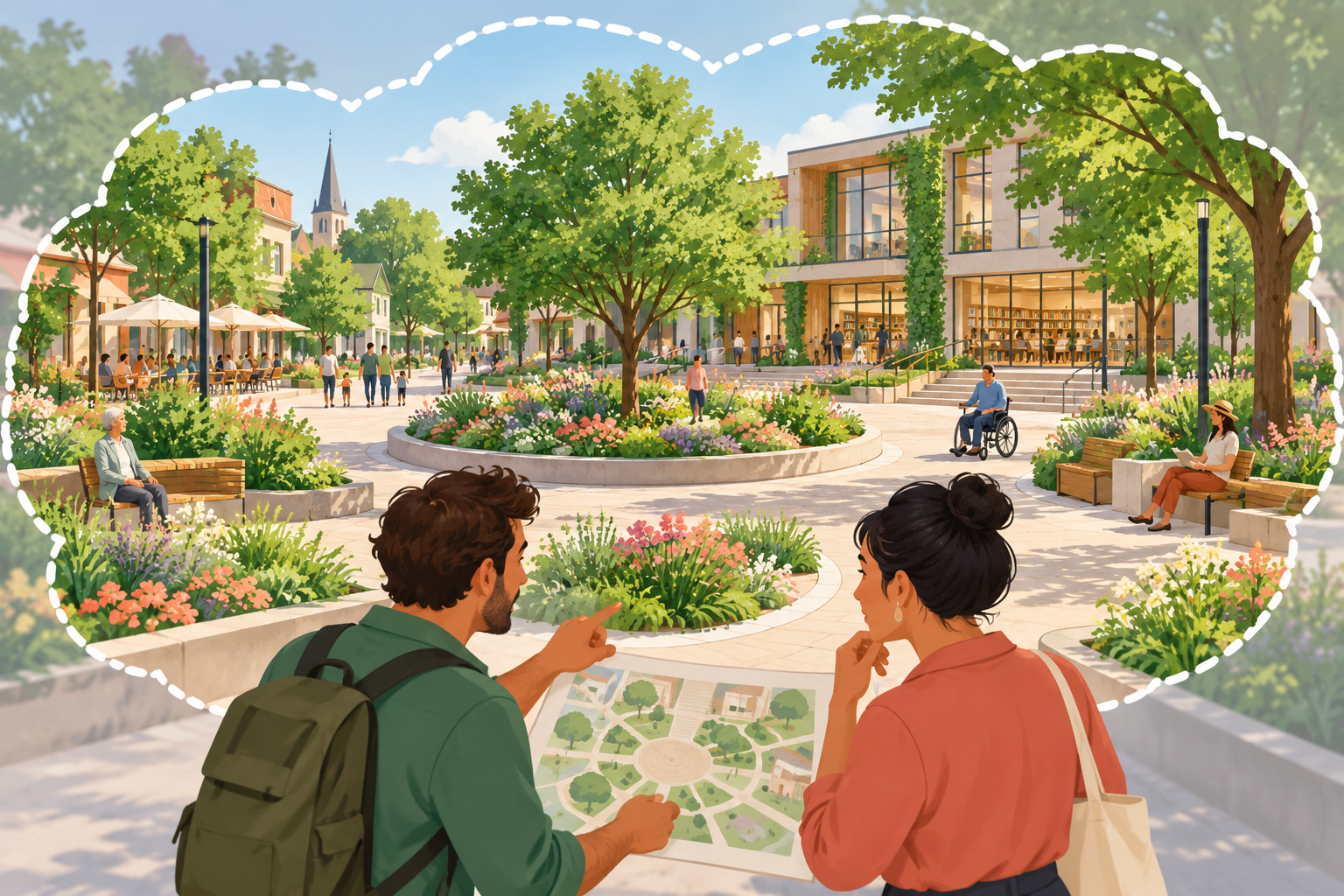
Imagine a change to a shared space and explain its possible results. You will separate current facts from hypothetical ideas, practise clause forms and write a short proposal. Allow about 30 minutes. The town and its options below are fictional; no real planning proposal is being made.
Read the current situation
Brookfield is a small town with a library, a market square and a busy car park. There is no public garden near the centre. An empty shop beside the library belongs to a private owner. The town has not agreed to buy it, and there is no budget for a new community project.
At a discussion group, residents are invited to imagine improvements. They do not have to make a promise or describe an approved plan. Their task is to explain what would change if the town had more space or money, and to recognise any practical limits.
Three imagined ideas
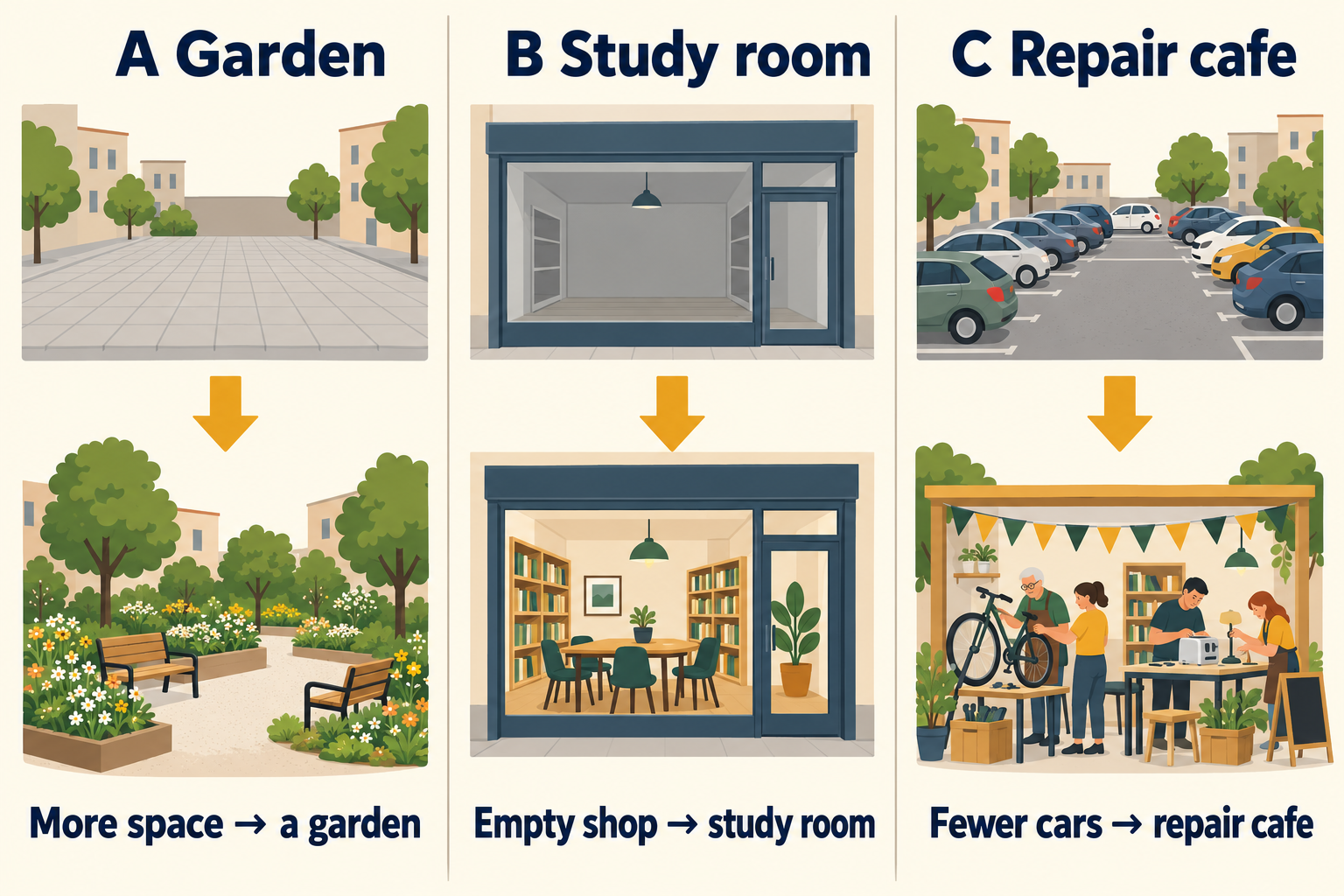
Lina: If we had a garden near the library, I would grow herbs with my neighbours. If there were benches, people could rest there after shopping. But we would need volunteers to water the plants.
Omar: If the empty shop belonged to the town, we would turn it into a study room. Workers could visit after work if it stayed open in the evening. We would still need someone to look after it.
Marta: If fewer cars used the square, we would have room for a weekend repair café. People might bring broken lamps or clothes. If I were the organiser, I would check safety rules and ask experienced volunteers to help.
Meaning before form
None of the speakers says that their idea is already approved. Had, belonged and used are past forms, but the ideas concern an imagined present or future. Could points to an opportunity. Might leaves the result uncertain. The second conditional is useful here because the situation is hypothetical.
Use would plus a base verb in the result: would grow, would turn, would have. Use an ordinary past form in the condition: if we had, if it belonged, if cars used. If I were the organiser introduces advice from an imagined role. You can reverse the two clauses without changing their main meaning.
Plan an 80–100-word proposal
Choose a community garden, study room or repair café, or create another realistic idea. Write one sentence about the imagined condition. Explain two benefits. Add one condition about access, cost, staffing or safety. Finish with advice or a limit.
Before writing, list three useful verbs in pairs: have/had, belong/belonged, use/used. Check that your result verbs stay in the base form after would or could. Your proposal may use other accurate structures too; you do not need a conditional in every sentence.
Review your proposal
Underline at least two second-conditional sentences. Check whether they imagine a present or future alternative. Circle each would, could or might, and check the following base verb. Make sure the benefits follow logically from the condition. Include a practical limit instead of promising a perfect result. Compare your work with the two possible models below; different ideas can be equally good.
Practice: check meaning and form
Choose or type your answers. Then read every explanation. The short checks give feedback on these answers only.
Answer on paper, then open the explanations below. Enable JavaScript to check answers here.
Answer key and explanations
1. It belongs to a private owner. — The situation states this as a current fact; town ownership is imagined.
2. an imagined present or future condition. — The conditional context shows hypothetical meaning.
3. belonged — Use the past form belonged in this second-conditional if-clause.
4. sit — Would takes the base form sit.
5. If I were you, I would ask residents. — If I were you is the standard hypothetical advice expression.
6. If fewer cars used the square, people would have more room. — The condition uses past used and the result uses would have.
7. workers could visit after work. — Could visit describes an opportunity in the imagined situation.
8. This is a possible result, not a guarantee. — Might expresses uncertainty about the result.
9. had — The hypothetical condition uses had.
10. We would buy more chairs. — Remove to; would needs the base form buy.
11. We would add a path if we had more space. — The clause order changes, but the hypothetical condition and result remain the same.
12. We would still need volunteers to water the plants. — It acknowledges a realistic requirement rather than an unsupported promise.
Your turn · self-review
Use the language yourself
Write or speak first, then compare these possible models. Your wording may be different. This is self-check practice; it does not automatically score your writing or pronunciation.
Practice only. Your writing stays on this page; it is not submitted or saved.
-
Model answer and explanation
If our town had more space, I would suggest a community garden beside the library. Residents could grow herbs there and share what they learned. If we added a few benches, older visitors would have a comfortable place to rest. The garden would also give neighbours somewhere to meet. I would keep a wide path so that people using wheelchairs could move around easily. If I were on the planning team, I would ask local residents for ideas first. We would need volunteers and a small budget before starting.
-
Model answer and explanation
If the empty shop belonged to the town, we would turn it into a quiet study room. People could read, study or use a shared computer there. If we opened it in the evening, workers would have time to visit. I would include a table for group work and a separate quiet corner. If I were the organiser, I would check the cost of heating before making a promise. We might receive donated furniture, but we would still need a reliable team to look after the room.
Self-check and next step
Check the meaning first, then the form. Read your answer aloud at a comfortable speed. Correct one feature, try again, and compare with the examples. Ask a teacher or partner for feedback if you are unsure.
Useful reference
Related Lessons






Continue learning this topic
Review an explanation, study examples or try a related practice test.
- Practice test Days of Patience in the Rescue of an Orphaned Walrus in Alaska — C1 English Listening Practice Test
- Practice test Days of Patience in the Rescue of an Orphaned Walrus in Alaska — C1 English Grammar Practice Test
- Practice test Days of Patience in the Rescue of an Orphaned Walrus in Alaska — C1 English Vocabulary Practice Test
- Course lesson Conditional inversion: Had I, were I and should you – C1: Precision and Expression
- Course lesson First conditional: If, unless and as long as – B1–B2: Grammar in Context
- Course lesson Second conditional: Imagining a different situation – B1–B2: Grammar in Context