
Lesson
B1 · Intermediate
Listening
When Game Instructions Are Unclear
Resolve unclear card-game instructions with targeted questions, twelve comprehension checks and a six-turn clarification model.
9 min read
1,542 words
Updated Nov 4, 2026

On this page (4 sections)
Listen to solve the misunderstanding
Nia is explaining a fictional card game to Ben. Ben asks questions when a word, sequence or limit is unclear. Your goal is to follow the final corrected rules and notice how each question helps. Allow about thirty minutes for listening, practice and your own short dialogue. No knowledge of a commercial card game is needed.
Listen once for the purpose of the game. On the second listen, note the four things Ben checks: the meaning of set, the order of actions, face up, and the one-card limit. Answer the twelve checks before reading the transcript. Then replay a short exchange and notice how Nia’s answer changes Ben’s understanding.
Prepare the language
A pile is a group of cards placed on top of each other. Face down means that the symbols are hidden; face up means that they are visible. In this game, a set is three cards with the same symbol. Matching colours are not required. A turn is one player’s opportunity to act. These definitions belong to this fictional game and should not be assumed to be the rules of another game.
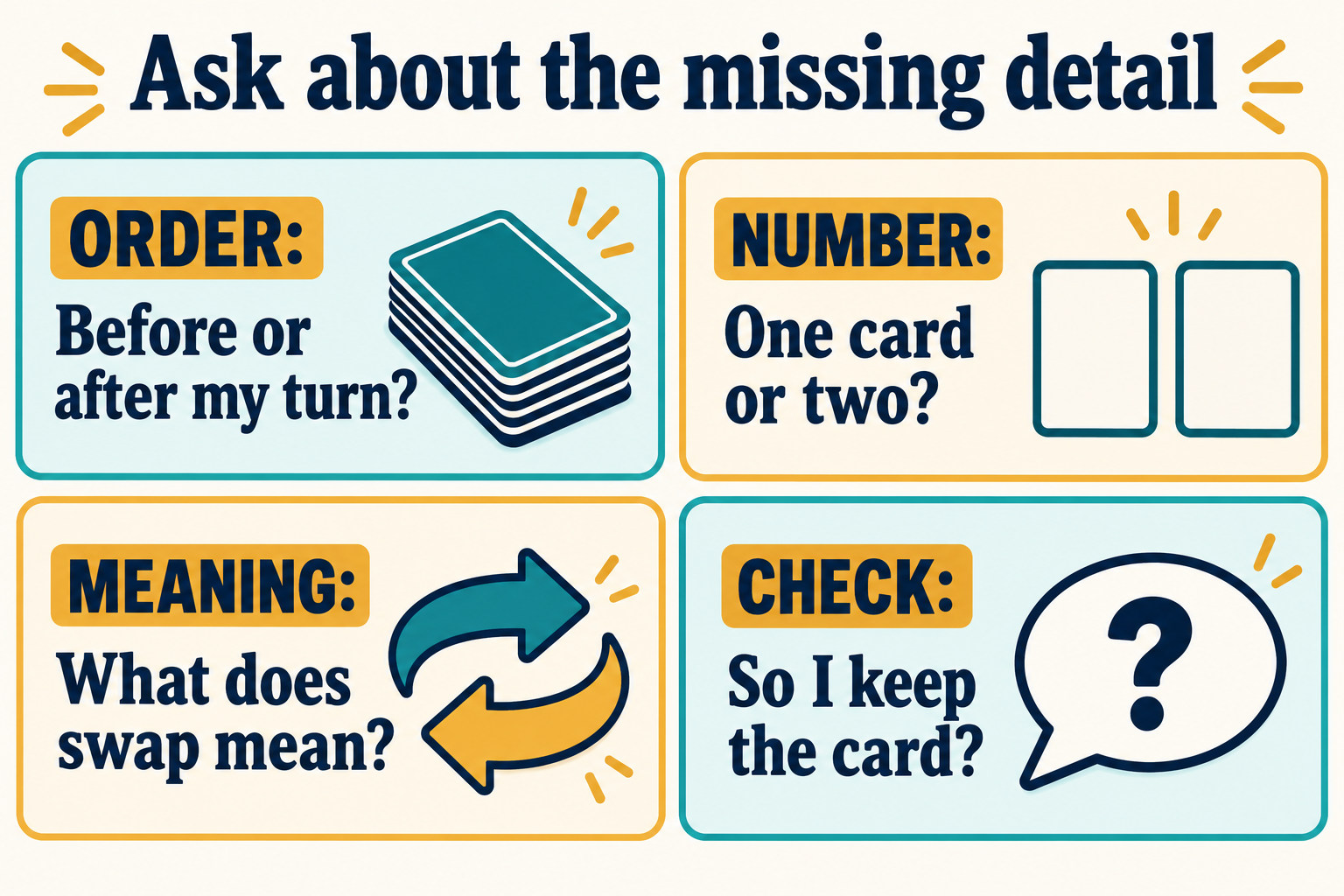
The image groups useful questions by purpose: order, number, meaning and checking. For order: ‘Before or after my turn?’ For number: ‘One card or two?’ For meaning: ‘What does swap mean?’ For checking: ‘So I keep the card?’ The word swap is an extra practice example, not a rule in the recording.
Listen and learn
Game instructions: clarification dialogue
Open audio separatelyRead the transcript
Nia: Before we begin, each player takes nine cards. Put the remaining cards face down in the middle. We are trying to make sets of three cards with the same symbol.
Ben: Sorry, by a set, do you mean three cards of the same colour?
Nia: The same symbol, such as three stars. The colours do not matter. When it is your turn, take one card from the middle and then choose one card to put down.
Ben: Let me check the order. I take a card first, and put one down after that?
Nia: Exactly. Put the unwanted card face up beside the pile. If you complete a set, place all three cards in front of you. You can only do that during your own turn.
Ben: What do you mean by face up?
Nia: The side with the symbol should be visible. The next player may take that card instead of taking one from the face-down pile.
Ben: So I can take the visible card or a hidden card, but not both?
Nia: That is right. One card in total. If the face-down pile becomes empty, turn the unwanted cards over and use them as the new pile.
Ben: And how do we finish? Is it the first person with three sets?
Nia: Yes. Three complete sets. Call stop when you put down the third set, and we will check the symbols together.
Ben: Great. I understand now. Nine cards to start, one card each turn, and three matching sets to win.
Practice tasks
Try each item before opening the answer. Read the explanation even when your answer is correct.
Answer on paper, then open the explanations below. Enable JavaScript to check answers here.
Your turn · self-review
Apply it and compare
Write or say your own answer first. The models are examples, not the only acceptable answers. Use the checklist to review your work; open responses are not automatically assessed.
Practice only. Your writing stays on this page; it is not submitted or saved.
-
Model answer and explanation
1. Host: “Take two tokens. You can exchange one blue token for a card.” 2. Player: “By exchange, do you mean I give you a token and you give me a card?” 3. Host: “Yes, exactly. Give me one blue token.” 4. Player: “So I use only one token and keep the other?” 5. Host: “That’s right. Keep the second token for later.” 6. Player: “Thanks. One token for one card, and I keep the other token.”
-
Model answer and explanation
Self-check: exactly six turns; one meaning question; one quantity check; an accurate answer; a final paraphrase; no invented extra rule. Speak clearly, allow the other person to finish, and repeat only the detail that still needs clarification.
Full transcript: read after listening
Nia: Before we begin, each player takes nine cards. Put the remaining cards face down in the middle. We are trying to make sets of three cards with the same symbol.
Ben: Sorry, by a set, do you mean three cards of the same colour?
Nia: The same symbol, such as three stars. The colours do not matter. When it is your turn, take one card from the middle and then choose one card to put down.
Ben: Let me check the order. I take a card first, and put one down after that?
Nia: Exactly. Put the unwanted card face up beside the pile. If you complete a set, place all three cards in front of you. You can only do that during your own turn.
Ben: What do you mean by face up?
Nia: The side with the symbol should be visible. The next player may take that card instead of taking one from the face-down pile.
Ben: So I can take the visible card or a hidden card, but not both?
Nia: That is right. One card in total. If the face-down pile becomes empty, turn the unwanted cards over and use them as the new pile.
Ben: And how do we finish? Is it the first person with three sets?
Nia: Yes. Three complete sets. Call stop when you put down the third set, and we will check the symbols together.
Ben: Great. I understand now. Nine cards to start, one card each turn, and three matching sets to win.
Related Lessons






Continue learning this topic
Review an explanation, study examples or try a related practice test.
- Practice test At the University of Maryland, a historic campus farm remains a classroom — C2 English Listening Practice Test
- Practice test At the University of Maryland, a historic campus farm remains a classroom — C2 English Grammar Practice Test
- Practice test At the University of Maryland, a historic campus farm remains a classroom — C2 English Vocabulary Practice Test