
Lesson
C1 · Advanced
Grammar
Make the Notice Clearer: Nominalisation Editing Practice
Unpack dense public notices and choose useful noun phrases in a clear rewrite.
11 min read
1,874 words
Updated Oct 21, 2026

On this page (8 sections)
C1 · 32 minutes · 16 explained checks. Work through the examples, try the questions, then use the final checklist. All people, venues and notices in this resource are fictional.
Read the original notice and fact card
You are editing this fictional community-centre notice for room users. The source is deliberately dense. Use the fact card to recover supported agency, and leave an unknown requester unknown. Your clearer version should help a reader act without silently changing the conditions.
Original notice: The introduction of a new booking system by the centre will take place on Monday. The committee’s approval of the change was given on Friday following a review of room use. Completion of a short induction is required before the use of Room 2 under the new arrangement. The induction will be provided by the caretaker at reception at nine on Monday morning. The recording of each booking will be the responsibility of reception staff, and confirmation of the booking will be sent by email. Access to Room 2 will remain unavailable before the receipt of that confirmation. The cancellation of an existing booking by a user must be communicated to reception before four on the previous day. A request for a review of the first week has been received. The identity of the requester is not included in this notice. The collection of comments by the centre will continue until Friday at noon. An extension of the room’s opening hours may be considered after the review, but no decision on an extension has been made. Existing opening hours therefore remain in force.
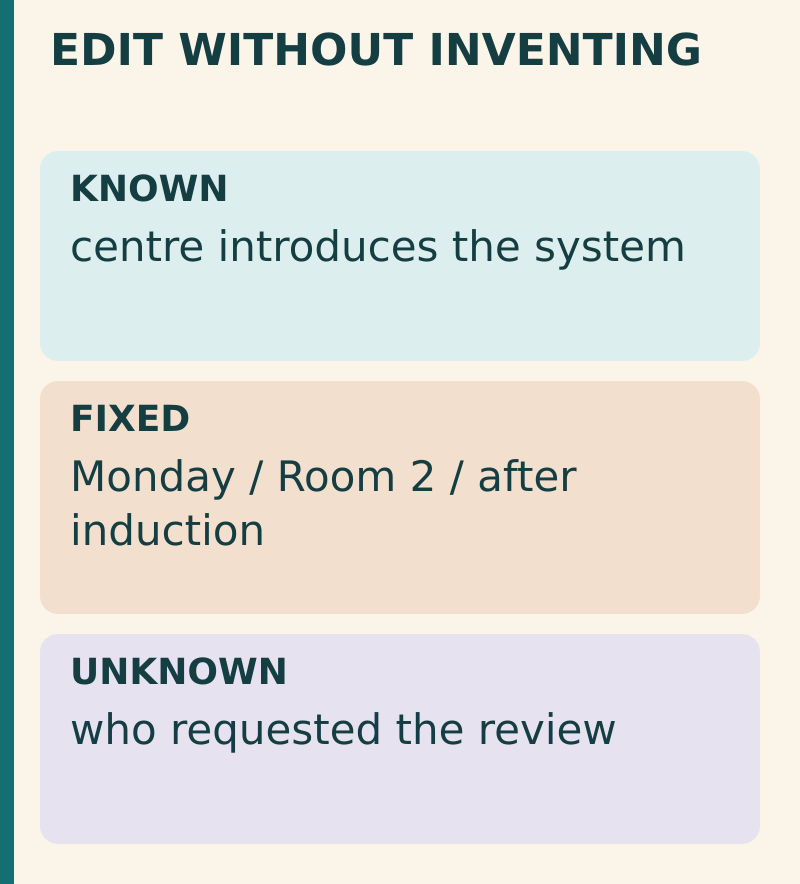
Fact card: The centre introduces the system on Monday. The committee approved the change on Friday. The caretaker provides induction at reception at nine on Monday. Reception staff record bookings and send confirmation emails. Users must complete induction and receive confirmation before using Room 2. Users tell reception about cancellations before four on the previous day. The centre collects comments until Friday noon. The review requester is unknown. Longer hours are only a possibility.
Find the action nouns
Questions 1–4 recover the source verb or adjective behind four nouns. Read the surrounding phrase as well as the suffix. Introduction connects to introduce; approval to approve; confirmation to confirm; extension to extend. A word-family match helps you find the event, but it does not by itself reveal the actor or time.
When rebuilding a sentence, fit the verb into the correct tense and complement pattern. “The centre will introduce” expresses a future plan. “The committee approved” describes an earlier completed decision. A noun often carries less visible tense information, so use the whole source to choose.
Answer on paper, then open the explanations below. Enable JavaScript to check answers here.
Recover the meaning
Questions 5–8 use the actor/action matrix. Some actors are explicit inside by-phrases or possessives, and others are supplied by the fact card. The review requester is deliberately not recoverable. “A request has been received” tells us a request exists, but it does not justify assigning it to users, staff or the committee.
Your matrix should distinguish a missing word you can recover from a supported source from a missing fact that requires clarification. In a public rewrite, preserve the unknown fact or omit it only if the summary’s purpose allows that omission. Never make a likely guess look like confirmed information.
Answer on paper, then open the explanations below. Enable JavaScript to check answers here.
Choose a useful form
Questions 9–12 compare forms for a named audience and focus. Room users mainly need direct instructions, so “Complete the induction” is easier to act on than “Completion of induction is required.” A heading or a repeated reference may still benefit from a noun: “Booking confirmation” is a useful label for information about the email.
Direct wording is not a licence to remove conditions. The source requires both induction and confirmation. A rewrite that mentions only induction may be short and grammatical but still wrong. Keep a useful nominalisation where it earns its place; remove one when it merely hides a straightforward action.
Answer on paper, then open the explanations below. Enable JavaScript to check answers here.
Repair the draft
Questions 13–16 complete controlled rewrites. They keep the main facts visible and avoid marking every valid full-sentence alternative as wrong. For your own notice, different phrasing is acceptable if it preserves the actor, action, object, time and conditions.
Be especially careful with the possible opening-hours extension. “The centre will extend its hours” is not supported. The source says an extension may be considered after a review, with no decision yet. Keep the current hours in force until a confirmed change is announced.
Answer on paper, then open the explanations below. Enable JavaScript to check answers here.
Write the final notice
Write 110–140 words for Room 2 users. Use direct verbs for required actions and one useful noun phrase as a repeated reference or label. Retain the start day, induction time and place, confirmation requirement, cancellation deadline, comment deadline and uncertainty about longer hours. You do not need to invent a name for the requester.
Compare the annotated model after drafting. Then trace each instruction back to the original notice or fact card. If you have moved a condition into a separate sentence, check that readers can still see which action it limits.
Answer key and fidelity audit
The sixteen checks cover four word families, four meaning-recovery decisions, four form-for-purpose decisions and four controlled repairs. The final open notice is reviewed by comparison rather than automatic exact matching. Your fidelity audit should include the genuine unknown, because making an actor visible is valuable only when the source supports that actor.
Your turn · self-review
Model clear notice
Write 110–140 words first. Compare facts and the usefulness of each remaining action noun.
Practice only. Your writing stays on this page; it is not submitted or saved.
-
Model answer and explanation
The centre will introduce its new booking system on Monday. Before using Room 2, complete the induction and wait for your booking confirmation by email. The caretaker will provide the induction at reception at nine on Monday morning. Reception staff will record bookings and send confirmations. Tell reception about any cancellation before four on the previous day. The centre will collect comments until Friday at noon. Someone has requested a review of the first week, but the notice does not identify that person. Longer opening hours may be considered after the review; no decision has been made, so existing hours still apply. The committee approved the booking change on Friday.
Why this model is faithful: Direct verbs identify supported actors and actions. Booking confirmation remains a useful topic noun. Both access conditions and the two deadlines survive. Someone preserves the unknown requester. May be considered and no decision prevent an invented promise about longer hours.
Your final check
Read the complete sentence or source again. Check the actor, action, time, quantities, conditions and intended meaning. Explain why your version works rather than memorising its surface form. Revisit any question whose explanation differs from your reasoning.
Related Lessons






Continue learning this topic
Review an explanation, study examples or try a related practice test.
- Practice test Higher borrowing costs make homes, cars and education harder for many households to afford — B2 English Listening Practice Test
- Practice test Higher borrowing costs make homes, cars and education harder for many households to afford — B2 English Grammar Practice Test
- Practice test Higher borrowing costs make homes, cars and education harder for many households to afford — B2 English Vocabulary Practice Test
- Course lesson Nominalisation and formal style – C1: Precision and Expression