
Lesson
B1 · Intermediate
Listening
B1 Listening Practice: Making Plans — Audio and Answers
Practise B1 listening with a making-plans dialogue, original audio and transcript. Try 10 questions with explained answers about changes, times and decisions.
13 min read
2,166 words
Updated Oct 14, 2026
On this page (14 sections)
Practise B1 listening with a making-plans dialogue, original audio and transcript. Try 10 questions with explained answers about changes, times and decisions. This is an original practice conversation, not a recording from an official exam. The level label helps you choose a lesson; it is not a certified assessment of your English.
How to use this listening lesson
Listen once without reading the transcript. Identify the speakers' purpose and the final decision.
Read the ten questions and listen again. Write your own answers before looking at the key.
Check each answer against the matching speaker turn in the transcript. Replay any detail you missed.
Practise the useful phrases aloud, then retell the final arrangement in two or three sentences.
You may pause or repeat the audio as often as you need. One correct answer earns one practice point, giving a total out of ten. Your score is a learning check, not an official proficiency result. If an answer is wrong, focus on the detail that caused the confusion rather than on the number alone.
Listen for changes, not only the first suggestion
When friends arrange a day out, the first place or time they mention is not always the final choice. Listen for words such as instead, though and after. In this conversation, weather changes the activity and work changes the meeting time. Keep those reasons separate so that you can explain both changes accurately.
On a second listening, make three short notes: original plan, reason for the change, final plan. Do not try to write every word. A rejected suggestion is useful evidence, but it must not replace the arrangement that the speakers finally accept.
Useful phrases for making plans
Are we still going to...? — check an existing arrangement.
How about...? — suggest an alternative.
Could we meet at...? — propose a new time politely.
That works — accept a suggestion. Just to check — introduce a final confirmation.
Opposite describes something across from another place. By six on Friday gives a deadline: the booking must happen no later than that time. Running late means arriving later than planned. These phrases help you understand practical arrangements without translating every word separately.
Keep meeting times, deadlines and estimates separate
A meeting time tells you when the friends see each other. A tour time tells you when an activity starts. A booking deadline tells you the latest time to reserve a place. All three can appear in one conversation, so ask yourself what each number describes.
An estimate such as about an hour expresses an expected amount of time, not certainty. When you explain question nine, connect the expected finish time to the market's closing time. Do not assume the tour can never run late or that the conversation gives a real bus timetable.
B1 listening: Maya and Ben make plans
Use the audio player attached to this lesson. Read the transcript after your first listening attempt, or earlier if you need reading support. The named places, arrangements, prices and transport details below are invented for language practice; do not use them as real travel information.
Speaker | Dialogue |
|---|---|
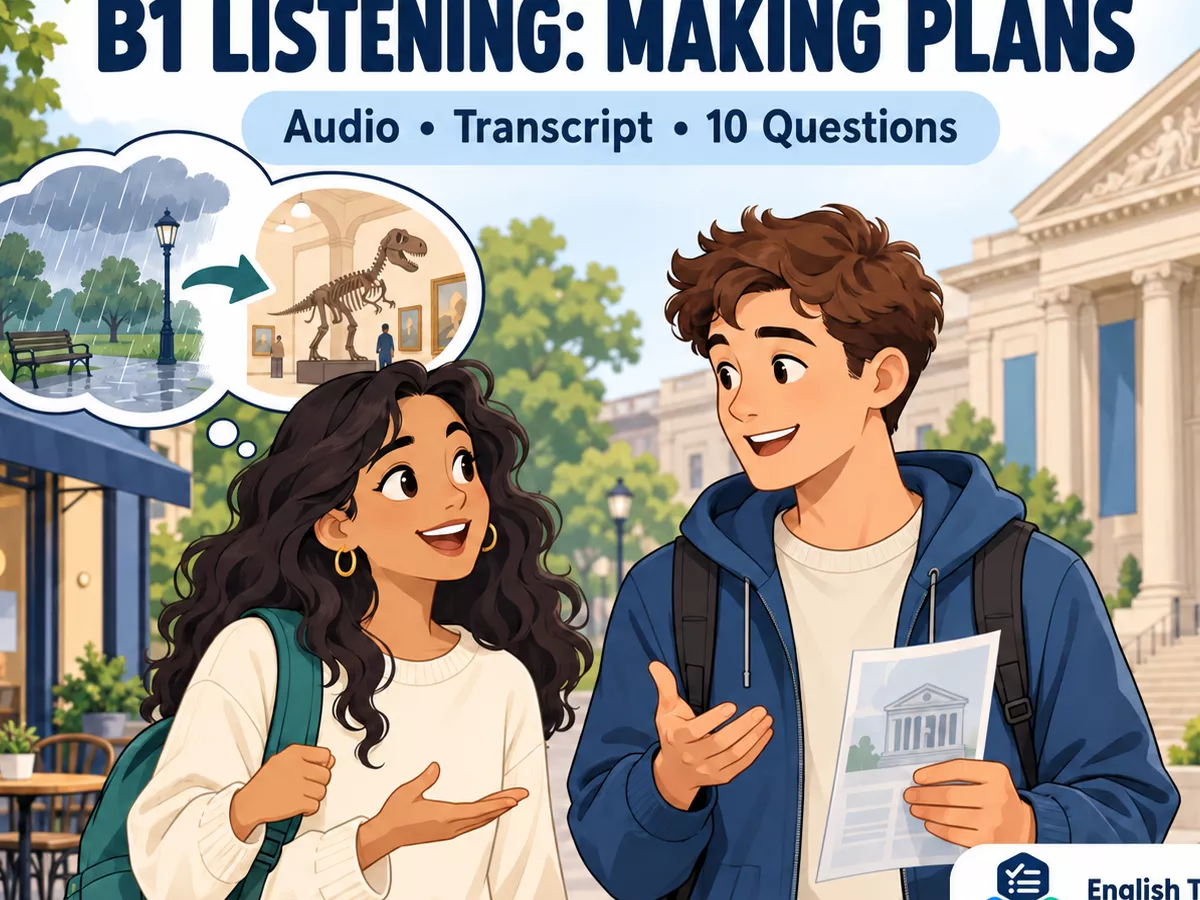
1. Maya | Hi Ben. Are we still going to the park on Saturday? I checked the weather forecast this morning. It says there will be heavy rain in the afternoon. |
2. Ben | Then let's choose something indoors. How about the town museum? The new photography exhibition looks interesting, and the museum is open until six. |
3. Maya | Good idea. I can no longer meet at one, though. My manager has asked me to work until half past one. Could we meet at quarter past two instead? |
4. Ben | Yes, that works. Let's meet at the cafe opposite the museum at two fifteen. We can have a drink before the guided tour, which starts at two forty-five. |
5. Maya | Shall I buy our tickets online? The website says the tour costs eight pounds per person, and we need to book by six on Friday evening. |
6. Ben | Please do. I'll send you my share tonight. I can get bus twenty-one from the library at one forty. It should leave plenty of time to reach the cafe. |
7. Maya | Great. After the museum, could we visit the indoor market? I need a birthday present for my sister. The stalls close at five. |
8. Ben | We should finish the tour by four, so that gives us about an hour at the market. Let's leave the cafe plan as it is and go shopping afterwards. |
9. Maya | All right. I'll book the tickets this evening and message you when I've done it. Please tell me if the bus time changes. |
10. Ben | Of course. Just to check: Saturday, two fifteen, at the cafe opposite the museum. Not inside the museum, and not at the park. |
11. Maya | Exactly. I'll bring the ticket confirmation on my phone. We won't need to print it; the museum accepts the digital version. |
12. Ben | Perfect. I'll see you there. If you're running late after work, send me a message rather than trying to hurry. |
Ten listening comprehension questions
Choose the best answer to each question. Listen for the final agreed details, then use the transcript to check your evidence before reading the explained answer key.
Answer on paper, then open the explanations below. Enable JavaScript to check answers here.
Answers and explanations
Complete each exercise and choose Check my answers to reveal its answers and explanations. You can also open the complete answer key below for self-study.
Show the complete answer key (1–10)
A. Heavy rain is forecast for the afternoon. Maya reports the forecast before Ben suggests an indoor alternative. They do not change the plan because the park is closed. Evidence (turn 1): “It says there will be heavy rain in the afternoon.”
B. The town museum. Ben suggests the town museum and its photography exhibition. The indoor market is an additional activity later. Evidence (turn 2): “How about the town museum?”
C. She has to work until half past one. Her manager has asked her to stay at work until 1:30. This changes the meeting time, not the day. Evidence (turn 3): “My manager has asked me to work until half past one.”
A. 2:15 p.m. Maya proposes quarter past two and Ben accepts it. Two forty-five is the tour's start time, so it is not the meeting time. Evidence (turn 4): “at two fifteen”
B. At the cafe opposite the museum. The final check confirms the cafe opposite the museum, not inside the museum. Listen for the location word opposite. Evidence (turn 10): “at the cafe opposite the museum”
C. 6:00 p.m. on Friday. This is the booking deadline. It is different from the museum's closing time of six and the Saturday meeting time. Evidence (turn 5): “we need to book by six on Friday evening”
A. By bus 21 from the library. Ben names both the bus number and the starting point. Maya does not describe her own route in the conversation. Evidence (turn 6): “bus twenty-one from the library”
B. To buy a birthday present for her sister. Maya explicitly gives the reason. Buying tickets and meeting for a drink are separate tasks. Evidence (turn 7): “I need a birthday present for my sister.”
C. One hour. Ben expects the tour to finish by four and the market stalls close at five. This is their estimate, not a guarantee that the tour will finish on time. Evidence (turn 8): “that gives us about an hour at the market”
A. A digital confirmation on her phone. Maya says the digital version is accepted, so printing is unnecessary in this fictional situation. Evidence (turn 11): “I'll bring the ticket confirmation on my phone.”
Check your learning
Choose Check my answers at the end of each exercise to see your score and explanations, up to 10 points in total. Accepted alternatives also count. Record your first attempt, then use Try again to practise mistakes. This is practice, not a CEFR level test, and your answers are not saved.
If an old plan confused you, replay the change and final confirmation, then note the accepted arrangement.
If a number confused you, label it as a meeting time, tour time, bus number or booking deadline.
Retell the final plan without the transcript, then listen again to check the details you included.
Build your own short conversation
Use the speakers' phrases in a new situation, but change the names and details. Take turns making a request, responding, asking for clarification and confirming the final information. Record yourself if you wish, then listen for understandable numbers, natural pauses and complete questions. Accuracy matters more than copying the voices exactly.
Frequently asked questions
Should I read the transcript before listening?
Try one listening without it if that feels manageable. Then use the transcript to connect unfamiliar sounds with words and check your evidence. Reading support is useful; the aim is gradually to need it less, not to avoid it completely.
How can I avoid choosing an old arrangement?
Note any change words and mark the final confirmation near the end. Here, the first plan is the park and an earlier meeting time, but those details are replaced. The answer must describe the accepted plan, not merely a number or place you heard.
Does a score of ten prove that my English level is B1?
No. This is one practice dialogue with a B1 learning focus. A complete level assessment samples several tasks and skills. Use this score to decide which listening details need more practice, not as a qualification or a guaranteed level.
Continue practising
Build a regular listening routine; Review everyday English vocabulary
Choose a small listening target for your next practice session: a time, a reason, a price or a final decision. Keeping that target specific makes it easier to notice improvement. Return to this lesson after a few days and see whether you can understand the conversation without opening the transcript.
Related Lessons



Continue learning this topic
Review an explanation, study examples or try a related practice test.
- Practice test UNLV Introduces a Minor in Teaching Mariachi as Demand for Instructors Grows — C2 English Listening Practice Test
- Practice test UNLV Introduces a Minor in Teaching Mariachi as Demand for Instructors Grows — C2 English Grammar Practice Test
- Practice test UNLV Introduces a Minor in Teaching Mariachi as Demand for Instructors Grows — C2 English Vocabulary Practice Test