
Lesson
A2 · Elementary
Reading
Find the Right Room at Riverside Centre
Use a two-floor directory, four visitor cards and two dated updates to find accurate room information at fictional Riverside Centre.
9 min read
1,470 words
Updated Oct 19, 2026
On this page (7 sections)
A2 • 26 minutes • 16 scored checks. Use a two-floor directory, four visitor cards and two dated updates to find accurate room information at fictional Riverside Centre.
A first visit to Riverside Centre
It is 10 October in this fictional scenario. You are visiting Riverside Centre for the first time. The directory uses a British-style convention: ground floor is the entrance level; first floor is one level above. G at the beginning of a room number means ground floor. Numbers beginning with 1 are first-floor room identifiers, not lesson times.
Read the ordinary directory and four visitor cards first. Later, you will receive two dated updates. Use the ordinary entries for questions that say before the updates, then apply the new information only to the affected service. This is a reading task, so no spoken directions or real-world route is required.
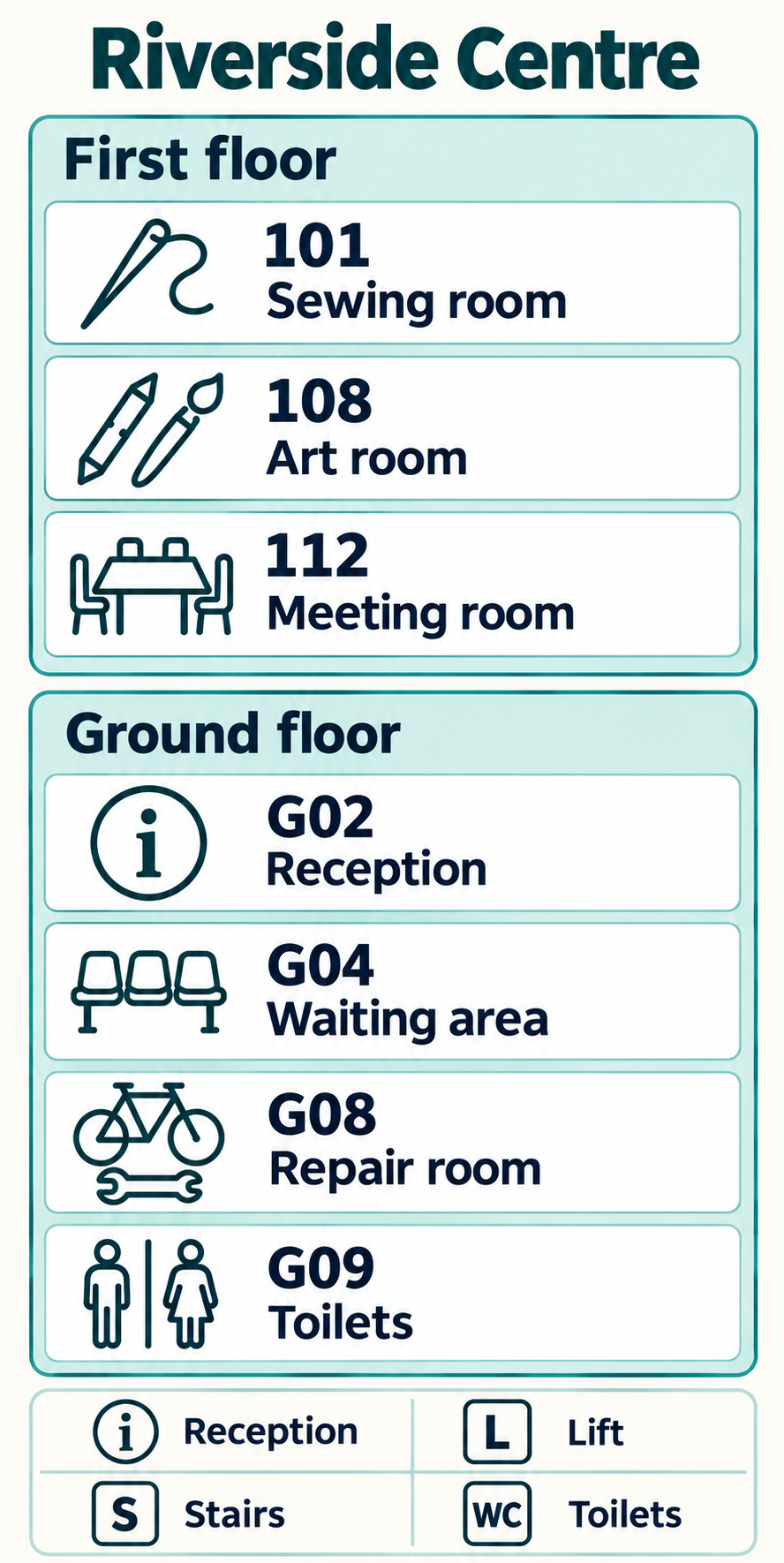
Floor | Room | Service |
|---|---|---|
Ground floor | G02 | Reception: registration and visitor questions |
Ground floor | G04 | Waiting area: seats before appointments |
Ground floor | G08 | Repair room: bicycle repair workshop |
Ground floor | G09 | Toilets |
First floor | 101 | Sewing room: sewing class |
First floor | 108 | Art room: drawing class |
First floor | 112 | Meeting room: book club |
Visitor | Stated purpose |
|---|---|
A • Mara | I need to register for my first visit. |
B • Ivo | I am here for the bicycle repair workshop. |
C • Noor | I want to join the drawing class. |
D • Ellis | I am meeting the book club. |
Identify the facility words
The plan key uses i for reception and information, L for lift, S for stairs and WC for toilets. Lift / elevator carries visitors between floors. Stairs are steps between floors. The words toilets and restrooms name the WC facility. Reception handles registration and visitor questions; the waiting area has seats before appointments.
Match the four descriptions to facility names. Read the complete definition. Waiting and registration are different purposes even if the two places are near each other. A room's name does not tell you every service it offers, so keep your answers within the definitions printed here.
Answer on paper, then open the explanations below. Enable JavaScript to check answers here.
Read the directory entries
Find each entry and read across its row. The floor column names a level. The room column supplies the identifier. The service column tells you what happens there. Do not answer a floor question with a room number or a room question with a facility name.
Write only the requested detail in the next six answers. For the sewing-class question, use its ordinary location at this stage. The later update has its own questions. This separation lets you practise reading both a stable directory and a new notice without confusing their time frames.
Answer on paper, then open the explanations below. Enable JavaScript to check answers here.
Match visitors to rooms
Match the four visitors to the directory's room numbers. Use the purpose each person states. Mara's registration request needs a service point, whereas Ivo, Noor and Ellis name activities. The matches are about the source information only; do not infer additional needs.
After each answer, use the feedback to compare a phrase from the visitor card with a phrase from the directory row. Matching words can be useful here because the activity names are explicit. Still check the floor and number in that same row so you do not copy a neighbouring location.
Answer on paper, then open the explanations below. Enable JavaScript to check answers here.
Apply a temporary update
Notice 1: Today, 10 October: the sewing class is in Room 108 instead of Room 101. The drawing class still uses Room 108 at its usual separate time. Notice 2: The waiting area in G04 is closed today. Reception in G02 remains open.
Apply these notices exactly. Instead of replaces the ordinary room for today's sewing class. Still preserves the drawing-class location. Remains open tells you that reception has not closed with the waiting area. The notices give no class times, so do not invent them or claim the two classes happen together.
Answer on paper, then open the explanations below. Enable JavaScript to check answers here.
Review the evidence
Review all sixteen answers through their feedback. The explanations cite a directory row, facility-key definition or dated notice. If your answer named a correct facility on the wrong floor, correct both fields in your notes. A partial match is not enough when the visitor needs a full location.
The updated information affects the sewing class and the waiting area only. It does not move the repair workshop or book club. A good reading habit is to keep unaffected rows unchanged until a source explicitly changes them. This avoids turning a small update into a building-wide claim.
Write a concise visitor information card
Write a 30–45-word information card for a visitor attending today's sewing class. Name the activity, today's floor and room, the date limit and a place for questions. You can use reception's normal directory entry because Notice 2 explicitly keeps it open.
Your card should inform, not invent directions. You do not need to describe turning left, taking a particular stairwell or arriving at an unstated time. Check the floor-number convention and current room before comparing your card with the model.
Your turn · self-review
Your transfer task
Write your own response first, then open the model and compare. Checklist: 30–45 words; activity; floor and current room; date scope; no invented route or time.
Practice only. Your writing stays on this page; it is not submitted or saved.
-
Model answer and explanation
Today, 10 October, the sewing class is in first-floor Room 108 instead of Room 101. This change is for today. If you have visitor questions, reception remains open in ground-floor Room G02.
Related Lessons





Continue learning this topic
Review an explanation, study examples or try a related practice test.
- Practice test U.S. Job Seekers Are Taking Longer to Find Work as Hiring Slows — C1 English Listening Practice Test
- Practice test U.S. Job Seekers Are Taking Longer to Find Work as Hiring Slows — C1 English Grammar Practice Test
- Practice test U.S. Job Seekers Are Taking Longer to Find Work as Hiring Slows — C1 English Vocabulary Practice Test