
Lesson
A2 · Elementary
Reading
What Needs Repair? Match the Object Descriptions
Match five fictional repair-café objects to precise intake notes. Eighteen explained vocabulary and reading checks focus on materials, parts and distinguishing evidence.
11 min read
1,834 words
Updated Oct 21, 2026

On this page (7 sections)
The repair café intake board
This is a fictional object-description task at a repair café. Match the notes to the object cards, then write a short description using only known features.
The illustration shows five objects in order A–E. The accessible descriptions below give the same observable features and the materials supplied in the records. You can complete the whole lesson using this text. None of the descriptions contains the matching note number.
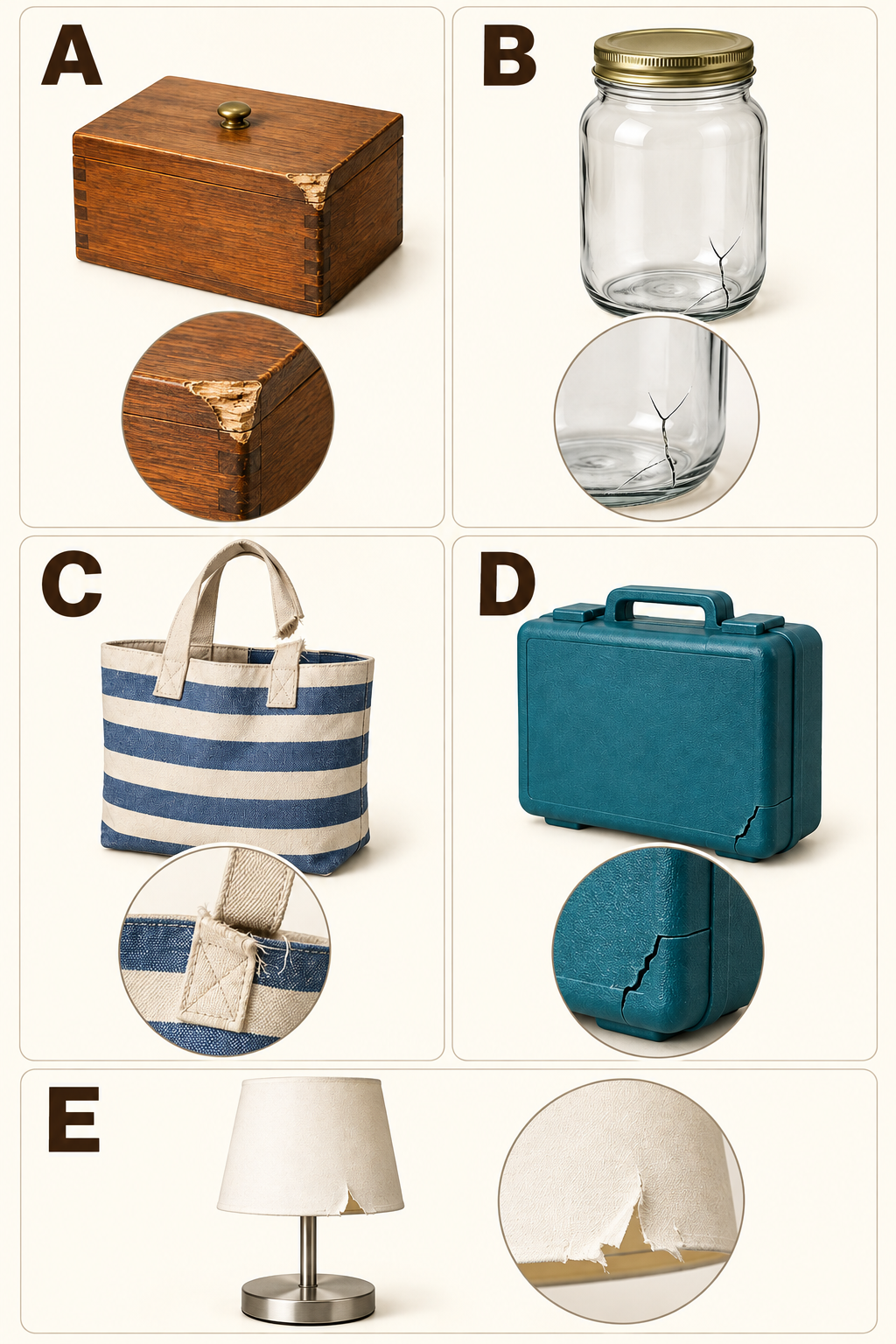
Important: material information comes from the written object records. The picture alone may not distinguish glass from clear plastic or cotton from another fabric.
Sort the word bank
Word bank: cotton, wooden, metal; round, rectangular, flat; smooth, rough, soft; lid, handle, strap. Material tells you what an object is made of. Shape tells you its form. Texture describes a surface or feel. Part names one component of an object. Here soft is grouped with texture or feel; it does not name a material.
Say one short phrase for each category: cotton bag, round lid, smooth side, metal handle. A phrase can contain more than one category, but each question asks about one word.
Answer on paper, then open the explanations below. Enable JavaScript to check answers here.
The six checks sample the word bank. In your notes, sort the other six too: metal is material; round and flat are shape or form; rough and soft describe texture or feel; handle is a part. This review is unscored.
Match notes to objects
Read the five notes. Each note gives several clues. Choose the image whose accessible description matches all the clues. You may use an image only once in this set. Do not decide from the word rectangular alone: two objects are rectangular.
Answer on paper, then open the explanations below. Enable JavaScript to check answers here.
Find the distinguishing feature
Sometimes two objects share almost everything. A useful description names the small feature that separates them. In the next three comparisons, the second object is described in the question. Read both descriptions before answering.
Answer on paper, then open the explanations below. Enable JavaScript to check answers here.
Notice what did not help: both boxes are wooden, both bags are cotton, and both lamps have arms. “Wooden”, “cotton” and “arm” are accurate words, but they do not distinguish these specific pairs. The knob, stripes and straight arm do.
Complete accurate intake descriptions
Use each word once: wooden, lid, smooth, narrow. The sentence context and the object record work together. Do not add an adjective because it sounds attractive; use the one supported by the source.
Answer on paper, then open the explanations below. Enable JavaScript to check answers here.
The accurate version uses the supplied material and shape to help the reader identify the object.
Evidence-based answer review
Notes 1–5 match B, C, E, D and A. For each answer, identify two source details: B has a round glass body and a metal lid; C is striped cotton with two short handles; E has a straight arm and a paper shade; D is hard plastic with a carrying handle; A is wooden with a metal knob.
A and D are the closest distractor pair. They are both rectangular containers with lids, so those two shared facts do not settle the answer. The supplied material and the knob-versus-handle distinction do. B has a lid too, but its body is round and glass.
The feature answers are knob, stripes and straight. The gap answers are wooden, lid, smooth and narrow. Their feedback quotes the source. If your wording has the same meaning, use the accepted variants or compare it with the model. Do not replace a more precise answer with an unrelated true fact.
Write a two-sentence object card
Choose Image C or E. Use a material word and at least one distinguishing feature. You may also mention the supplied condition.
Your turn · self-review
Transfer task: your turn
Four-point self-check: correct object; at least one supplied material; at least one distinctive feature; two understandable sentences.
Practice only. Your writing stays on this page; it is not submitted or saved.
-
Model answer and explanation
Model C: It is a striped cotton bag. It has two short handles, and one is loose. Model E: It is a lamp with a round metal base and a paper shade. Its arm is straight, and the shade has a small tear.
Review Materials and Shapes in English: Describe Everyday Objects if you mixed up material, shape and part. Then describe another fictional item from memory and check it against its source card.
Related Lessons






Continue learning this topic
Review an explanation, study examples or try a related practice test.
- Practice test What Time Is It on the Moon? Scientists Consider How Lunar Clocks Could Work — C1 English Listening Practice Test
- Practice test What Time Is It on the Moon? Scientists Consider How Lunar Clocks Could Work — C1 English Grammar Practice Test
- Practice test What Time Is It on the Moon? Scientists Consider How Lunar Clocks Could Work — C1 English Vocabulary Practice Test