
Guide
C1 · Advanced
Grammar
Nominalisation Editing Toolkit: Recover Who Did What
Use a fact matrix, ambiguity triage and a four-pass audit to make nominalised notices clearer without inventing facts.
9 min read
1,447 words
Updated Oct 20, 2026

On this page (9 sections)
C1 · 25 minutes · 8 explained checks. Work through the examples, try the questions, then use the final checklist. All people, venues and notices in this resource are fictional.
Start with an actor/action/fact matrix
Nominalisation turns an action, process or quality into a noun: decide becomes decision, improve becomes improvement, arrive becomes arrival and accurate becomes accuracy. A related noun can help us discuss a whole event as one topic. It can also make a notice heavy or hide who is responsible. This toolkit gives you a repeatable way to edit a dense notice without guessing missing facts. If locating this core is difficult, first find the subject and main verb, then return to the actor/action matrix.
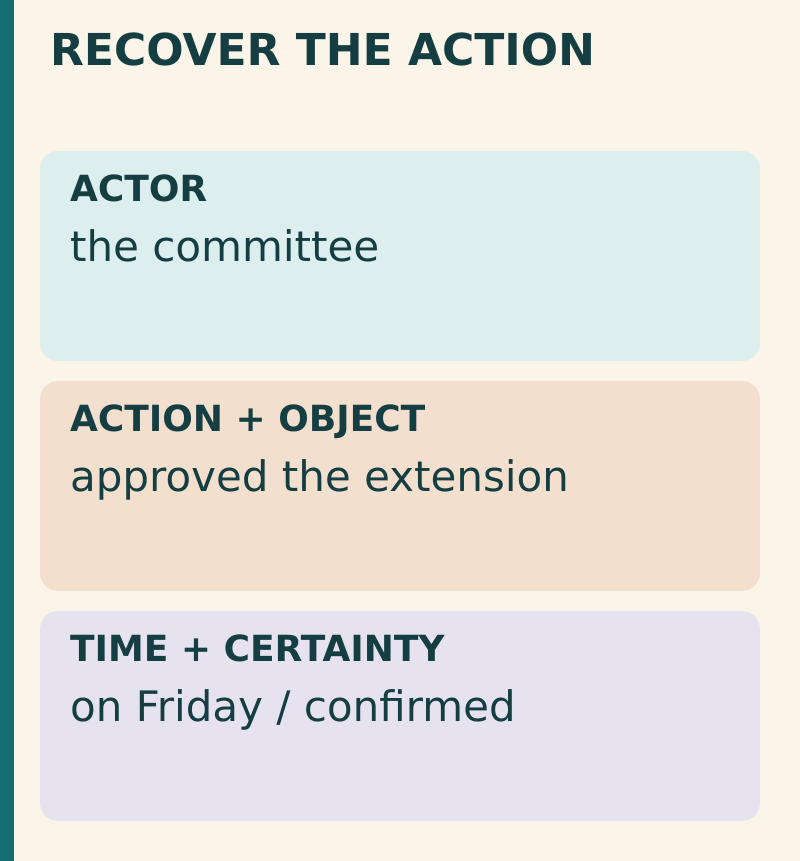
Write five boxes before rewriting: actor; action; object or affected person; time; certainty or condition. For “The committee’s approval of the extension was given on Friday,” the boxes are committee / approved / the extension / Friday / confirmed event. A clear revision is “The committee approved the extension on Friday.” Every fact has a place. The shorter version is useful because the noun-plus-light-verb structure was doing little extra work.
Learn the word family, then the whole pattern
Suffixes are clues, not automatic conversion machines. Improvement is related to improve; arrival to arrive; accuracy to accurate. A dictionary can confirm unfamiliar forms and complements. Do not invent an action noun by attaching -tion to any verb. Some related nouns also have meanings that are not simple names for the action: a building can be an object, and an application can mean a request or a piece of software.
Check the full phrase. “The team decided to postpone the event” becomes “the team’s decision to postpone the event.” The possessive keeps the decision-maker visible, while to postpone keeps the decision’s content. “The approval of the plan by the panel” identifies the plan as what was approved and the panel as who approved it. A change in structure still needs appropriate determiners, prepositions and agreement.
Triage agency: known, recoverable or unknown
Case 1, known in the phrase: “the manager’s cancellation of the meeting.” The manager cancelled the meeting. Case 2, recoverable from a source: a fact card says the caretaker inspected Room 2, and the notice refers to “the inspection.” You can name the caretaker only because that source supplies the actor. Case 3, unknown: “A request for review has been received.” Without more context, the requester is not identified.
Do not turn the third case into “Residents requested a review” merely because residents are plausible. Keep the gap visible: “Someone has requested a review” or “We have received a request for a review,” if the receiving we is independently established. For a public notice, you may need to ask the author who requested it. Grammar cannot recover information that the document never gives.
Unpack noun stacks before rebuilding them
“Room access review arrangements” could mean arrangements for reviewing access to a room, or arrangements arising from a review of room access. The nouns alone do not always settle the relation. Ask what event happened and what action is now required. If the intended meaning is arrangements for a review, write “arrangements for reviewing access to Room 2.” If a review produced new arrangements, write “the new room-access arrangements agreed after the review.”
A stack can be compact and familiar within a team, yet unclear to newcomers. Expand it long enough to establish the relation, then choose the shortest unambiguous wording for your reader. Do not treat a hyphen as a cure for every hidden relationship. Punctuation can group words, but it cannot tell you an unknown agent or an unstated decision.
Keep useful topic nouns
Not every nominalisation needs removal. Suppose a notice explains that the centre will introduce a booking system on Monday. The next sentence can say “The introduction will take one day.” Introduction efficiently refers back to the event without repeating the full clause. A heading such as “Booking confirmation” can also help readers scan a page.
Compare three versions: “The centre will introduce the new system on Monday.” “The introduction of the system by the centre will take place on Monday.” “The centre will introduce the new system on Monday; the introduction will take one day.” The first is direct, the second is unnecessarily heavy for a simple announcement, and the third uses a noun for a useful repeated reference. Audience and purpose determine the best balance.
Run a four-pass fidelity audit
Pass 1, recover: underline action nouns and fill the actor/action/object/time/condition matrix. Mark unknown information explicitly. Pass 2, decide: keep nouns that establish a useful topic or prevent clumsy repetition; restore direct verbs where they make instructions clearer. Pass 3, rebuild: choose subjects and finite verbs, repair complements and agreement, then read complete sentences.
Pass 4, verify: compare the revised notice with the source in both directions. Did you keep not, may, only, after and any deadline? “A possible extension of opening hours” cannot become “We extended opening hours.” The original states a possibility, not a completed action. “The reduction in delays is welcome” has singular reduction as the head, even though delays is plural. A grammatical rewrite still fails if it changes time, certainty, quantity or agency.
Eight checks and a clarity decision card
Use the checks below to practise word families, actor recovery and precise revision. For a real notice, your decision card is: Can I name the action? Is the actor stated or supported elsewhere? Does this noun help the reader follow the topic? Would a direct verb make the required action easier to find? Which facts must survive?
A responsible edit sometimes leaves a question for the source author. “Approval was given” can be made shorter only after you know who gave it, unless a passive such as “The plan was approved” best preserves the genuine information gap. Clear writing includes honest uncertainty. It does not require every sentence to have a newly invented human subject.
Check your understanding
Choose the best answer for the stated purpose. In short answers, type only the requested words. For open rewrites, compare meaning as well as form: other well-formed answers may be possible. Each submitted answer reveals an explanation.
Answer on paper, then open the explanations below. Enable JavaScript to check answers here.
Your final check
Read the complete sentence or source again. Check the actor, action, time, quantities, conditions and intended meaning. Explain why your version works rather than memorising its surface form. Revisit any question whose explanation differs from your reasoning.
Related Guides






Continue learning this topic
Review an explanation, study examples or try a related practice test.
- Practice test What Time Is It on the Moon? Scientists Consider How Lunar Clocks Could Work — C1 English Listening Practice Test
- Practice test What Time Is It on the Moon? Scientists Consider How Lunar Clocks Could Work — C1 English Grammar Practice Test
- Practice test What Time Is It on the Moon? Scientists Consider How Lunar Clocks Could Work — C1 English Vocabulary Practice Test
- Course lesson Nominalisation and formal style – C1: Precision and Expression