
Guide
B1 · Intermediate
Grammar
Subject–Verb Agreement: Find the Subject, Choose the Verb
Find the subject head before choosing is/are, has/have, do/does or present-simple endings. Includes twelve explained checks and a two-pass proofreading routine.
7 min read
1,122 words
Updated Oct 29, 2026

On this page (7 sections)
If these verb forms are new to you, review basic be and present-simple forms before working with longer subjects.
1. Find the subject before the verb
The box is here. The box of spare keys is here. The box of spare keys beside the chairs is here. The sentence grows longer, but its main subject word remains box. That singular head controls is. Keys and chairs belong to describing phrases.
Subject–verb agreement means choosing a verb form that matches the subject. Do not simply choose the nearest noun before the verb. First find who or what the sentence is about. Then identify the head of that subject phrase.
2. The core form map
A compact present-tense map
I
Special form of be
I am ready. I have a key. I do the checks. I work here.
you / we / they
Base forms for have, do and most verbs
You are ready. We have keys. They do the checks. They work here.
he / she / it
Third-person singular
She is ready. He has a key. It does the job. She works here.
a singular noun / a plural noun
Match the head
The box is open. The boxes are open.
In a negative or question, do/does carries the present-tense agreement: The list does not include names. Do the lists include names? Keep the following main verb in its base form. Do not write does includes.
Most third-person singular present-simple verbs add -s or -es: works, checks, watches. I and you are important exceptions to a simple “one person means -s” shortcut: I work and you work are correct even when one person is involved.
3. Ignore distracting plural nouns
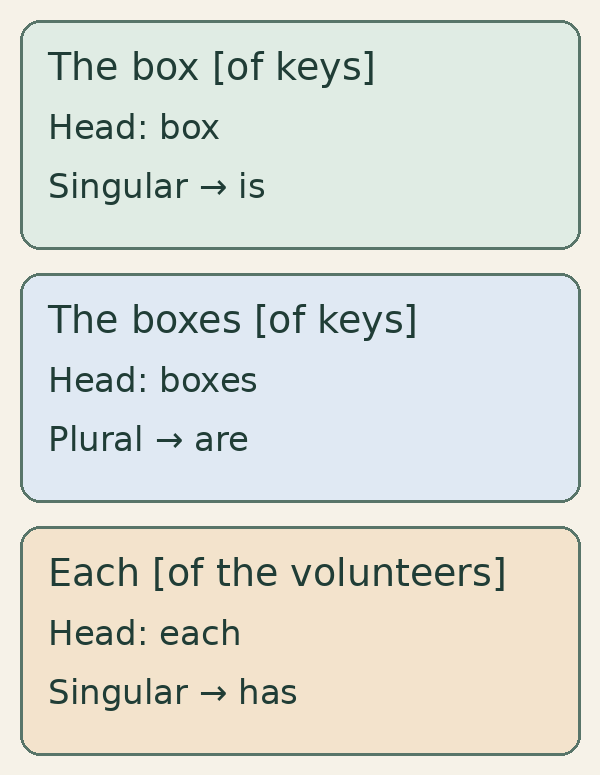
Compare “The box [of keys] is open” with “The boxes [of keys] are open”. Remove the bracketed description in your mind. The remaining subject and verb are The box is or The boxes are. Changing keys to key would not change the number of box or boxes.
The same method works with other phrases: The shelf near the windows is dusty. The shelves near the window are dusty. Windows is closer to the verb in the first sentence, but shelf is the subject head. Words inside a description do not automatically control agreement.
4. Two subjects and special pronouns
Two separate subjects joined by and normally take a plural verb: Ava and Ben work here. The desk and the chair are ready. These straightforward examples refer to two separate people or things.
Everyone, someone and each normally take singular agreement: Everyone knows the plan. Someone has a key. Each of the volunteers is ready. The plural noun volunteers belongs to the of phrase; each is the singular head.
Do not use the number of real people as your only test. Everyone can refer to many people but is grammatically singular. This guide leaves complex either…or and neither…nor agreement for a later stage.
5. Do not overcorrect variation
Collective nouns such as team and family can take different agreement patterns. British English often allows singular or plural agreement depending on whether the group is viewed as a unit or as its members. American edited usage more often prefers the singular for the unit.
Because that variation is real, do not mark “The team are…” wrong in every context. Follow a stated house style and keep the intended viewpoint consistent. The closed questions here avoid collective nouns so that each answer has a clear basis.
6. Trace and correct
For the first four questions, choose the verb. For the next four, type the subject head. Then correct four verb errors.
Answer on paper, then open the explanations below. Enable JavaScript to check answers here.
7. Proofread in two passes
Proofread in two passes. Pass one: find the whole subject, then mark its head. Bracket any following description. Pass two: match the finite verb to that head, checking be, have, do and present-simple endings.
Model: The collection [of maps] is useful. Collection is singular, so is is correct even though maps is plural. Change the head to collections and the verb becomes are. This explains the choice rather than relying on how close a noun sits to the verb.
When you edit someone’s paragraph, change only the error you can explain. Do not replace a legitimate collective-noun variant without a style reason. The neighbourhood-newsletter lesson gives you targeted mistakes and correct sentences to leave alone.
Related Guides






Continue learning this topic
Review an explanation, study examples or try a related practice test.
- Practice test Nearly Two-Thirds of American Teens and Tweens Use AI Chatbots, Surveys Find — C1 English Listening Practice Test
- Practice test Nearly Two-Thirds of American Teens and Tweens Use AI Chatbots, Surveys Find — C1 English Grammar Practice Test
- Practice test Nearly Two-Thirds of American Teens and Tweens Use AI Chatbots, Surveys Find — C1 English Vocabulary Practice Test
- Course lesson The verb be: Am, is and are – A1–A2: Grammar Foundations
- Course lesson Subject pronouns and possessives: I and my – A1–A2: Grammar Foundations
- Course lesson Participle clauses: Clear subjects and time relationships – C1: Precision and Expression