
Guide
B1 · Intermediate
Grammar
Future Time Clauses: When, Until, Before and As Soon As
Connect future events with when, before, after, until and as soon as. Learn the time-clause pattern and its question exceptions with 12 explained checks.
9 min read
1,499 words
Updated Nov 1, 2026

On this page (7 sections)
“I’ll call when I arrive.” One clause gives the action; the other tells us its time. Future time clauses help us explain order, waiting and immediate next steps. This B1 guide covers when, before, after, until and as soon as. Allow about 20 minutes. You should know present simple and basic future forms.
Connect two future events
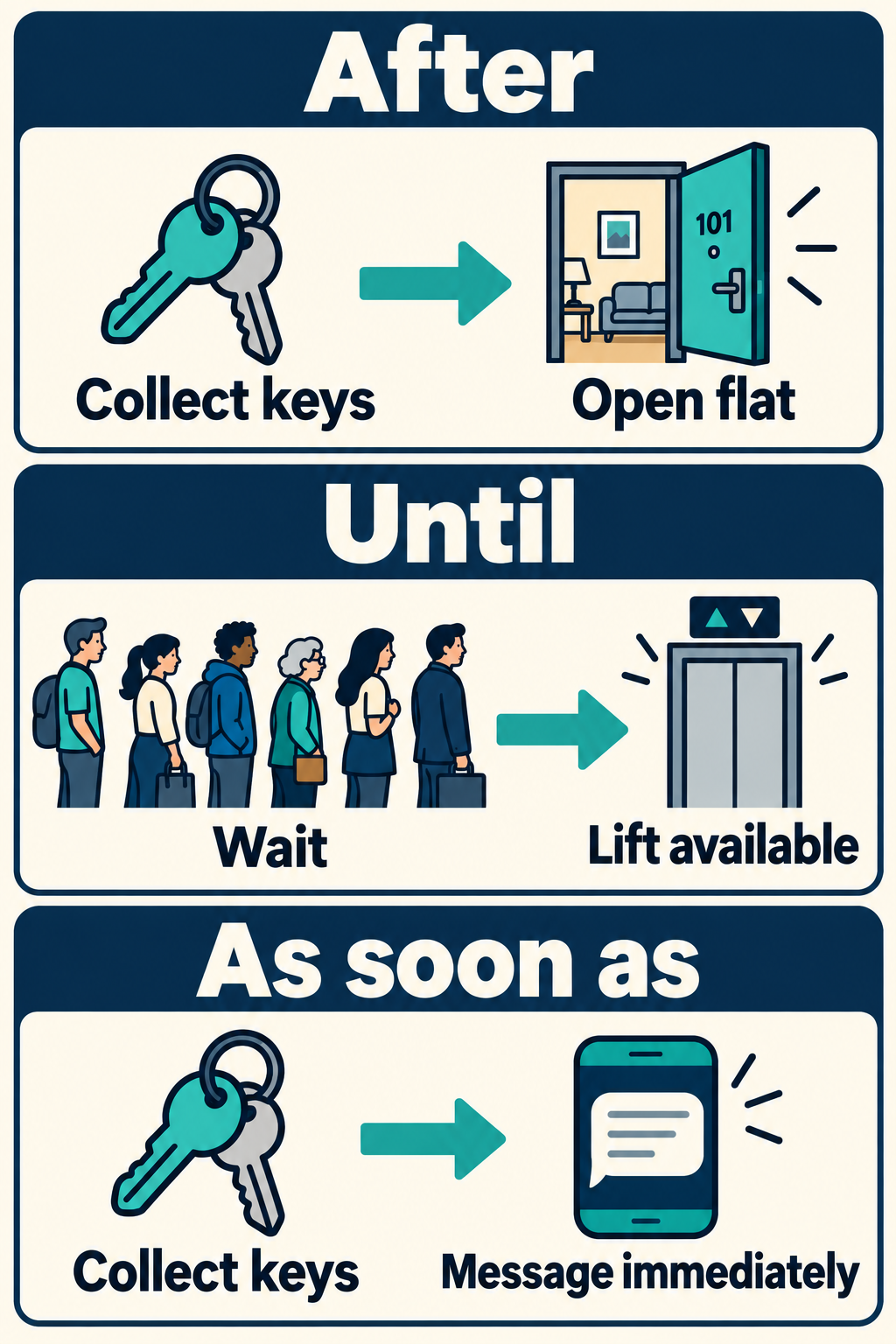
On a fictional move-in day, a team needs keys before it can open the flat. Someone will keep the entrance clear until the furniture arrives. The team will send a message as soon as the keys are collected. These links do different jobs: order, continuation and immediate follow-up.
Choose the relationship before choosing the verb. “We’ll unpack after the boxes arrive” and “We’ll unpack before the boxes arrive” are both grammatical, but they describe different plans. Grammar alone cannot tell you which matches the facts.
The ordinary tense pattern
In an ordinary future time clause, use a present form: “I’ll call when I arrive”, not “I’ll call when I will arrive”. Will belongs in the main clause here. Other main clauses are possible: “Call me when you arrive” gives an instruction. “We can start after everyone arrives” uses can.
This is not a ban on will after the word when. A direct question can ask “When will you arrive?” An embedded question can say “I don’t know when she will arrive.” In those examples, when asks about an unknown time; it does not introduce the time condition for a main action. Compare “I’ll wait here when she arrives”, which links waiting to her arrival.
Before and after for order
“Collect the keys before you open the flat”: key collection comes first. “Open the flat after you collect the keys”: the same order, different wording. The position of a clause on the page does not necessarily show which event happens first.
When the time clause comes first, a comma usually separates it from the main clause: “After the boxes arrive, we’ll unpack them.” With the main clause first, a comma is normally unnecessary: “We’ll unpack them after the boxes arrive.” The meaning stays the same.
Until and as soon as
Until shows continuation up to a point: “We’ll wait until the lift is available.” Waiting continues; availability is the endpoint. As soon as shows an immediate response: “We’ll start as soon as the lift is available.” The start follows availability without an intended delay.
By and until are different. “Finish by six” gives a deadline: no later than six. “Work until six” describes continuing work up to six. Do not use “finish until six” to mean the same deadline. This guide focuses on clauses such as until the lift is available, rather than a full lesson on time prepositions.
When, if and completion
When often presents an event as expected: “When the furniture arrives, we’ll carry it in.” If presents an uncertain condition: “If the furniture arrives today, we’ll carry it in.” Neither word promises that the delivery will actually happen. Choose the meaning that matches your plan; do not replace every if with when. To compare a time clause with a condition, review how if works in zero and first conditional sentences.
A present perfect time clause can emphasize completion before the next action: “After we have checked the rooms, we’ll return the spare key.” “After we check the rooms” can also be natural. Both are present forms referring to future time. The perfect puts attention on the completed check; it does not need will have inside this ordinary time clause.
Match timelines and repair
Follow the facts given in each question. Some prompts name the linker to keep the answer focused.
Answer on paper, then open the explanations below. Enable JavaScript to check answers here.
Build a dependable plan
Your turn · self-review
Use it yourself
Make your own answer before opening the model. Other accurate answers are possible. Use the checklist to review meaning and form.
Practice only. Your writing stays on this page; it is not submitted or saved.
-
Model answer and explanation
Collect the keys before you open the flat. Wait until the lift is free. Send a message as soon as you arrive. Checklist: preserve each relationship; use a present form in each time clause; keep the instruction clear. Equivalent wording is possible.
Check the relationship, not just the verb. What happens first? What continues? Is an immediate response required? Then check the present form inside the future time clause and the comma if that clause comes first.
Related Guides






Continue learning this topic
Review an explanation, study examples or try a related practice test.
- Practice test First-Time Homebuyers Are Scarce, but More Are Paying Cash — B1 English Listening Practice Test
- Practice test First-Time Homebuyers Are Scarce, but More Are Paying Cash — B1 English Grammar Practice Test
- Practice test First-Time Homebuyers Are Scarce, but More Are Paying Cash — B1 English Vocabulary Practice Test
- Course lesson Negative inversion: Never, rarely and not until – C1: Precision and Expression
- Course lesson Future time clauses: When, until and as soon as – B1–B2: Grammar in Context
- Course lesson Participle clauses: Clear subjects and time relationships – C1: Precision and Expression