
Guide
B1 · Intermediate
Grammar
Embedded Questions: Do You Know Where It Is?
Put questions inside requests, statements and reports using statement order and whether/if.
9 min read
1,578 words
Updated Oct 31, 2026

On this page (12 sections)
B1 • About 20 minutes. Use subject-before-verb order inside an embedded question. Use if/whether for yes/no content. Keep subject-question order where the question word is already the subject. Choose end punctuation from the whole main clause.
Before working with a question inside another sentence, review subjects and verbs in a sentence.
A question inside another sentence
“Where is the desk?” is a direct question. “Do you know where the desk is?” puts that information question inside a larger question. “I wonder where the desk is” puts it inside a statement. The inner part, where the desk is, is an embedded interrogative clause. It keeps the question meaning but normally uses statement word order.
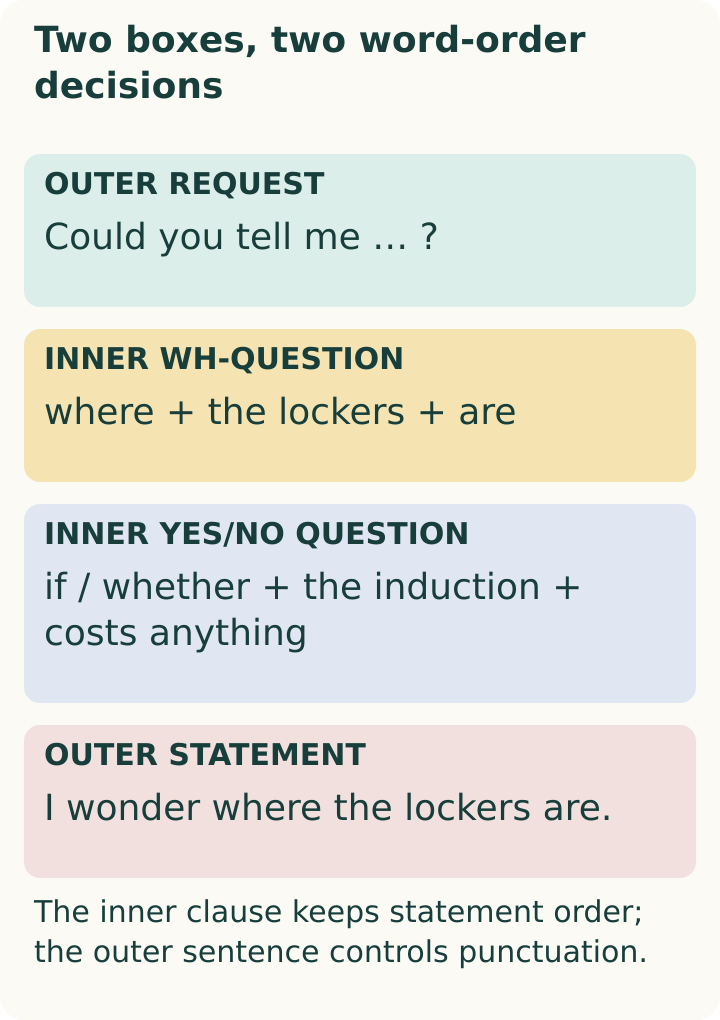
Imagine two boxes. The outer box tells you what the speaker is doing: asking whether someone knows, requesting information, expressing uncertainty or reporting a question. The inner box names the information wanted. In “Could you tell me where the desk is?”, the outer request is Could you tell me and the inner question is where the desk is.
Check each box separately. The outer question has could before you. The inner clause has the desk before is. Seeing a question mark at the end does not mean that every clause inside the sentence must have question word order. This two-box check is more reliable than trying to rearrange the entire sentence at once.
Statement order inside the clause
With be, move from “Where are the lockers?” to “Could you tell me where the lockers are?” With a modal, move from “When can we enter?” to “Do you know when we can enter?” With perfect have, move from “Where has she gone?” to “I wonder where she has gone.” The inner subject comes before its verb or first auxiliary.
Direct questions with do, does or did need an additional step. “When does the desk open?” becomes “Do you know when the desk opens?” Remove does from the embedded clause and put the present-simple ending on opens. “Where did Ben put the keys?” becomes “Do you know where Ben put the keys?” The past form put happens to look like the base form, but it still carries past time.
Use a verb with a visible past form to see the change: “When did she arrive?” becomes “I wonder when she arrived.” Do not keep did and add arrived. The embedded clause is when she arrived, not when did she arrived. The outer clause may still contain do: Do you know when she arrived? That do belongs to the outer question.
Not every do must disappear. In “Do you know what she does?”, does is the main verb meaning performs or works at, not a question auxiliary. In “I wonder what he did”, did is also the main verb. Remove only the auxiliary that was used to form the direct inner question.
Yes/no content: if and whether
For an embedded yes/no question, use if or whether: “Is the desk open?” becomes “Do you know if the desk is open?” or “Do you know whether the desk is open?” In this ordinary frame, both are standard. The embedded clause keeps the desk is, not is the desk.
“Does the induction cost anything?” becomes “Could you tell me if the induction costs anything?” Again, remove does and use costs. “Did Sam book?” becomes “I wonder whether Sam booked.” A statement of uncertainty can contain the same embedded content as a request.
If and whether are not interchangeable everywhere. Before a to-infinitive, use whether: “I am deciding whether to book.” Whether also works directly with or not: “I do not know whether or not booking is necessary.” In an ordinary clause, “I do not know if booking is necessary or not” is possible. Learn the complete frame instead of replacing every whether with if.
When the question word is the subject
“Who called?” already has subject-before-verb order because who is the subject. Its embedded form is “Do you know who called?” Do not add did simply because it is a question. “Which key opens this door?” becomes “Can you tell me which key opens this door?” The subject is the whole phrase which key.
Compare the object question “Who did Ben call?” Its embedded form is “Do you know who Ben called?” Ben is the subject and who represents the object. The two meanings are different: who called asks for the caller; who Ben called asks for the person Ben contacted. Preserve that relationship while changing the frame.
Questions, statements and punctuation
Choose final punctuation from the outer sentence. “Could you tell me when the desk opens?” is a question, even though the inner clause has statement order. “I would like to know when the desk opens.” is a statement. “I wonder whether the desk is open.” is also normally punctuated as a statement in careful writing.
Writers sometimes use a question mark with I wonder to create a conversational effect. In these controlled exercises, follow ordinary sentence punctuation and label the outer structure first. Do not call the embedded clause a statement in meaning: it still asks for information. Statement order describes its grammar, not a claim that the information is already known.
Requests, uncertainty and reports
Embedded questions are useful at a service desk, in planning and when talking about interests: “Could you tell me where to collect the materials?”; “I am not sure whether we need to book”; “Do you know who designed the building?” They give you several ways to package a genuine information gap.
A longer form is not automatically more polite. Tone, context and reasonable content matter. “Could you possibly tell me…” cannot turn an intrusive demand into a considerate question. For a routine enquiry, choose a clear short frame and ask for a detail the notice has not already supplied.
In reports, keep the wanted information intact: “She asked where the keys were.” This guide concentrates on word order rather than every reported-speech tense change. If the retelling changes time or speaker, check that separate issue as well. Correct ordering cannot rescue a question about the wrong person, object or time.
Eight checks: apply the rule
Answer before you check. For typed answers, use the requested wording; valid listed variants are accepted. Read the explanation even if your answer is right.
Put the inner clause in order
Answer on paper, then open the explanations below. Enable JavaScript to check answers here.
Choose if or whether
Answer on paper, then open the explanations below. Enable JavaScript to check answers here.
Punctuate the outer sentence
Answer on paper, then open the explanations below. Enable JavaScript to check answers here.
Your decision card
Outer question: Could you tell me … ? Inner clause: where + the lockers + are. For yes/no information: if/whether + subject + verb. Remove inner auxiliary do; restore the main verb’s tense and agreement. Let the outer sentence control final punctuation.
Related learning
Companion resource: A First Visit to the Makerspace: Embedded Question Practice.
Related references for further study: The Hidden Blueprint of a Clear English Sentence; Clarifying and Checking Understanding in English.
Related Guides






Continue learning this topic
Review an explanation, study examples or try a related practice test.
- Practice test What We Know About the $6.3 Billion Binance Cryptocurrency Heist — C1 English Listening Practice Test
- Practice test What We Know About the $6.3 Billion Binance Cryptocurrency Heist — C1 English Grammar Practice Test
- Practice test What We Know About the $6.3 Billion Binance Cryptocurrency Heist — C1 English Vocabulary Practice Test
- Course lesson Present simple questions: Do, does, don't and doesn't – A1–A2: Grammar Foundations
- Course lesson Reported questions and requests: Ask and tell – B1–B2: Grammar in Context
- Course lesson Past simple questions and negatives: Did and didn't – A1–A2: Grammar Foundations