
Guide
A1 · Beginner
Grammar
Adverbs of Frequency and Word Order
Describe how often you do something and place frequency adverbs correctly. Includes a meaning scale, sentence frames and six checks.
6 min read
967 words
Updated Nov 11, 2026

On this page (8 sections)
How often do you do it?
I always read before bed. I sometimes cycle to work. I never play tennis. The words always, sometimes and never describe frequency: how often something happens. They help you talk about habits without listing every date. This guide focuses on useful meanings and the normal word order in simple present sentences.
1. A useful range of meanings
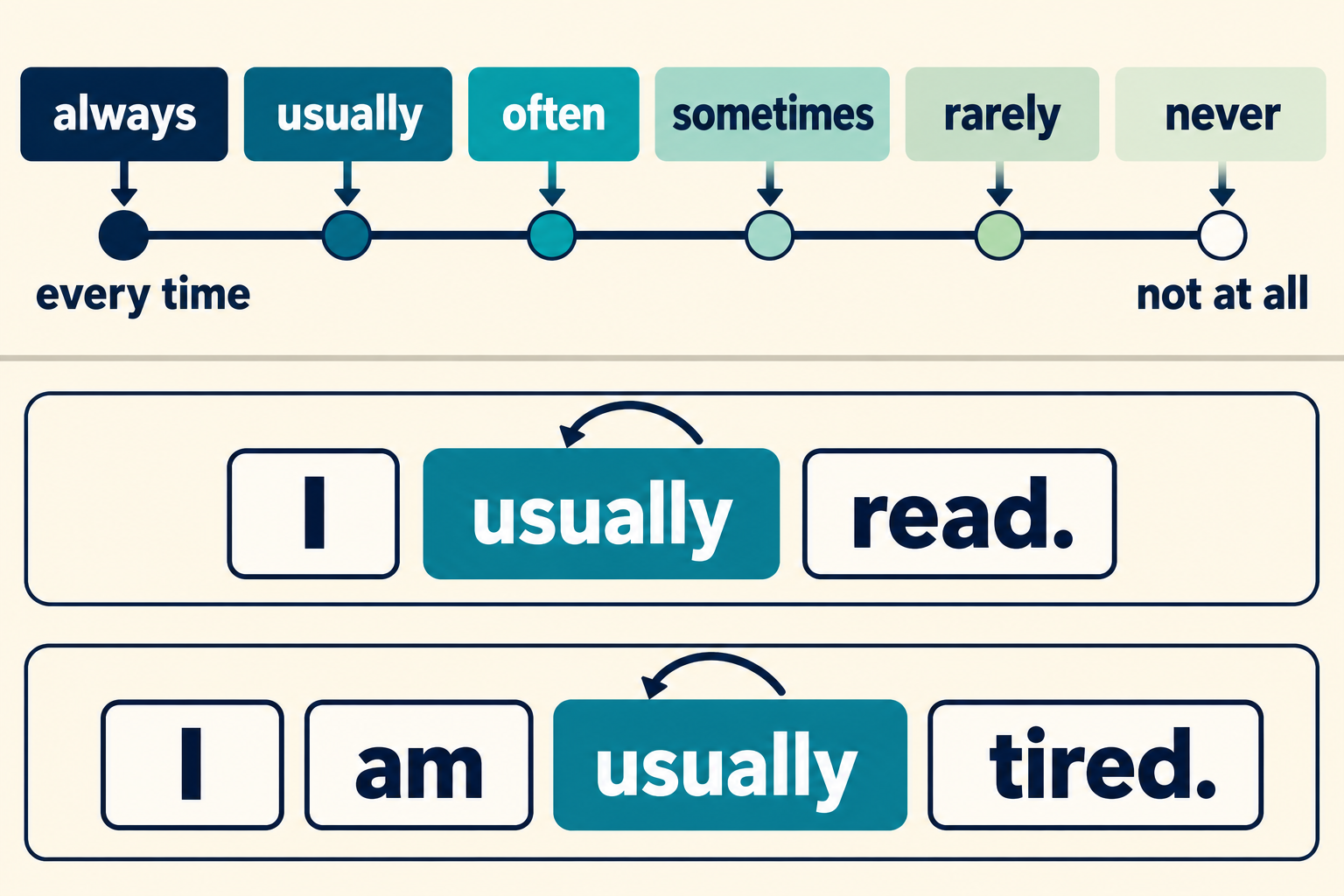
Always means every time in the situation you are describing. Usually means most of the time. Often means many times. Sometimes means on some occasions. Rarely means not often. Never means not at any time in the situation.
The visual scale reads always → usually → often → sometimes → rarely → never. It is a helpful guide to broad meanings, not a measuring tool. The spaces on the line do not represent exact percentages. Speakers can use often differently for different activities: often visiting another country is not the same number of times as often drinking water.
Use details when exact frequency matters. I cycle twice a week is more precise than I often cycle. Do not decide a person's long-term habits from one unusual week. Ask about their usual routine or use a longer record.
2. Before most main verbs
With most simple present main verbs, put the frequency adverb before the verb: I usually read. You often cook. They sometimes walk. She rarely drives. The order is subject + frequency adverb + main verb.
Keep the normal verb ending for he, she and it: He usually reads. She often plays the guitar. The adverb does not remove -s. Say She sometimes cycles, not She sometimes cycle. With I, you, we and they, use the base form: We often cycle.
A sentence frame
I usually read.
Usually comes before the main verb read.
I usually read in the evening.
She often cycles.
Often comes before cycles; the -s stays.
She often cycles to the park.
3. After be
With the verb be, put the frequency adverb after am, is or are: I am usually ready. He is often tired. They are sometimes late. The order is subject + be + frequency adverb + the rest of the sentence.
Compare She usually arrives early and She is usually early. Arrives is a main verb, so usually goes before it. Is is a form of be, so usually goes after it. This small difference is more useful than memorising one position for every English sentence.
Sometimes is flexible. Sometimes I walk is also natural, as is I walk sometimes. For the first practice here, use the simple middle position: I sometimes walk. Do not assume all frequency adverbs can move to every position in the same way.
4. Never already has a negative meaning
Never means not at any time. In standard English, say I never swim, not I don't never swim. You do not need don't because never already makes the idea negative. She never drives also keeps the usual -s ending.
Compare I don't always cook and I never cook. The first means there are occasions when I do not cook; I may cook on other days. The second says I do not cook at all in the situation. Small changes can make a big difference to meaning.
5. Ask How often?
Use How often to ask about frequency: How often do you read? How often does she cycle? Use do with I, you, we and they; does with he, she and it. After does, the main verb returns to the base form: How often does she cycle?
Useful exact answers include once a week, twice a week and three times a week. Once means one time; twice means two times. These phrases usually come at the end: I cycle twice a week. She plays the guitar once a week. Every day also gives a clear routine: We read every day.
Quick check: six questions
Answer on paper, then open the explanations below. Enable JavaScript to check answers here.
Describe your routine
Write one sentence with a main verb, one with be, and one with an exact frequency. Model: I usually read at home. I am sometimes tired. I cycle twice a week. Check the position of the adverb and whether your words match your real routine.
Related Guides






Continue learning this topic
Review an explanation, study examples or try a related practice test.
- Practice test Transport and Trips Words — A1 English Vocabulary Practice Test
- Practice test Places Around Town Words — A1 English Vocabulary Practice Test
- Practice test Clothes and Weather Words — A1 English Vocabulary Practice Test
- Course lesson Adverbs of frequency: Always, sometimes and never – A1–A2: Grammar Foundations