
Lesson
B2 · Upper-intermediate
Grammar
Plan a Better Week: Preferences and Overdue Action
Express practical preferences and overdue actions from an original planning diary while preserving who acts and when.
11 min read
1,931 words
Updated Oct 21, 2026

On this page (8 sections)
B2 · 32 minutes · 16 explained checks. Work through the examples, try the questions, then use the final checklist. All people, venues and notices in this resource are fictional.
Read the weekly planning diary
This fictional diary records practical choices for the coming week. The task is to express the preferences accurately, including who should act. You are not being asked to diagnose feelings or invent a past regret. Read each entry’s actual plan before choosing a grammar pattern.
Monday: I am preparing an article at home tomorrow. The café nearby is lively, but I can concentrate better in the quiet flat. I would choose home for this writing session. My flatmate is free to invite friends another evening; I want tomorrow evening kept quiet. We have not argued, and I want to explain the preference calmly rather than make it sound like a permanent rule.
Tuesday: Noor and I need to discuss the article. We can meet early on Thursday or late on Friday. I favour the early Thursday meeting because it leaves time for changes. Noor will send the agenda, and I want it sent before we meet. The meeting is not confirmed yet, so my message should leave room for her answer.
Wednesday: The presentation is on Monday, but we have not started making the slides. Starting is already due. I think we should begin today. I do not want to work late tonight, and I would choose a short focused session now over a long evening session. Each person can prepare two slides.
Thursday: My colleague plans to call during Friday’s staff meeting, which is separate from the still-unconfirmed article discussion. I want the call after the staff meeting instead. I also favour taking the bus myself if the weather is wet. These are different people’s actions, so my final message must keep the callers and travellers clear.
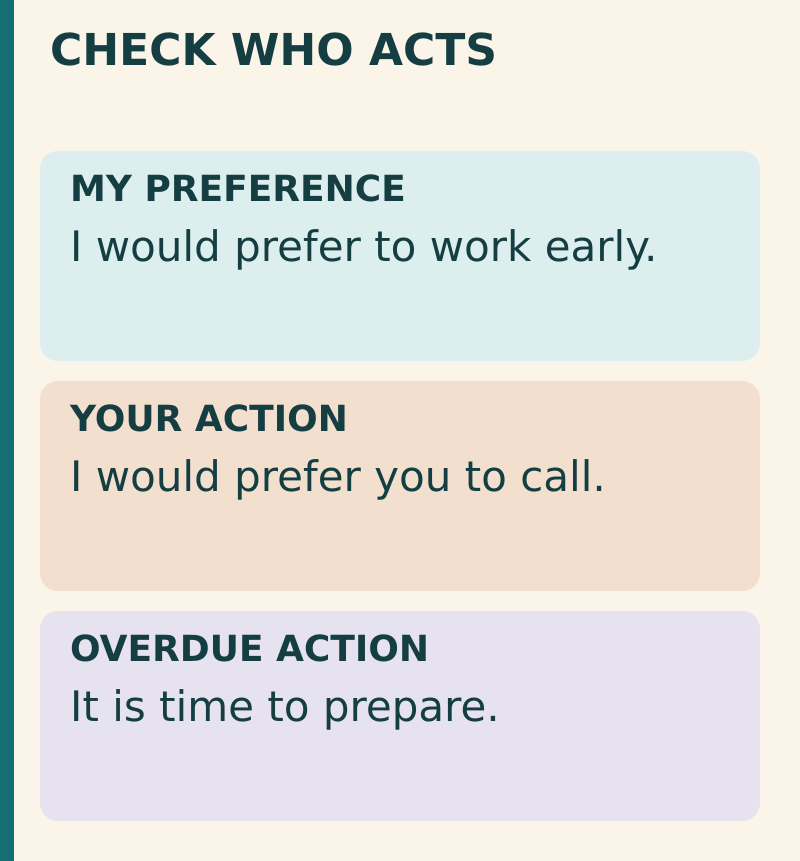
Recover the actors and intended times
Questions 1–4 identify who acts and when. A future preference can use a past form after would rather with a different subject: “I’d rather you called later.” That form does not rewrite the diary as a past event. Keep the actual circumstances separate from the wording used to express the speaker’s view.
Make three columns: preference-holder; actor; time. For the agenda, the speaker has the preference, Noor sends it, and sending should happen before the meeting. For not working late, the speaker is both preference-holder and actor, and the time is tonight.
Answer on paper, then open the explanations below. Enable JavaScript to check answers here.
Select a preference pattern
Questions 5–8 choose rather and prefer frames. Would rather + base form suits the speaker’s own action; would rather + another subject + past form suits someone else’s action. Would prefer uses a to-infinitive here, with an object when needed: “I’d prefer Noor to send the agenda first.”
Do not confuse would prefer with the general pattern “prefer walking to driving.” The diary describes particular choices this week. Other patterns are possible, but the prompts specify which frame to practise so the answer is checkable.
Answer on paper, then open the explanations below. Enable JavaScript to check answers here.
Preferences and overdue action
Questions 9–12 compare actions or express that preparation is due. Both “It is time to start” and “It is time we started” can fit Wednesday. The past-clause version often suggests action is due or overdue. It does not imply the slides are already complete.
A preference is a message to negotiate, not necessarily a rule imposed on another person. For Noor, add a context phrase such as “if that works for you.” For the flatmate, make clear that quiet is requested for tomorrow evening, rather than claiming a permanent ban on visitors.
Answer on paper, then open the explanations below. Enable JavaScript to check answers here.
Fix the planning message
Questions 13–16 repair unwanted to after rather, missing to after prefer, negative placement and changed actors. Read the entire corrected sentence. If the original asks a colleague to call later, a rewrite about the speaker calling later is not faithful.
In open writing, contractions and full forms are acceptable. “I’d rather” and “I would rather” differ in register, not basic meaning. “I’d prefer it if you sent the agenda first” is another useful option, so do not reject it simply because the model uses object + to.
Answer on paper, then open the explanations below. Enable JavaScript to check answers here.
Write a useful reflection
Write four clearly dated mini-messages, one for each diary entry, with 100–130 words in total. Include one same-subject preference, one preference about another person’s action, a comparison and an it-is-time construction. Label each message Monday, Tuesday, Wednesday or Thursday so that today and tomorrow have clear reference. Preserve the unconfirmed article meeting and the separate Friday staff meeting.
Compare each dated message with its own diary entry by actor, action and time. The Tuesday article discussion remains unconfirmed. The Thursday message concerns a separate staff meeting on Friday. Do not merge the diary’s different days into one undated today or tomorrow.
Explained answers and time audit
The sixteen checks cover four fact decisions, four form choices, four preferences/action patterns and four repairs. The final writing task is open and is not automatically graded. Before finishing, label each past form as an actual past event or a present/future stance construction. Then check that every requested action belongs to the intended person.
Your turn · self-review
Four dated planning messages
Write four dated mini-messages, 100–130 words in total. Compare actor, time, form and courtesy.
Practice only. Your writing stays on this page; it is not submitted or saved.
-
Model answer and explanation
Monday: I’d rather work at home tomorrow than go to the café. I’d prefer my flatmate to invite friends another evening. Tuesday: I’d prefer to discuss the article early on Thursday rather than late on Friday, if that works for Noor. I’d rather she sent the agenda first. Nothing is confirmed yet. Wednesday: It is time we started the slides for next Monday. I’d rather have a short session today than work late tonight. Each of us can prepare two slides. Thursday: For tomorrow’s separate staff meeting, I’d prefer my colleague to call afterwards. If it is wet, I’d rather take the bus myself.
Why this model works: Each weekday label fixes the reference of today or tomorrow. Work and take follow same-subject would rather. My flatmate to invite and my colleague to call keep the other actors explicit. She sent expresses a future preference; we started expresses action due now. The article discussion stays unconfirmed and is distinct from Friday’s staff meeting.
Your final check
Read the complete sentence or source again. Check the actor, action, time, quantities, conditions and intended meaning. Explain why your version works rather than memorising its surface form. Revisit any question whose explanation differs from your reasoning.
For a different grammar job, review Wish, if only and regrets in the grammar course. That lesson covers wishes and earlier regrets; this resource focuses on current preferences and action due now.
Related Lessons






Continue learning this topic
Review an explanation, study examples or try a related practice test.
- Practice test A train-accessible weekend on the Shropshire Way combines dramatic landscapes with historic towns and welcoming pubs — C2 English Listening Practice Test
- Practice test A train-accessible weekend on the Shropshire Way combines dramatic landscapes with historic towns and welcoming pubs — C2 English Grammar Practice Test
- Practice test A train-accessible weekend on the Shropshire Way combines dramatic landscapes with historic towns and welcoming pubs — C2 English Vocabulary Practice Test
- Course lesson Unreal time and preferences – C1: Precision and Expression