
Lesson
B2 · Upper-intermediate
Grammar
Before the Open Day: Participle Clause Editing Practice
Practise participle clauses and repair unclear subjects in everyday event writing.
10 min read
1,693 words
Updated Oct 24, 2026

On this page (9 sections)
B2 • About 32 minutes. Trace actors through a preparation log. Combine clauses only when their subjects and time relations allow it. Correct dangling or falsely simultaneous actions. Produce a concise, accurate event introduction with full clauses where needed.
Meet the people and sequence
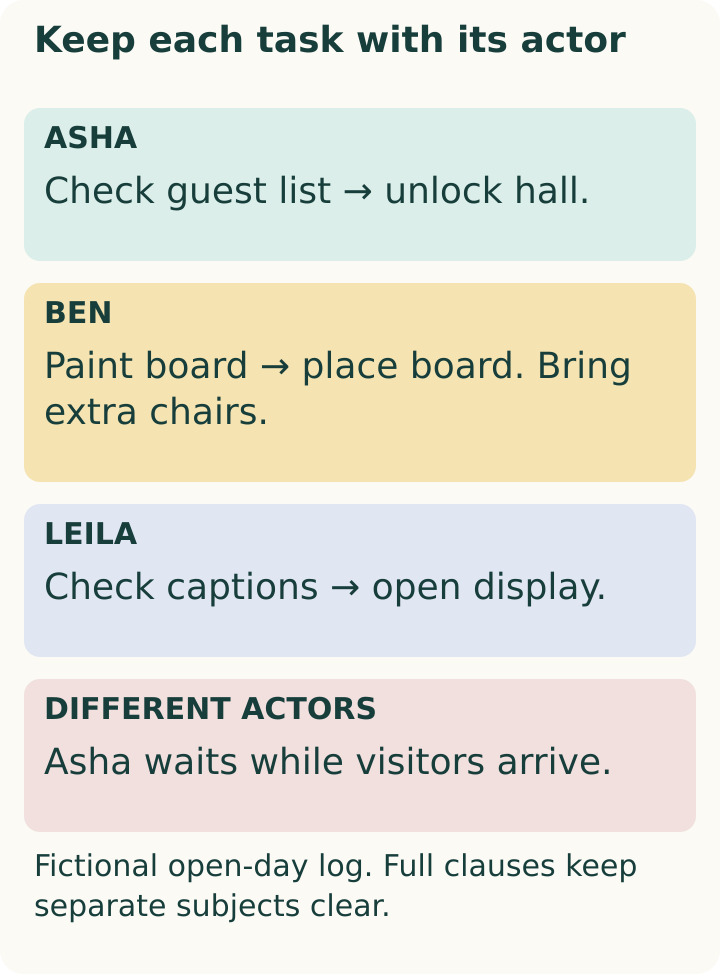
The following open-day log is fictional. Asha was the organiser, Ben was the caretaker, and Leila prepared the display. At eight, Asha checked the guest list at her desk. She finished the check before she unlocked the hall at eight fifteen. Ben had painted the welcome board the previous afternoon. The board was dry by the morning, and Ben placed it near the entrance. Leila carried a box of photographs into the hall and arranged them on a table. At eight thirty, Asha counted the chairs. She noticed that two were missing and asked Ben for help. Ben brought the extra chairs from the storeroom. While Asha waited at the entrance, the first visitors arrived. One visitor, Ravi, walked into the hall and found the lights too bright. He asked Ben to adjust them. Ben changed the setting, and the display became easier to see. After checking every caption, Leila opened the display area. Asha welcomed the visitors at nine. The hall had been built in 1980, but its entrance had been widened the previous year. No visitor painted a board, counted the chairs or unlocked the hall.
Actor map: Asha — checks the guest list, unlocks, counts, waits, welcomes. Ben — paints and places the board, brings chairs, adjusts lights. Leila — carries and arranges photographs, checks captions, opens the display. Ravi — enters, notices bright lights, asks Ben. The board receives paint; the hall was built. Keep these roles separate.
Use the editing test
Before combining two sentences, underline each subject. If the same person performs both actions, reduction may be possible. If the subjects differ, either name both in full clauses or rebuild the main clause without changing the facts. A past participle may describe an object that receives an action. A perfect participle marks earlier completion, but it still needs a logical subject.
The goal is a readable event introduction. Two clear participle clauses are enough for the final writing. Preserve finite clauses where they help the reader distinguish volunteers from visitors. Do not attach an opening phrase to the nearest convenient noun when that noun is not its actor or experiencer.
Subject tracing
Match each action to the person or thing identified in the log.
Answer on paper, then open the explanations below. Enable JavaScript to check answers here.
Choose the right form
Use active, passive or earlier-completion meaning as the evidence requires.
Answer on paper, then open the explanations below. Enable JavaScript to check answers here.
Safe sentence combining
Choose the version that preserves who did what and when.
Answer on paper, then open the explanations below. Enable JavaScript to check answers here.
Fix the noticeboard draft
Repair agency and sequence. Clear full-clause versions are welcome.
Answer on paper, then open the explanations below. Enable JavaScript to check answers here.
Write, compare and revise
Your turn · self-review
Independent writing
Write your own response first, then compare the model and use the self-review checklist below. The model is one possible answer, not a script to copy.
Practice only. Your writing stays on this page; it is not submitted or saved.
-
Model answer and explanation
Welcome to our open day. Asha organised the morning preparations. Having checked the guest list, she unlocked the hall at eight fifteen. Ben placed the welcome board near the entrance; he had painted it the previous afternoon. Leila carried in the photographs and arranged them on a table. Asha counted the chairs, and Ben brought two extra ones from the storeroom. While Asha waited at the entrance, the first visitors arrived. Ravi found the lights too bright, so Ben adjusted them. Having checked every caption, Leila opened the display area. Asha welcomed everyone at nine. The hall dates from 1980, and its entrance was widened last year.
Self-review and transfer
The model’s two participle clauses are Having checked the guest list and Having checked every caption. Their understood subjects are Asha and Leila respectively. Ben’s separate actions stay in finite clauses. Ask a partner to name the actor of every opening phrase without reading the log. Then check time, voice and source fidelity. If a full-clause repair is clearer than your reduced version, keep it. Do not count a shorter sentence as an improvement unless its meaning is equally recoverable.
Related learning
Companion resource: Participle Clauses: Shared Subjects, Time and Clear Meaning.
Related references for further study: How a T-Shirt Is Made: Passive Voice Practice; An Unexpected Visitor: A2 Past Continuous Listening; From Scattered Notes to a Clear Community Update.
For the structured course sequence, study Participle clauses and shared subjects. Use this standalone reference and its original exercises to diagnose and apply the patterns.
Related Lessons






Continue learning this topic
Review an explanation, study examples or try a related practice test.
- Practice test Fired OpenAI employees question the company’s commitment to safety — C2 English Listening Practice Test
- Practice test Fired OpenAI employees question the company’s commitment to safety — C2 English Grammar Practice Test
- Practice test Fired OpenAI employees question the company’s commitment to safety — C2 English Vocabulary Practice Test
- Course lesson Future time clauses – B1–B2: Grammar in Context
- Course lesson Participle clauses and shared subjects – C1: Precision and Expression
- Course lesson Defining relative clauses – B1–B2: Grammar in Context