
Lesson
B2 · Upper-intermediate
Grammar
Who Changed the Booking? Cleft Sentence Practice
Practise choosing and building clefts to correct specific misunderstandings.
10 min read
1,631 words
Updated Oct 23, 2026

On this page (9 sections)
B2 • About 30 minutes. Locate the exact mistaken fact in a short message. Select an it-cleft or what-cleft that answers the actual problem. Write corrections that preserve time, agent and object. Revise unnecessary emphasis out of a final message.
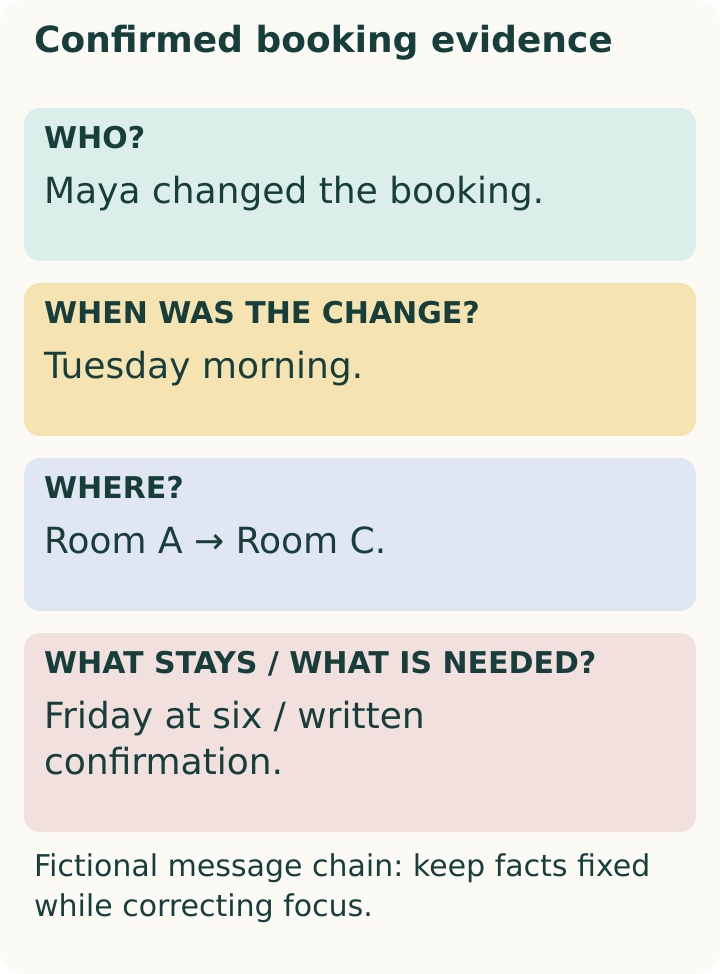
The booking evidence
Message 1, Monday, Omar: I have checked the workshop notes. The group is due to meet in Room A on Friday at six. I have not changed the room booking. I am sending this now so everyone can check the same information. Please tell me if the caretaker contacts you about the room.
Message 2, Tuesday, Maya: The caretaker has just confirmed that a pipe in Room A needs repair. I changed our booking to Room C this morning. The workshop is still on Friday at six. Room C has enough tables, but we need a written confirmation of the change for the person setting up.
Message 3, Wednesday, Leila: Thanks, Maya. I will prepare the materials. A note in our shared folder says that Omar moved the workshop on Monday and that the start time is seven. That note is incorrect. Please use Maya’s Tuesday message. We do not need another room; we need the written confirmation. I will replace the old note once the group has checked the details.
Confirmed evidence matrix: person who changed the booking — Maya; day of the change — Tuesday; original room — A; replacement room — C. Unchanged event details: Friday at six. Needed action: obtain written confirmation. The change was caused by a pipe repair, not a request for a later time.
Read the disagreement before choosing a structure
The same booking has generated several different errors. One person has confused the agent; another has confused the day of the change with the day of the workshop. Correct the exact mistaken detail. A cleft about Maya will not directly fix a wrong time, even if the full sentence also happens to mention Friday.
Use it-clefts for a disputed person, room or time. Use a what-cleft to foreground the needed item or action. Keep ordinary sentences for the background. In the final message, two well-chosen clefts will usually help more than six emphatic sentences. For typed reconstructions, follow the requested beginning; the key lists natural who/that alternatives where appropriate.
Find the misunderstanding
Match each incorrect claim with the source fact that corrects it.
Answer on paper, then open the explanations below. Enable JavaScript to check answers here.
Choose a useful focus
Choose the sentence that directly addresses the quoted mistake.
Answer on paper, then open the explanations below. Enable JavaScript to check answers here.
Build the corrections
Use the evidence and the exact frame provided.
Answer on paper, then open the explanations below. Enable JavaScript to check answers here.
Edit for truth and tone
Identify the relevant repair. Do not call a merely emphatic sentence ungrammatical.
Answer on paper, then open the explanations below. Enable JavaScript to check answers here.
Write, compare and revise
Your turn · self-review
Independent writing
Write your own response first, then compare the model and use the self-review checklist below. The model is one possible answer, not a script to copy.
Practice only. Your writing stays on this page; it is not submitted or saved.
-
Model answer and explanation
Hi everyone, here is a clarification of the workshop booking. It was Maya who changed the room on Tuesday, after the caretaker confirmed that a pipe in Room A needed repair. We will now use Room C. The workshop is still on Friday at six, so please ignore the old note saying seven. What we need is written confirmation of the room change for the person setting up. We do not need to find another room. Leila will prepare the materials and replace the old note after we have checked the details. Please use Maya’s Tuesday message as the source for the current arrangement.
Self-review and transfer
The model’s it-cleft corrects the agent; its what-cleft foregrounds the remaining need. Check four things: facts match the messages; each cleft answers a real misunderstanding; the background clause is complete without a repeated object; ordinary sentences carry undisputed details. A different valid message may focus Tuesday or Room C instead, provided it still uses two purposeful clefts and preserves all required facts.
Related learning
Companion resource: Cleft Sentences: Put the Important Information in Focus.
Related references for further study: Community Swap: Defining Relative Clauses Practice; From Scattered Notes to a Clear Community Update; Disagree Without Ending the Conversation.
For the structured course sequence, study Cleft sentences and focus. Use this standalone reference and its original exercises to diagnose and apply the patterns.
Related Lessons






Continue learning this topic
Review an explanation, study examples or try a related practice test.
- Practice test Air Canada Rebooking Left a Delayed Traveler Without a Return Flight — C2 English Listening Practice Test
- Practice test Air Canada Rebooking Left a Delayed Traveler Without a Return Flight — C2 English Grammar Practice Test
- Practice test Air Canada Rebooking Left a Delayed Traveler Without a Return Flight — C2 English Vocabulary Practice Test
- Course lesson Be and basic sentences – A1–A2: Grammar Foundations
- Course lesson Cleft sentences and focus – C1: Precision and Expression