
Lesson
A2 · Elementary
Reading
Care for the Clothes: Match Labels, Tasks and Supplies
Read four fictional garment labels, match them to task cards and order an explicit routine. Sixteen explained checks practise cleaning and laundry language.
10 min read
1,625 words
Updated Oct 23, 2026
On this page (7 sections)
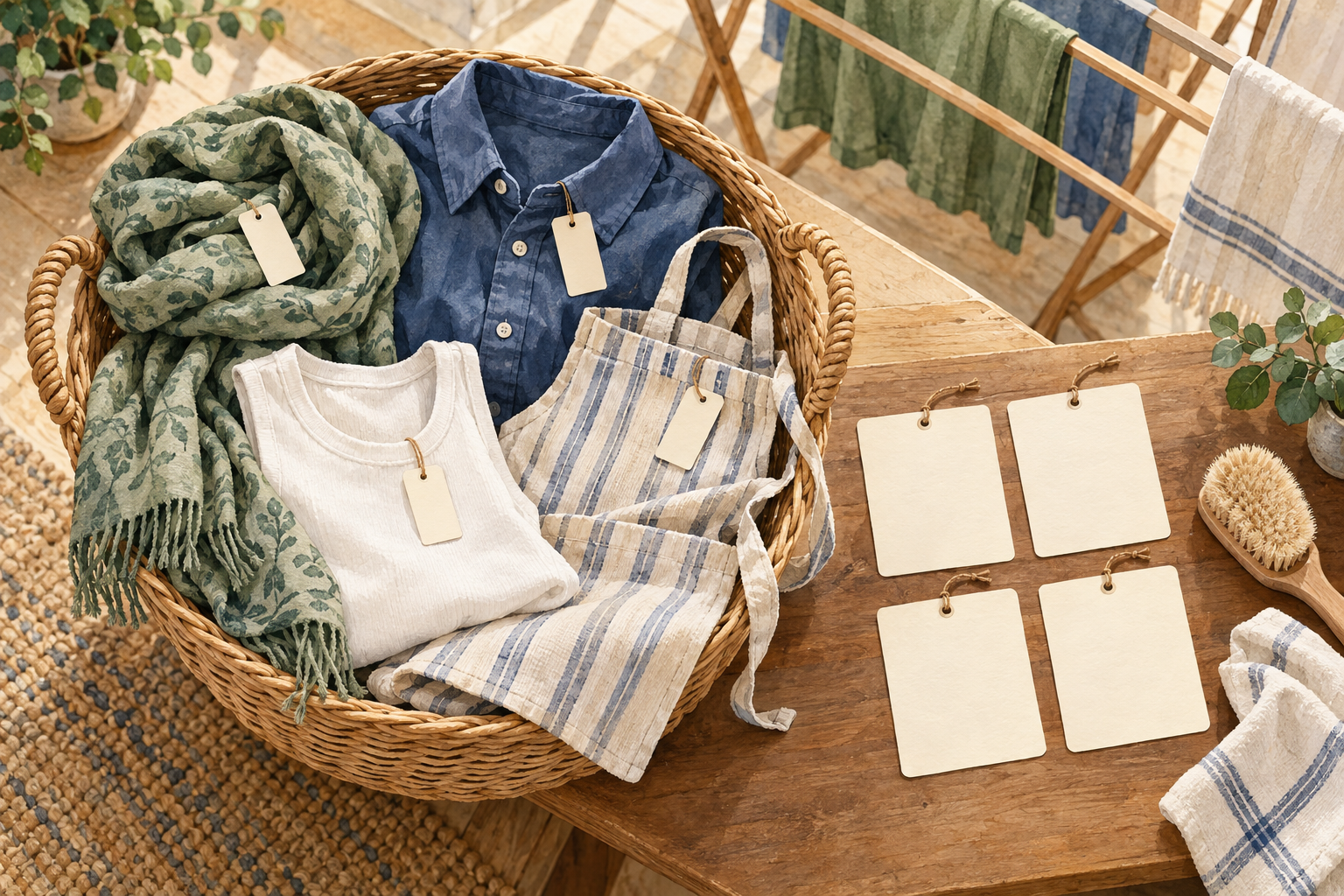
A fictional laundry basket
Today’s basket contains four garments with four written labels. Your job is to read, match and explain the words. These are fictional labels for English practice. Follow the real label on your clothes.
All necessary facts are printed below. Keep the labels separate from the task cards so that you can compare them accurately.
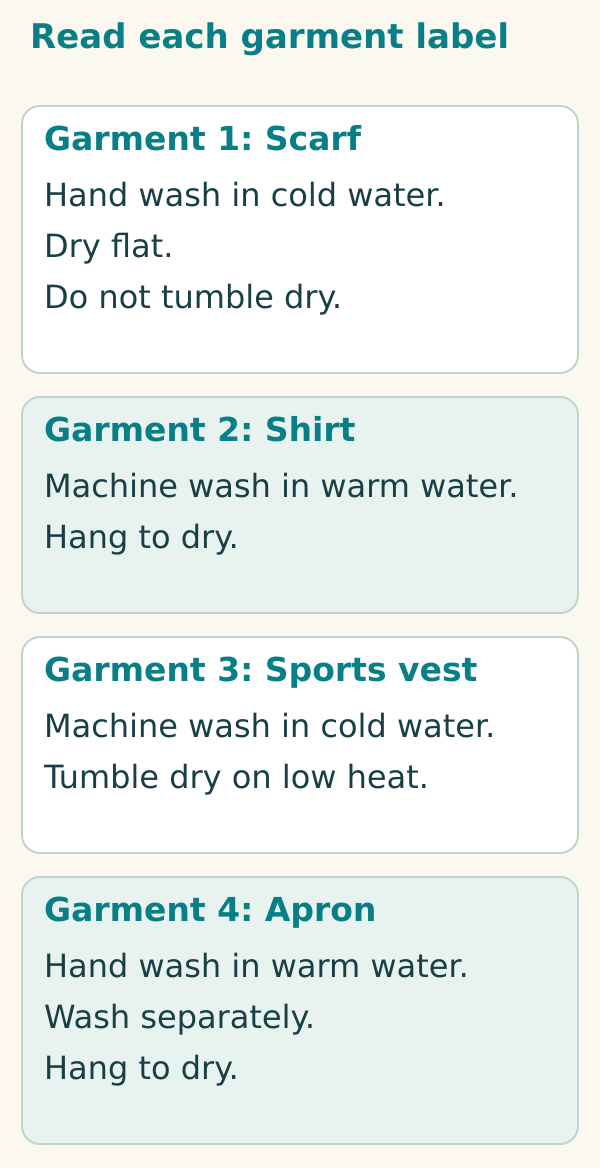
A task card is correct only if every stated detail agrees with its garment’s label. A familiar method is not enough. The illustration helps you locate each garment, while this selectable text supplies the evidence.
Match actions to objects
Use the short scene descriptions for questions 1–4. You can answer without viewing a picture. Notice the tool, surface and movement. Cloth plus table plus movement across the top suggests wipe; broom plus loose dirt on a floor suggests sweep.
The supplies in this lesson are ordinary nouns: a cloth, brush, bucket, washing machine, drying rack and line. Match each word to its object and role in the scene.
Answer on paper, then open the explanations below. Enable JavaScript to check answers here.
A shirt on a line can be described as drying, but the question asks for the specific action used to put it there: hang. A question about purpose and a question about action can have different answers.
Read the care labels
Copy the exact words into a three-slot note: wash method; water-temperature wording; drying method. For the scarf, the first slot is hand wash. Do not replace cold or warm with a number. These fictional labels do not supply one.
Garment | Find these facts |
|---|---|
Scarf | Wash method, water wording, flat-drying instruction. |
Shirt | Wash method, water wording, hanging instruction. |
Sports vest | Wash method, water wording, tumble-drying heat. |
Apron | Wash method, water wording, separate-wash condition, drying method. |
Answer on paper, then open the explanations below. Enable JavaScript to check answers here.
Not stated is a valid source-reading answer. It means the label does not provide the information. It does not mean that any choice is allowed. In a real situation, missing care information may need checking with the product’s instructions.
Choose the matching task card
Compare each garment with cards A–D. Check the washing method first, then the temperature word, then the drying instruction and any extra condition. Each wrong card conflicts with at least one supplied fact. Use each card once for this set.
Answer on paper, then open the explanations below. Enable JavaScript to check answers here.
Do not stop after seeing cold water. Both the scarf and sports vest mention cold water, but their washing and drying methods differ. The apron shares hanging with the shirt, but it specifies hand washing and separately. These distinctions are the point of the task.
Put a simple routine in order
This is a separate four-stage routine. Use its sequence words: first, next, after washing and finally. Choose one action for each position.
Answer on paper, then open the explanations below. Enable JavaScript to check answers here.
The source says nothing about ironing. Do not insert an extra stage. It also explicitly says dry cloths before fold, so the order comes from the text, not from an assumption about household routines.
Check answers against the source
Action answers 1–4: wipe, sweep, fold, hang. Each is linked to a specific movement or tool in its scene. Label answers 5–8: hand wash, warm, low heat, not stated. Keep water temperature separate from a tumble-drying heat setting.
Card answers 9–12: C, D, A, B. The scarf must be hand washed in cold water and dried flat. The shirt uses machine washing in warm water and hanging. The vest uses machine washing in cold water and tumble drying on low heat. The apron uses hand washing in warm water, separately, and hanging.
Routine answers 13–16: sort, wash, dry, fold. The sequence words provide direct evidence. If you chose another order, compare it with the routine source.
Explain a care routine simply
Choose the apron and write three short sentences. Word bank: hand wash, warm, separately, hang. Retain all four label details.
Your turn · self-review
Transfer task: your turn
Self-check: three understandable sentences; all four label details retained; each sentence agrees with the label.
Practice only. Your writing stays on this page; it is not submitted or saved.
-
Model answer and explanation
Hand wash the apron in warm water. Wash it separately from the other items. Hang it to dry.
Alternative model: “Wash the apron by hand in warm water. Keep it separate from the other items during washing. Then hang it to dry.” Both models preserve the same source facts.
Return to Laundry and Cleaning Vocabulary: Read Everyday Care Instructions if you confused wash with rinse or hang with fold. The related instruction and clothing-language resources offer further practice when available.
Related Lessons





Continue learning this topic
Review an explanation, study examples or try a related practice test.
- Practice test Colleges reshape degree programs around influencing, artificial intelligence, and health careers — C1 English Listening Practice Test
- Practice test Colleges reshape degree programs around influencing, artificial intelligence, and health careers — C1 English Grammar Practice Test
- Practice test Colleges reshape degree programs around influencing, artificial intelligence, and health careers — C1 English Vocabulary Practice Test