
Lesson
B1 · Intermediate
Listening
Volunteer Shift: Hear the Small Words
Decode six short volunteer messages, hear weak forms and linking, and practise fourteen listening checks with supported shadowing.
9 min read
1,548 words
Updated Nov 4, 2026

On this page (6 sections)
Your listening task
You are joining a fictional donation-centre shift. Lena has sent six separate voice messages. Listen for the practical instruction first, then investigate the small words that are easy to miss. The task is suitable for B1 learners who already understand common instructions. Allow about twenty-five minutes, including replay and speaking practice. You need paper or a notes app; recording your own voice is optional.
First pass: listen to each message without reading the transcript and note the practical action. Second pass: answer the checks, replaying as needed. Third pass: open the full transcript, compare your notes and shadow two useful chunks. A missed weak word is a listening clue to investigate, not a reason to repeat the whole lesson from the beginning.
Useful words and visual cues
A badge is a small card or object that shows a person’s name or role. A tray is a shallow container. A trolley is a small wheeled vehicle used to move things. Spare pens are extra pens that are not currently needed. To pack up means to finish and put equipment away. To head out means to leave.
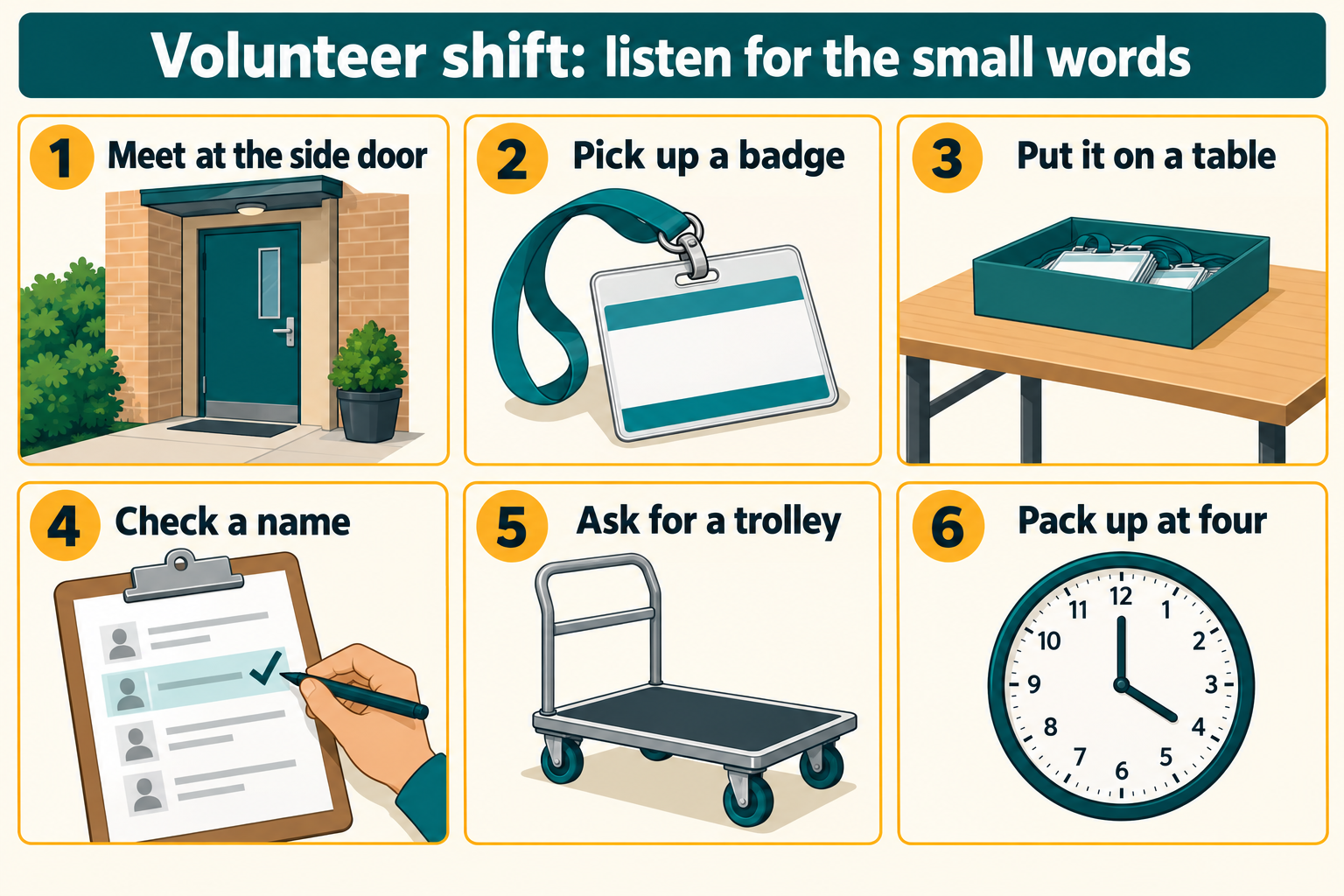
After answering the listening checks, use the illustrated task sequence in the review section to check your notes. It contains answer information, so leave it until you have listened. A written description beside the image gives the same information for readers who cannot see the picture.
How to use the dictation checks
For a gap, write the actual small word you hear. For a linked phrase, count the written words after listening; connected pronunciation does not remove written spaces. If a negative is unclear, replay the whole instruction and check the situation. Do not decide can versus cannot from volume alone. All answer explanations identify the relevant message and the reason for the answer.
Listen and learn
Message 1: volunteer shift
Open audio separatelyRead the transcript
Lena: Hi, it is Lena from the donation centre. Please come to the side door at ten, and ask for Ravi. He can show you where to leave your coat.
Listen and learn
Message 2: volunteer shift
Open audio separatelyRead the transcript
Lena: When you arrive, pick up a badge and a pen from the small tray. Write your first name on the badge, then clip it on your shirt.
Listen and learn
Message 3: volunteer shift
Open audio separatelyRead the transcript
Lena: There is a box of blank labels by the desk. Pick it up and put it on a table near the shelves. We will use those labels later.
Listen and learn
Message 4: volunteer shift
Open audio separatelyRead the transcript
Lena: Before you pack a bag, check the name on the list. If you cannot read it, ask me to check it with you. Please do not guess.
Listen and learn
Message 5: volunteer shift
Open audio separatelyRead the transcript
Lena: Some boxes are heavy. You can ask for a trolley, and I can help you move them. Leave a clear path to the door while you work.
Listen and learn
Message 6: volunteer shift
Open audio separatelyRead the transcript
Lena: We will pack up at four. Put any spare pens in the tray, and leave the badges on the desk. Please tell Ravi before you head out.
Practice tasks
Try each item before opening the answer. Read the explanation even when your answer is correct.
Answer on paper, then open the explanations below. Enable JavaScript to check answers here.
Visual review: check after listening
The six task cues are: meet at the side door; pick up a badge; put the box on a table; check a name; ask for a trolley; pack up at four. Compare this sequence with your notes, then replay any message whose detail you missed.
Your turn · self-review
Apply it and compare
Write or say your own answer first. The models are examples, not the only acceptable answers. Use the checklist to review your work; open responses are not automatically assessed.
Practice only. Your writing stays on this page; it is not submitted or saved.
-
Model answer and explanation
“PICK‿it‿UP / and PUT‿it‿on a TABLE.” The slashes suggest two meaning groups. And and a can be weak; the action and object stay clear. Your accent does not need to match Lena’s.
-
Model answer and explanation
“Come to the side door at ten and ask for Ravi. Pick up a badge and a pen, then write your name. If you cannot read a name on the list, ask Lena. We pack up at four.” Self-check: correct entrance and time; no invented rules; clear small words; a listener can follow the sequence.
Full transcript: read after listening
Message 1: Hi, it is Lena from the donation centre. Please come to the side door at ten, and ask for Ravi. He can show you where to leave your coat.
Message 2: When you arrive, pick up a badge and a pen from the small tray. Write your first name on the badge, then clip it on your shirt.
Message 3: There is a box of blank labels by the desk. Pick it up and put it on a table near the shelves. We will use those labels later.
Message 4: Before you pack a bag, check the name on the list. If you cannot read it, ask me to check it with you. Please do not guess.
Message 5: Some boxes are heavy. You can ask for a trolley, and I can help you move them. Leave a clear path to the door while you work.
Message 6: We will pack up at four. Put any spare pens in the tray, and leave the badges on the desk. Please tell Ravi before you head out.
Related Lessons






Continue learning this topic
Review an explanation, study examples or try a related practice test.
- Practice test At the University of Maryland, a historic campus farm remains a classroom — C2 English Listening Practice Test
- Practice test At the University of Maryland, a historic campus farm remains a classroom — C2 English Grammar Practice Test
- Practice test At the University of Maryland, a historic campus farm remains a classroom — C2 English Vocabulary Practice Test