
Lesson
B2 · Upper-intermediate
Grammar
As the Queue Grew: Comparing Degree and Change
Describe fictional waiting-time data using accurate modifiers, ratios and linked comparisons.
9 min read
1,456 words
Updated Nov 1, 2026

On this page (9 sections)
B2 • About 30 minutes. Compare the same unit across times or service points. Choose intensifiers justified by the displayed difference. Describe gradual and linked change without inventing causality. Write a concise data-informed everyday update.
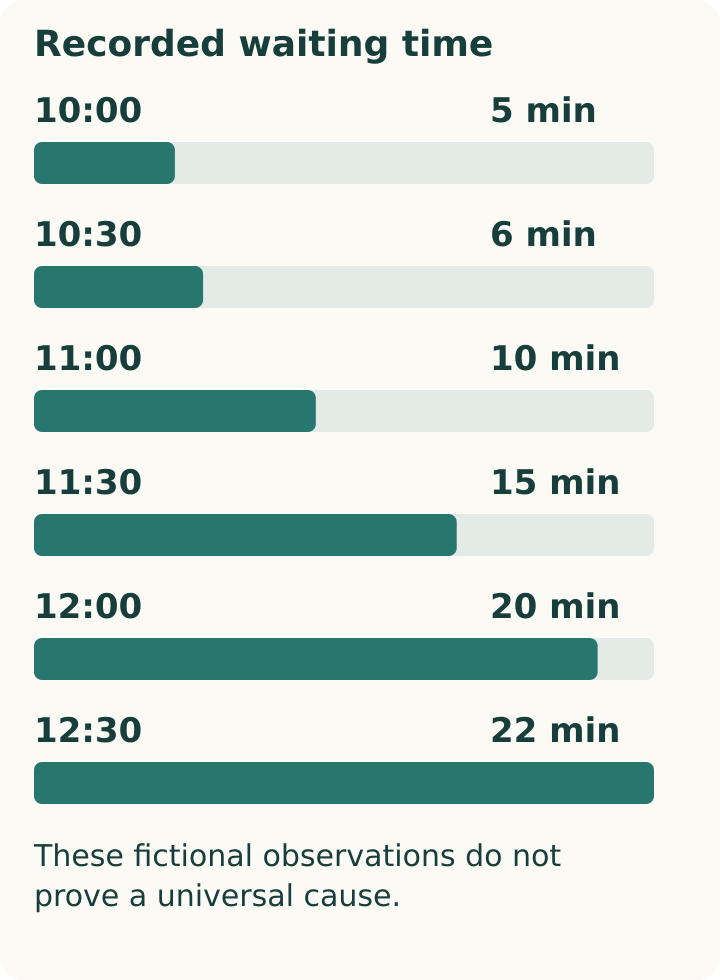
Read the café observation log
An organiser recorded six observations at a fictional community pop-up café. Each row gives the time, the number of people waiting, the approximate wait in minutes and the number of empty seats. The observations cover one morning only. They do not record staffing changes, order sizes or the time spent preparing each drink.
Time | Queue (people) | Wait (minutes) | Empty seats |
|---|---|---|---|
10:00 | 4 | 5 | 20 |
10:30 | 6 | 6 | 16 |
11:00 | 8 | 10 | 12 |
11:30 | 12 | 15 | 8 |
12:00 | 16 | 20 | 4 |
12:30 | 18 | 22 | 2 |
Unit audit: people are a count, minutes are a duration, and empty seats are another count. Compare waits with waits and queues with queues. The increasing queue and wait occur together in this log, but the log does not identify a cause. A claim about every café or every future morning would exceed the evidence.
Decide what your comparison says
Degree words such as slightly or much describe the size of a difference without giving an exact ratio. Some choices are matters of reasonable judgement. Ratio language, by contrast, can be checked directly: the ten-minute wait at eleven is twice the five-minute wait at ten. Keep the comparison direction visible.
Repeated comparatives describe gradual change. Linked comparatives describe two changing quantities together. Neither structure is a scientific explanation. In your final update, give the important numbers, use a few well-chosen comparisons and propose one extra observation that would help explain the pattern next time.
How different?
Where the prompt requests a degree, several natural modifiers may be accepted. Do not mistake a style preference for a unique mathematical answer.
Answer on paper, then open the explanations below. Enable JavaScript to check answers here.
Read the ratios
Use the two named rows and keep the unit fixed.
Answer on paper, then open the explanations below. Enable JavaScript to check answers here.
Describe the change
Tie each structure to the observed morning.
Answer on paper, then open the explanations below. Enable JavaScript to check answers here.
Edit inaccurate claims
Repair the unit, ratio or unsupported conclusion.
Answer on paper, then open the explanations below. Enable JavaScript to check answers here.
Write, compare and revise
Your turn · self-review
Independent writing
Write your own response first, then compare the model and use the self-review checklist below. The model is one possible answer, not a script to copy.
Practice only. Your writing stays on this page; it is not submitted or saved.
-
Model answer and explanation
The café became busier and busier during the recorded morning. At ten, four people were waiting and the wait was five minutes. By eleven, the queue had doubled to eight people, and the ten-minute wait was twice as long as at ten. At noon, sixteen people were waiting and only four seats were empty. In these observations, the longer the queue grew, the longer the wait became. This does not show that queue length alone caused the delay. Next time, we could also record how many staff members are serving at each observation, so we can compare the pattern with another relevant detail.
Self-review and transfer
The model gives a two-to-one wait ratio and restricts the linked comparison to the observations. It proposes a staffing count as new information to collect, without claiming staff numbers caused the recorded change. Check every pair of units, the direction of each ratio, the time window and the difference between an observation and a cause. A different suitable next observation might be order size or service-point availability.
Related learning
Companion resource: Advanced Comparisons: Much Better, Twice as Fast and The More.
Related references for further study: Choose a Bicycle for Your Commute: A2 Comparisons; Pack a Bag That Fits: Too and Enough Practice; How Sure Can We Be About This Claim?.
Related Lessons






Continue learning this topic
Review an explanation, study examples or try a related practice test.
- Practice test Places Around Town Words — A1 English Vocabulary Practice Test
- Practice test Clothes and Weather Words — A1 English Vocabulary Practice Test
- Practice test Finding the Library on Green Street — A1 English Listening Practice Test
- Course lesson Degrees of certainty: Must be, may have and likely to – C1: Precision and Expression
- Course lesson Reported statements: Say, tell and tense changes – B1–B2: Grammar in Context
- Course lesson Wish and if only: Regrets and things you'd change – B1–B2: Grammar in Context