
Lesson
B1 · Intermediate
Grammar
Move-In Day Messages: Say What Happens When
Turn a fictional move-in message thread into a dependable sequence. Twelve explained checks and two writing tasks practise future time clauses.
9 min read
1,441 words
Updated Nov 1, 2026

On this page (7 sections)
Coordinate a fictional flat-share move. Use a message thread to decide what happens first, what continues and what follows immediately. Then write clear messages of your own. Allow about 35 minutes. Twelve checks and two writing tasks practise future time clauses. No real address or booking is involved.
Read the move-in plan
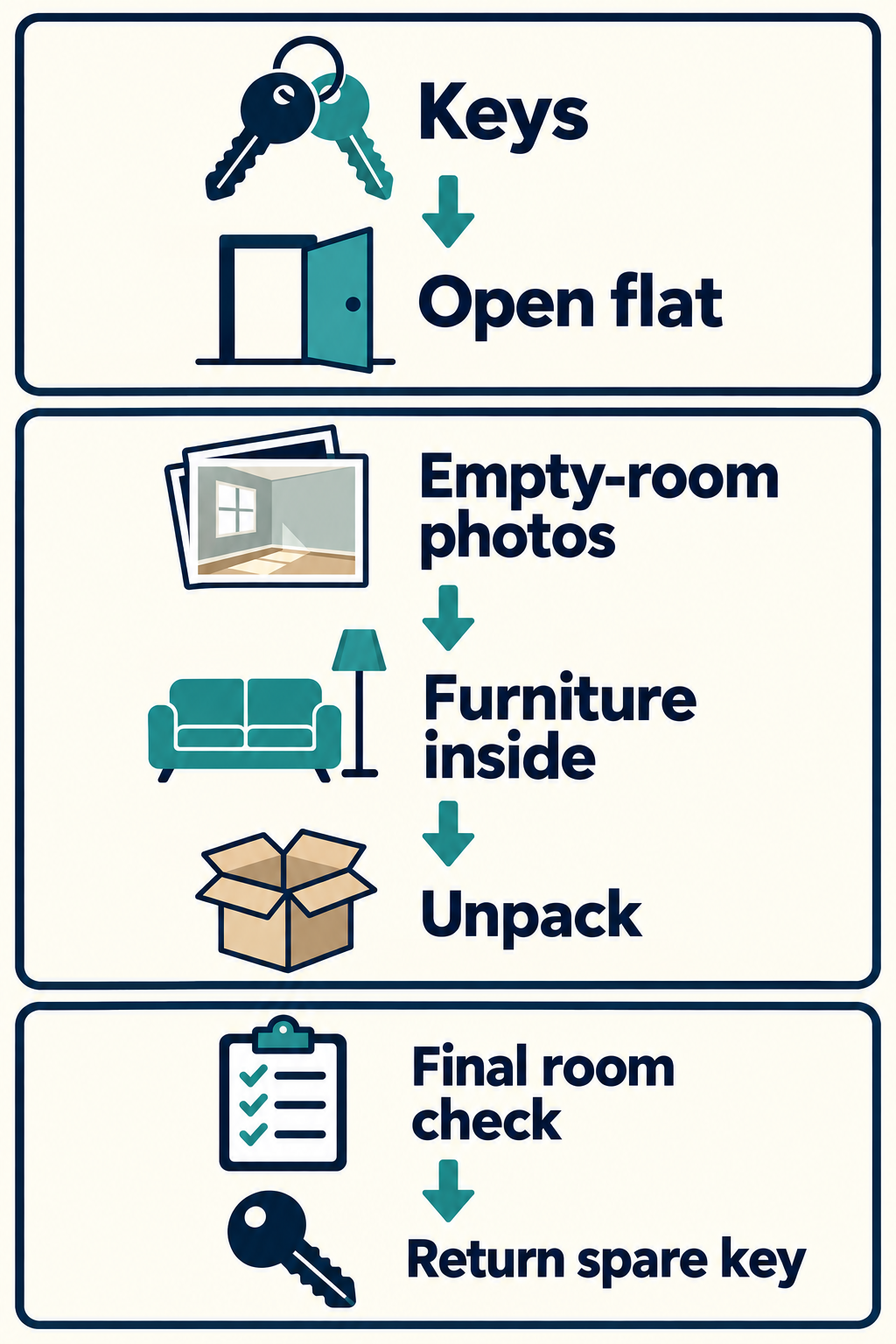
Mina collects the keys at nine. The lift is available from ten. Furniture arrives later, but its exact arrival time is not stated. Small boxes belong in the side room so the entrance stays clear. Read the thread for the rest of the plan; do not invent a delivery time.
Map the dependencies
Choose the time relationship
Answer on paper, then open the explanations below. Enable JavaScript to check answers here.
Repair the message thread
Answer on paper, then open the explanations below. Enable JavaScript to check answers here.
Write three useful messages
Your turn · self-review
Use it yourself
Make your own answer before opening the model. Other accurate answers are possible. Use the checklist to review meaning and form.
Practice only. Your writing stays on this page; it is not submitted or saved.
-
Model answer and explanation
Mina: I’ll collect the keys at nine. After I collect them, I’ll open the flat and check the rooms. Please keep the entrance clear until the furniture arrives. Rafi: I’ll take photos before we move any furniture inside. We’ll wait until the lift is free at ten before taking the heavy boxes upstairs. I’ll message as soon as I collect the boxes from the van. Mina: Thanks. We’ll unpack the kitchen boxes after the furniture is in place. I’ll return the spare key after we have checked the rooms together. Checklist: preserve order, continuation and immediacy; present forms in time clauses; no invented delivery time.
-
Model answer and explanation
Wait until the lift is free at eleven before taking the heavy boxes upstairs. The time changes, but waiting still ends at lift availability. Other accurate wording is possible.
Check meaning as well as form
Before and after can both appear in correct sentences, but switching them can reverse the plan. Until marks an endpoint for an ongoing action; as soon as marks an immediate next action. Present simple in the time clause does not mean the move is happening now. The surrounding plan gives future reference.
Transfer to hosting a visitor
Possible messages: “I’ll send the code as soon as you reach the station. I’ll keep the soup warm until you arrive. I’ll serve it after everyone sits down.” Check each relationship separately and keep the verbs present in the time clauses.
Related Lessons






Continue learning this topic
Review an explanation, study examples or try a related practice test.
- Practice test What We Know About the $6.3 Billion Binance Cryptocurrency Heist — C1 English Listening Practice Test
- Practice test What We Know About the $6.3 Billion Binance Cryptocurrency Heist — C1 English Grammar Practice Test
- Practice test What We Know About the $6.3 Billion Binance Cryptocurrency Heist — C1 English Vocabulary Practice Test
- Course lesson Past perfect: What had happened before? – B1–B2: Grammar in Context
- Course lesson Present continuous: What's happening now? – A1–A2: Grammar Foundations
- Course lesson Future time clauses: When, until and as soon as – B1–B2: Grammar in Context