
Lesson
A1 · Beginner
Grammar
Hobbies Across the Week
Read a usual hobby routine, answer ten meaning and word-order checks, and write a short habits paragraph with a model and self-check.
5 min read
767 words
Updated Nov 11, 2026

On this page (6 sections)
Read a usual week
Sam wants to describe his hobbies. Use his usual routine below to choose accurate frequency phrases. This is a fictional regular schedule, not evidence from only one unusual week. Allow about 20 minutes.
Sam's hobby cards
Reading: every evening. Cycling: Tuesday and Saturday. Guitar: Friday. Painting: some Sundays, but not every Sunday. These written details repeat the four illustrated hobby cards.
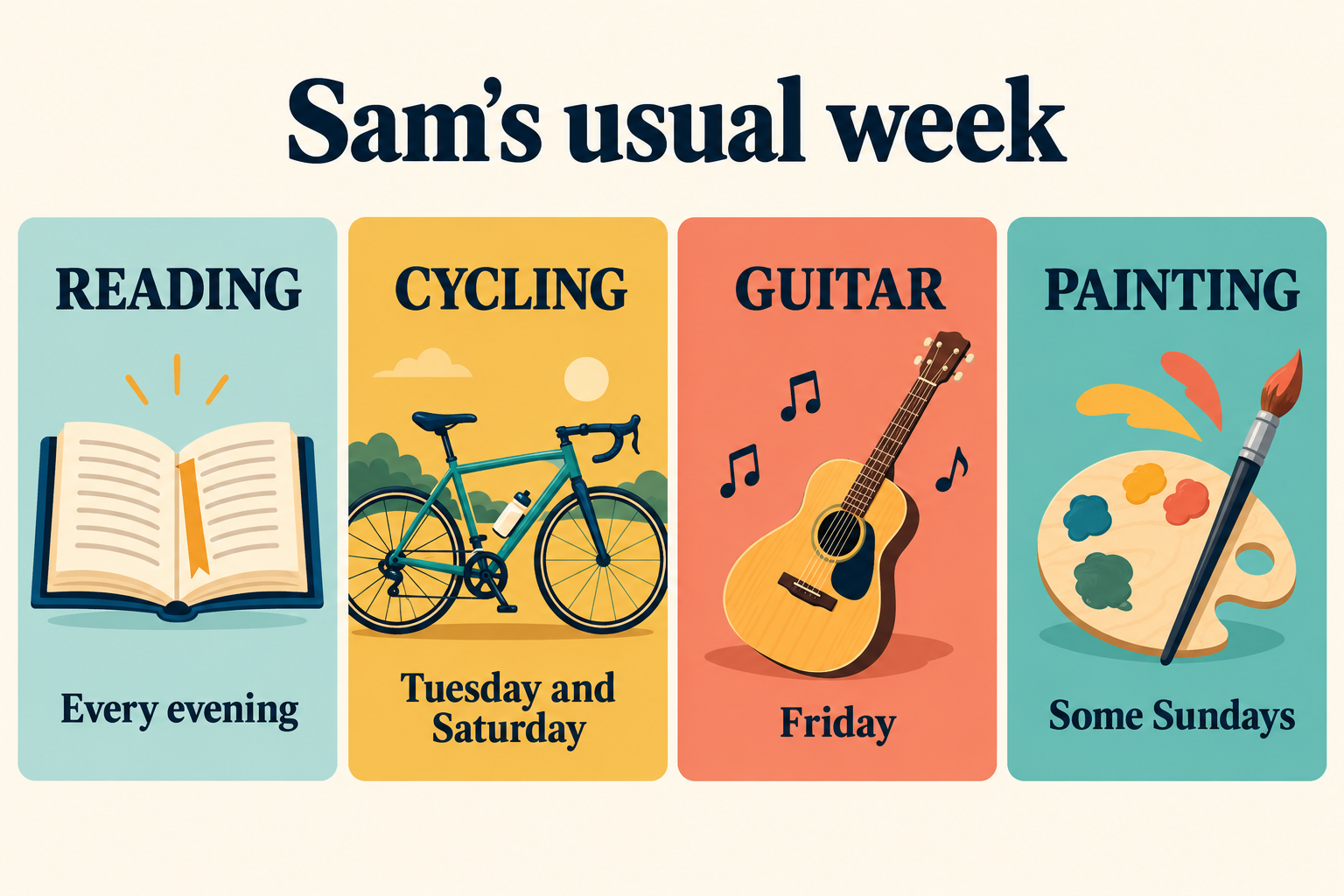
Sam says: I always read in the evening. I cycle twice a week. I play the guitar once a week, on Friday. I sometimes paint on Sundays. I never swim. I am usually ready for my guitar lesson, but I am sometimes tired after work.
Check the meaning
Every evening describes a regular daily habit. Tuesday and Saturday means twice a week. One Friday session means once a week. Some Sundays means sometimes; it does not mean every Sunday. Words such as usually and often give broad meanings rather than exact percentages.
Ten meaning, order and correction checks
Answer on paper, then open the explanations below. Enable JavaScript to check answers here.
Write 20–30 words
Your turn · self-review
A short habits paragraph
Write about your own hobbies, or use Sam's routine. Use at least two frequency expressions. Compare the model for language and length; your own facts can differ. This is self-check writing, not automatic grading.
Practice only. Your writing stays on this page; it is not submitted or saved.
-
Model answer and explanation
I always read in the evening. I cycle twice a week and play the guitar on Fridays. I sometimes paint on Sundays.
The model has 22 words when contractions and ordinary words are counted as written. Self-check: Is my paragraph 20–30 words? Did I put an adverb before a main verb or after be? Did I use once or twice accurately? Did I avoid don't with never?
Say it naturally
Read your paragraph aloud. Then cover it and answer: How often do you do each hobby? Exact counts are useful when you know them. Use usually, often or sometimes when a broad description is more honest.
Related Lessons






Continue learning this topic
Review an explanation, study examples or try a related practice test.
- Practice test Bomb Threat Hoaxes Disrupt Flights Across Italy, Poland and Spain — C2 English Listening Practice Test
- Practice test Bomb Threat Hoaxes Disrupt Flights Across Italy, Poland and Spain — C2 English Grammar Practice Test
- Practice test Bomb Threat Hoaxes Disrupt Flights Across Italy, Poland and Spain — C2 English Vocabulary Practice Test