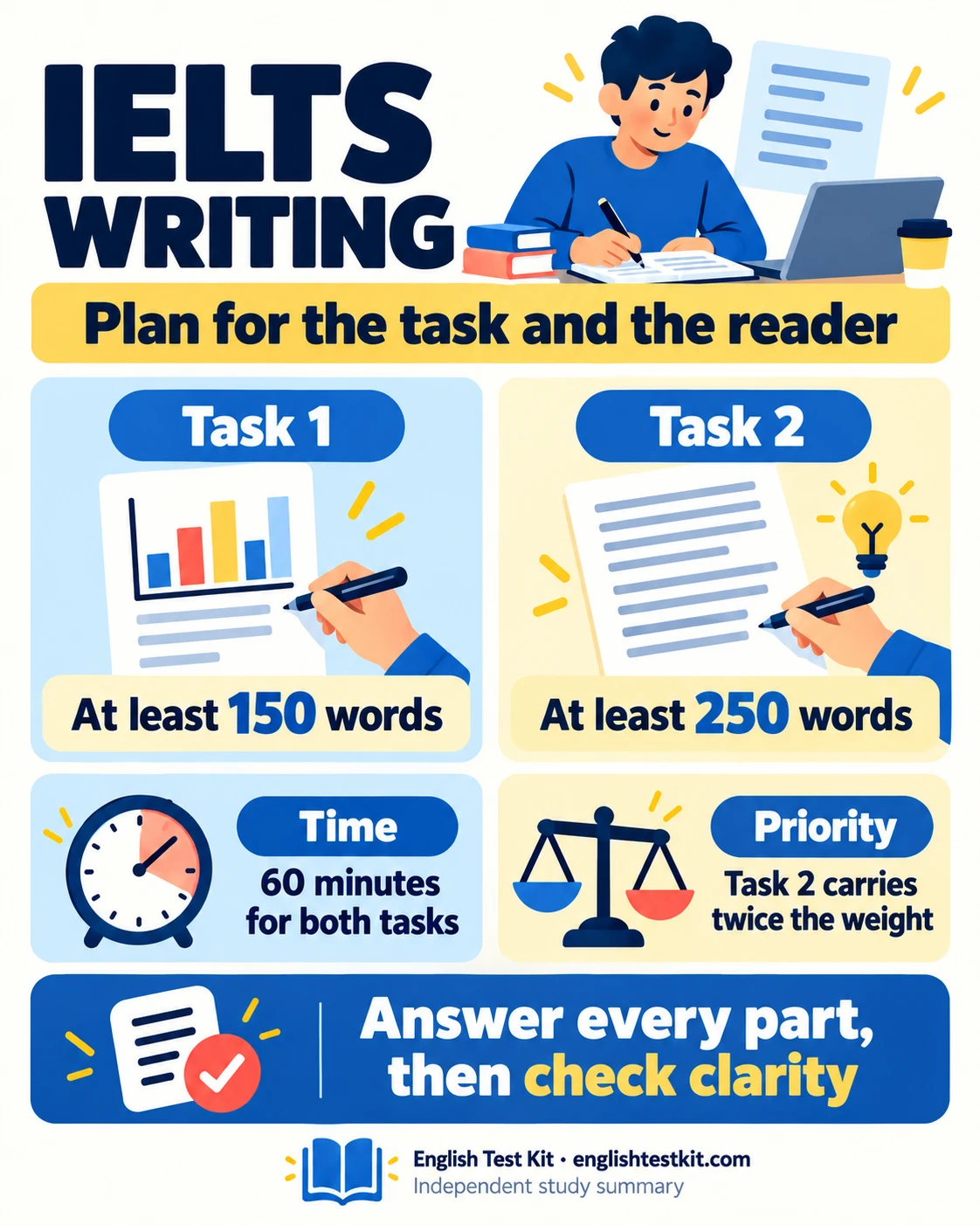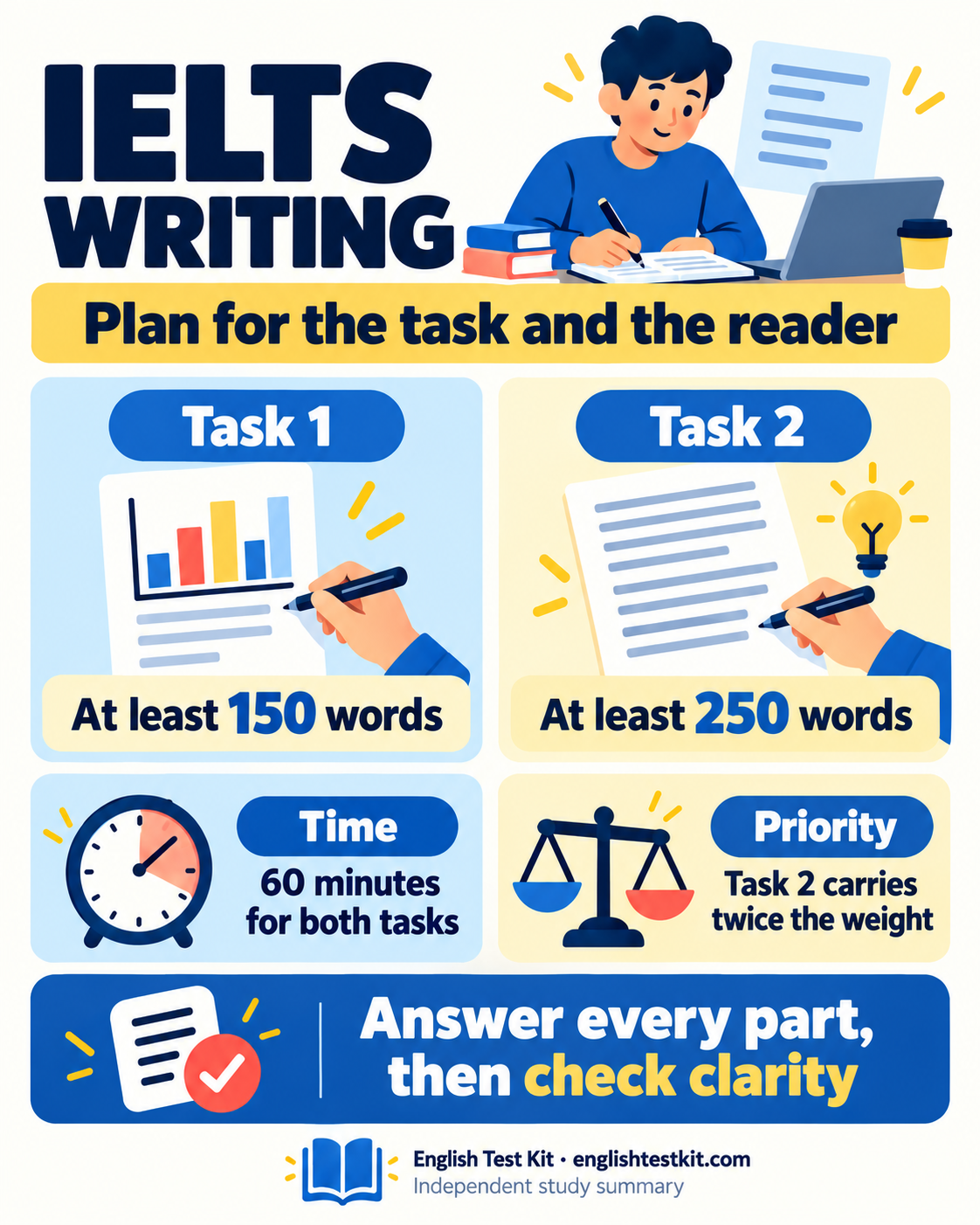
IELTS Writing requires relevant ideas organised for two different tasks. Strong preparation includes planning, selecting information, developing a point and revising an answer—not simply producing more words. Begin with the version you are taking, because an Academic visual report and a General Training letter need different decisions before the shared essay task.
Two tasks in 60 minutes
The Writing component lasts 60 minutes. Both tasks must be completed. Task 1 has a minimum of 150 words; Task 2 has a minimum of 250 words and contributes twice as much as Task 1 to the Writing score.
Task 1 changes by test type
In Academic Task 1, you describe visual information such as a graph, table, chart, or diagram. In General Training Task 1, you write a letter in response to a situation.
Task 2 and assessment
Task 2 asks you to discuss a point of view, argument, or problem. Examiners assess how well you answer the task, organise and connect ideas, use vocabulary, and control grammar. Keep the response relevant and write in connected prose.
Task achievement or task response
Coherence and cohesion
Lexical resource
Grammatical range and accuracy
Academic Task 1: select the important picture
Imagine an original practice chart showing the proportion of commuters cycling in two towns. In 2015, Town A is at 10% and Town B at 20%; in 2025, both are at 30%. A useful overview would identify the shared rise and the fact that the towns finish at the same level. The report should then support those patterns with selected figures.
“The chart shows some changes in cycling” is accurate but uninformative. A stronger sentence is: “Cycling increased in both towns, with Town A rising more sharply and both reaching 30% in 2025.” It captures the main comparison without inventing a cause. You cannot conclude that a new cycle lane caused the increase unless the task supplies that information.
Practise separating overview from detail. First write one or two sentences explaining the largest patterns; then decide which numbers demonstrate them. Avoid listing every figure in the order it appears. A report is easier to follow when related comparisons are grouped logically.
General Training Task 1: identify the reader's needs
For a letter, underline the situation, recipient and required points. Consider a fictional prompt asking you to write to a course organiser after the timetable changes. Your plan might cover the problem, the effect on your attendance and a requested alternative. A suitable tone depends on your relationship with the reader, not on a rule that every IELTS letter should sound highly formal.
“Please help me” is too vague to do much work. “Could I transfer to the Saturday group because the new Tuesday class overlaps with my work shift?” explains both the request and its reason. This makes the response purposeful while still leaving room to address the remaining prompt points.
Task 2: develop a position, not a list
Consider this original discussion question: should a town spend more on public transport or new roads? Before drafting, choose a position and identify the reasons you can actually explain. A paragraph about public transport might connect frequent services with access to work and then illustrate that connection with a specific hypothetical example.
A weak point is “Public transport is good for everybody.” A developed point explains who benefits and how: “More frequent buses can help shift workers reach jobs without owning a car, particularly when early services connect residential areas with employment centres.” The second version provides a line of reasoning rather than relying on an impressive adjective.
Your response must still address the exact wording you receive. A question asking you to discuss both views requires attention to both views; a question asking about causes and solutions requires both parts. An attractive memorised essay on a related topic does not replace that work.
Plan and check within the section
Use a small portion of the writing time to identify the required content and organise it. During drafting, keep each paragraph connected to its purpose. Leave time to check whether the task is fully answered, the overview or position is clear, and sentences express the intended meaning.
For language review, prioritise errors that damage clarity: incomplete sentences, unclear reference, wrong verb forms or a misleading comparison. Varied vocabulary is useful when it is accurate. Replacing a simple correct word with an unfamiliar synonym can make the writing less precise.
A productive practice cycle
Work on one stage at a time before repeatedly writing complete answers. Create several Task 1 overviews, revise one essay paragraph, or compare two ways to express a request. Then complete timed responses and assess task coverage, organisation, vocabulary and grammar. Keep the original draft and the revision so you can see whether your changes improve meaning. The examples here demonstrate techniques; they are not official scored responses or a promise of a band result.
Save your one-page study summary